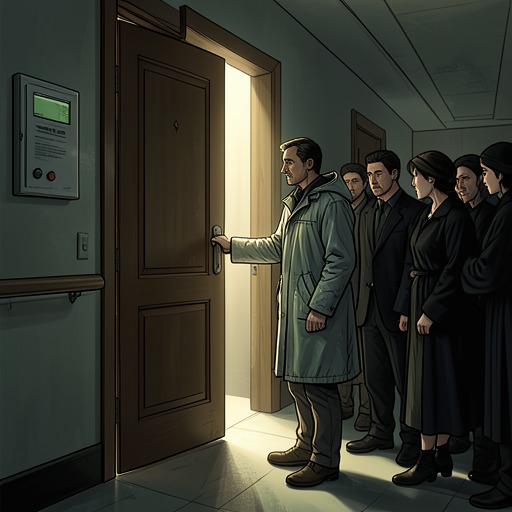
Four Strangers Break Into the Cabin
The Cabin at the End of the WorldFour Strangers Break Into the Cabin marks the transformation of Andrew, Eric, and Wen’s refuge into a place of confinement. The strangers first insist on a face-to-face conversation, then cut off the family’s access to help, breach the cabin, and hold the family under guard. Their eventual claim that a willing family sacrifice can prevent the apocalypse is presented as a choice, but it arrives after the intruders have removed the family’s practical freedom to refuse or leave.
Refusal and isolation
Andrew, Eric, and Wen initially respond to the strangers’ presence by keeping the door closed. Eric politely asks the four people outside to leave the property, while Wen asks him to make them go away. Andrew tries the cabin’s beige landline, only to discover that it has no dial tone; checking the connection does not restore it. The phone had worked the day before, making its failure an immediate change in the family’s ability to summon help.
Leonard insists that the group will not leave until they have been admitted and can speak with the family face-to-face. He addresses Andrew by name and says the matter is too important for the strangers to withdraw, describing the situation as one in which nobody has a choice. Eric threatens to call the police, but Sabrina then admits that she cut the landline and says her own phone has had no service since the group was travelling along the Daniel Webster Highway. Her awkward introduction does not soften the significance of the admission: the apparent conversation at the door is backed by deliberate isolation.
The strangers’ positions also differ in tone. Leonard repeatedly presents the intrusion as necessary and says the group does not intend to harm the family. Redmond, by contrast, tells the family to open the door and makes clear that the group will enter regardless. Andrew answers that he has a gun, and Eric holds Wen between himself and Andrew in a tight group embrace. When Leonard abruptly moves from reassurance to trying the bolted doorknob, Andrew calls out his refusal and Eric braces himself against the door. The family’s requests to be left alone have not changed the intruders’ intention.
The breach and failed escape
The family tries to turn the cabin’s furniture into a barrier. As heavy footsteps move on the deck, Andrew and Eric clear a path toward the rear slider and shift the couch toward the glass. Wen helps move smaller furniture. The barricade is an improvised response to the sound of the strangers approaching from different parts of the cabin; it offers the family a moment to prepare, not a secure way out.
Movement in the basement reveals that the intruders are already entering by another route. Redmond then breaks through the glass slider with his weapon and forces the couch inward. Andrew sees that at least one stranger has come up from the basement and calculates that the family might still get past the remaining people and reach Andrew’s SUV. He puts the keys in Eric’s pocket and urges them to go. The escape attempt meets another intruder in the bedroom: Adriane stands in the doorway with her weapon, having entered through an open window.
Eric tries to get past Adriane, and their brief struggle ends with him falling and becoming unconscious. Wen moves back to him, while Andrew, still near the front door, cannot simply abandon his family to reach the gun. Leonard then emerges from the basement, accompanied by the others, as the cabin’s barricades and cleared furniture cease to protect the family. Andrew’s effort to fight Redmond with a poker also fails when Redmond traps and disarms him. The entry has become a takeover: the family’s route to the vehicle, the front door, and the objects they can use to defend themselves are all contested.
The ultimatum and captivity
Once the family is under the strangers’ control, Leonard explains the group’s purpose. He says the family must willingly select and kill one of its three members to prevent the apocalypse. If they do not make the choice or do not carry it out, he claims, the rest of humanity—more than seven billion people—will die, while the family remains alive to witness the aftermath. Andrew had expected an extremist manifesto, but the scale and specificity of Leonard’s demand leave him struggling to take in its implications. He imagines a devastated Cambridge and Boston, yet the prediction remains a claim made by the people who have just forced their way into his home.
Leonard tells Wen that the group will not kill her or her parents and promises not to harm them further, but makes that assurance conditional on their staying in the cabin until they choose or their allotted time expires. This reassurance does not undo the circumstances of the demand. The family has been deprived of communication and movement, and the strangers retain control of the doors, their restraints, and the timetable. Leonard calls the decision voluntary while also making clear that the family cannot leave the situation.
The intruders regulate the family’s daily movements as part of the confinement. They untie Andrew and Eric’s legs when the men need to use the bathroom, but keep their hands bound and guard them. At night, they place the men in chairs beside the front door, tie them to the chairs, and arrange blankets and pillows for them to sleep sitting up. Sabrina apologizes for the restraints while explaining that the group cannot trust them to stay tied if they are allowed onto the mattresses. The ordinary gestures of care—food, warmth, and an offer of comfort—take place within a system that continues to restrict the family’s bodily autonomy and ability to act.
Repeated choice and resistance
The demand is not presented as a single conversation that the family can end by refusing to answer. After footage of a northern Pacific earthquake and tsunami appears on television, Leonard says the family will be given the same choice again the following morning. He frames the sacrifice as a gift and their refusal as allowing the clock to move closer to permanent midnight. Andrew responds that they do not need to wait and will not change their minds. The disaster coverage intensifies the pressure by making events that seem to resemble the prophecy visible to the family, but it does not establish that the strangers’ explanation is true.
The next morning, the group again presses the family to choose. Eric attempts to delay the decision by asking Adriane about the restaurants where she worked, trying to turn the encounter toward conversation about the intruders’ previous lives. Sabrina insists that the family has to choose, while the others close ranks rather than engage with Eric’s effort to keep talking. His stalling shows that the family’s resistance is not only a repeated verbal refusal: when the intruders control their immediate options, prolonging the conversation becomes one of the few available ways to resist the deadline.
Later, Andrew asks Eric directly whether he believes that one of them has to be killed by another to keep the world from ending. The question captures the pressure created by the intrusion: the family must weigh the strangers’ apocalyptic claim while living under the strangers’ control. The event therefore makes the meaning of consent central to the plot. The intruders call the sacrifice willing, but the demand is imposed on a family whose communications have been cut, whose attempted escape has failed, and whose movements are governed by their captors.