Gaudet Lake cabin siege
The Cabin at the End of the WorldThe Gaudet Lake cabin siege begins as an attempted conversation and becomes a contest over entry, safety, and choice. Leonard and his companions invade Andrew and Eric’s home, take control of the family, and impose an ultimatum: one of the three must be selected and killed to prevent the world’s destruction. The siege’s decisive tension is that the visitors present this demand as a gift and a voluntary decision, while the circumstances they create leave Andrew, Eric, and Wen unable to consider it freely.
The Approach and Breach
Leonard initially insists that the visitors do not intend to harm the family and that they need to speak face-to-face. Yet as soon as he announces that he is coming in, the bolted door rattles under an attempted entry. Andrew, Eric, and Wen do not respond at first; Andrew then objects, and Eric braces himself against the door and asks the group to leave. The gap between Leonard’s careful assurances and his actions establishes the siege’s central contradiction before the visitors have explained their purpose.
Outside, one of the women looks through a window and taps its screen with the wooden end of her tool. After a hushed discussion among the visitors, Redmond moves around the cabin toward the back deck. Leonard continues speaking in an even, controlled manner, repeating that the visitors need the family’s help. Andrew draws curtains across the front windows and the kitchen’s glass door, reducing the light in the room while trying to block the intruders’ view. These efforts provide a brief physical barrier, not a resolution: the visitors remain positioned around the cabin, and the family does not know where they will enter next.
The breach comes through the kitchen’s glass slider. Redmond uses the sledgehammer end of his makeshift weapon to break through it, then forces the barricading couch into the kitchen. Andrew assesses how many visitors may still be outside and decides that he and Eric might be able to reach their SUV. He puts the keys in Eric’s pocket and urges him to move. The attempted escape is interrupted inside the cabin: Eric swings a pair of tongs at a woman who has entered through a bedroom window. Their struggle ends with Eric falling and becoming unresponsive. Andrew, unable to open the front door and leave, is left with Wen and no clear way to carry out the escape plan.
Captivity and the Ultimatum
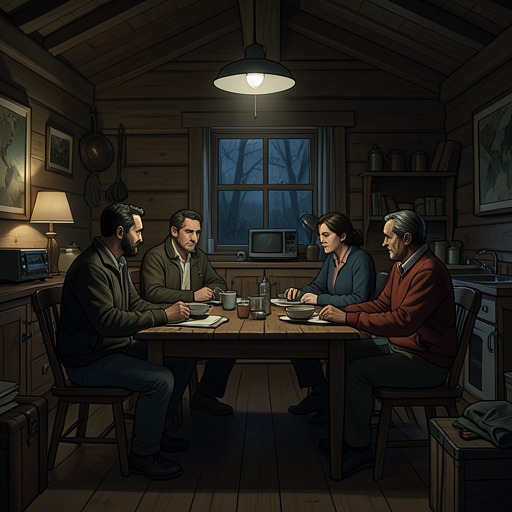
When Eric regains awareness, he and Andrew are seated in chairs and restrained. Eric remembers fragments of their effort to reach the SUV, including Andrew’s willingness to stay behind so Eric and Wen might get out, but cannot reconstruct everything that happened during his loss of consciousness. The family’s attempt to defend the cabin has therefore ended not in escape but in captivity, with the visitors controlling the room and the timing of what happens next.
Leonard eventually states the purpose of the invasion. He says that the family must willingly choose one of its three members and kill that person; otherwise, the world will end. In the visitors’ account, Andrew, Eric, and Wen would survive the catastrophe, but more than seven billion other people would die. Leonard initially presents the demand in a flat, announcement-like manner, then speaks with the fervor of someone trying to make the family accept an impossible proposition. Andrew is shocked by the scale and specificity of the claim, and imagines the destruction of Cambridge and Boston as he tries to grasp what the visitors are asking him to believe.
Leonard also promises that the visitors will not kill the family or touch them again, apart from what they say was necessary to enter the cabin and make them listen. He says they will remain in the cabin with the family until a choice is made or the available time runs out. That assurance does not undo the captivity or make the decision voluntary: the visitors have entered by force, keep the family there, and tie the family’s decision to a threat of worldwide death. Their language of choice and comfort sits beside the power they have taken over the family’s movements and circumstances.
A Repeated Choice Under Pressure
The ultimatum is not confined to a single announcement. After Andrew and Eric refuse to change their minds, Leonard says they will be offered the same decision again the next morning. He calls it a gift and casts sacrifice as a difficult but selfless act, while describing continued refusal as allowing the clock to move closer to an irreversible end. He says the visitors will attend to the family’s needs within reason and otherwise leave them alone to reflect and talk. The repetition gives the siege a deadline structure: the family is expected to reconsider, even though the visitors have already heard its answer.
The cabin’s television brings the visitors’ claims into contact with public events. After coverage of an earthquake and tsunami in the northern Pacific, Sabrina changes the channel to Cartoon Network. The change briefly places an ordinary children’s program beside the disaster coverage, but it does not settle whether the catastrophe confirms Leonard’s warning. Eric remains troubled by what he may or may not have seen in the light, and the family must weigh the broadcast against the visitors’ explanation rather than receiving a simple resolution.
As the group again presses for a decision, Eric tries to prolong the conversation. When Adriane hides a mask she has been holding, he asks her about the restaurants where she used to work; Sabrina responds that it is time for the family to choose. Eric’s attempt redirects attention toward the visitors’ former lives, treating conversation as a way to delay the demanded action and keep them engaged as people rather than as agents of a ritual. Their failure to answer and their closing together leave the pressure unresolved.
The Family’s Refusal and the Siege’s Significance
Andrew and Eric’s disagreement is not about whether the visitors’ claims sound extraordinary; it is about whether those claims justify killing one another. Andrew points to the disasters that have occurred and challenges Eric’s effort to explain them away. He asks directly whether Eric thinks one of them must be killed to keep the world from ending. Eric answers instead by asking why the visitors would invent the story and subject the family to the ordeal. The exchange shows that the siege has reached beyond physical confinement into a dispute over evidence, trust, and responsibility, without yet producing agreement between the partners.
The event’s central reversal is that the visitors call the sacrifice a choice while controlling the conditions in which it is to be made. Their stated goal is to save humanity; their method places a family’s love for one another against an asserted global consequence. Andrew and Eric’s resistance keeps the demand from becoming an accepted rule, even as the disasters reported on television make refusal harder to treat as an abstract position. The siege thus converts a question about the end of the world into an immediate test of whether love and consent can survive an ultimatum imposed by force.