Jeff O’Bannon
The Cabin at the End of the WorldJeff O’Bannon, known at the cabin as Redmond, is the man Andrew recognizes as the assailant from an earlier attack at a Boston bar. The revelation makes the cabin’s already dangerous confrontation personal: Redmond is not merely one of the visitors demanding a sacrifice, but someone whose past violence has shaped Andrew’s fear and vigilance. Sabrina’s later account adds another dimension, describing the unsettling figure she encountered online before the group’s shared visions brought its members together.
Identity and Introduction
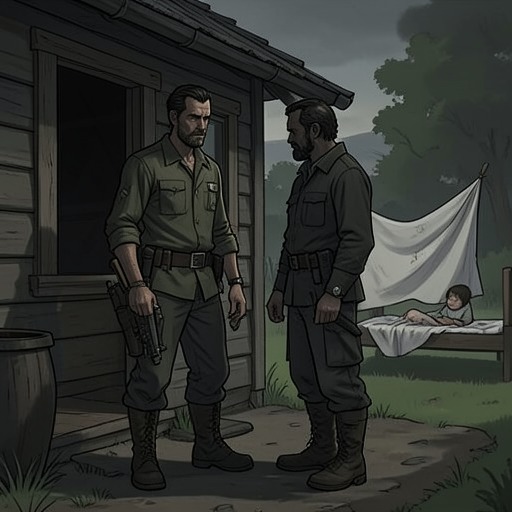
For much of the cabin confrontation, the visitors know Jeff as Redmond. Andrew recognizes him only after an episode that leaves him visibly shaken. He insists that the dead man outside is Jeff O’Bannon, a name Eric also recognizes as familiar, though he cannot immediately connect it to the face before him. Andrew explains the discrepancy: Redmond has shaved his head, grown older, and gained more than fifty pounds since the attack. Those changes altered his face enough to delay recognition, but once Andrew understands who he is looking at, he says he has never been more certain of anything.
Andrew proposes a practical way to check the identification: one of the others could find the dead man’s wallet and license and read the name. His certainty is not immediately shared. Adriane asks whether he could be inventing the connection to influence them, while Sabrina distinguishes between believing Andrew’s account of having been assaulted and knowing that Redmond was the attacker. Adriane points to the scar on the back of Andrew’s neck as evidence that an assault occurred. The exchange makes the identification a test of trust among captives as well as a revelation about Redmond.
The Attack on Andrew
Andrew’s recognition reaches back to an evening at a Boston bar. He had been talking and joking with Ritchie, who was engaging a woman in playful conversation. The mood was light; the conversation included teasing about dancing and whether the Celtics would ever be good again. O’Bannon came up behind Andrew and used an anti-gay slur. Andrew turned toward him, but did not see his attacker’s face at the time. O’Bannon then struck him with a beer bottle. Andrew remembered the sound and the sudden collapse that followed, but not the ambulance ride in full; he did remember insisting on sitting up during it.
At the hospital, Andrew felt shame when he first saw Eric, and struggled to explain what had happened. The attack later acquired an identity when O’Bannon pleaded guilty. In court, he said he had been drunk and not thinking clearly, and claimed that Andrew had spilled a beer on a friend before O’Bannon and his companions looked for a fight. Andrew regarded the explanation about the spilled beer as false. O’Bannon also repeatedly said that the violence did not represent who he was. The account establishes both the assault and the distance O’Bannon tried to place between the act and his self-image; it does not resolve Andrew’s questions about why he, specifically, was targeted.
The attack remained present in Andrew’s life well after the immediate injury had healed. He thought about it before boxing lessons, workouts, and trips to the shooting range. For the first couple of years afterward, sleepless nights led him to search the internet for O’Bannon and to spend hours looking through records of other people with the same name. He eventually stopped those searches and became less urgently watchful in public, but his hypervigilance did not disappear completely. At unguarded moments, he still wondered how O’Bannon had identified him as gay, whether he had been singled out by chance, and whether the attacker had watched him before striking. Andrew’s later recognition of Redmond therefore connects a present danger to a question that has never entirely settled into the past.
Redmond Among the Visitors
Sabrina’s account places Redmond in the group’s earlier online life. She and Adriane encountered him on a message board where people shared dreams, nightmares, messages, and visions. Redmond made sexualized remarks, including jokes about posting explicit pictures, and asked what the women were wearing. Sabrina remembers him as awful even then. Yet the board also offered relief: finding others who experienced the same frightening phenomena helped her feel less alone and less convinced that she was undergoing a mental breakdown. Her mixed account is important. Redmond was objectionable within a community that still mattered to Sabrina because it gave the members a way to compare experiences.
At first, Sabrina hoped the people sharing these experiences might be prophets, able to warn others about the harm people were doing to one another and to the environment. The group did not yet know what the visions meant or that its members might have a role in them. Redmond thus belongs to two different kinds of history: he is part of the group formed through shared visions, and he is also the person Andrew connects to a specific act of anti-gay violence. The later revelation does not erase the circumstances that first brought the visitors together; instead, it exposes a more troubling personal history inside that shared purpose.
Recognition and Consequences
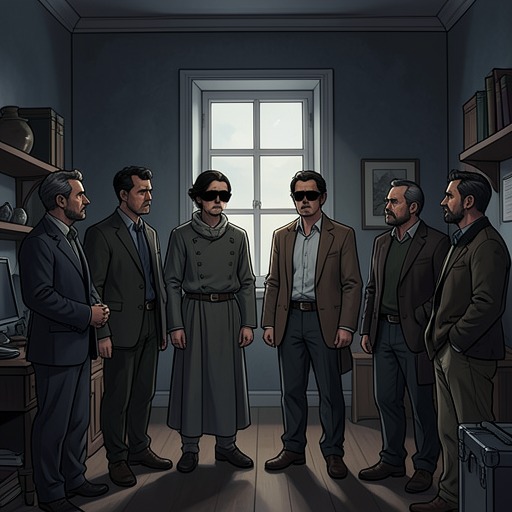
After Andrew identifies Redmond, the visitors back away and exchange uncertain looks. Sabrina asks whether anyone is using a false name, and Adriane and Leonard deny it. Their response leaves the group’s identity questions unresolved, while Andrew continues to insist that Redmond is O’Bannon. Sabrina eventually decides to help Andrew and Eric leave. She reports that the four visitors had hidden the keys to Redmond’s truck a few paces from the dirt road, and says she believes the dead man was O’Bannon even if Andrew might be mistaken. That qualification preserves a small measure of uncertainty, but her decision to assist the two captives shows that the identification has become consequential rather than merely argumentative.
Redmond’s death is already established when Andrew names the body outside; the supplied account does not detail how he died. The revelation’s force instead comes from recognition: the anonymous figure from Andrew’s past and the visitor known to the others as Redmond are one person. For Andrew, this collapses the distance between an old assault and the immediate crisis at the cabin. For Sabrina, it places the man she had encountered in the online group inside a history of violence that she had not previously known. Redmond’s narrative role is therefore defined by a reversal of identity: a name and face concealed by time and circumstance become legible, changing how the people around him understand both the past attack and their present danger.