Leonard’s approach to Wen
The Cabin at the End of the WorldLeonard’s approach to Wen is the deceptively gentle opening of the visitors’ arrival: he meets her during a backyard project, wins her attention through kindness, and then reveals that more strangers are coming to the cabin with a mission that will demand terrible choices from her family. Because the encounter is filtered through Wen’s alert, imaginative attention, Leonard first appears less like a threat than a very large man willing to help with grasshoppers; the footsteps approaching behind him steadily change the meaning of that trust.
An interruption in Wen’s project
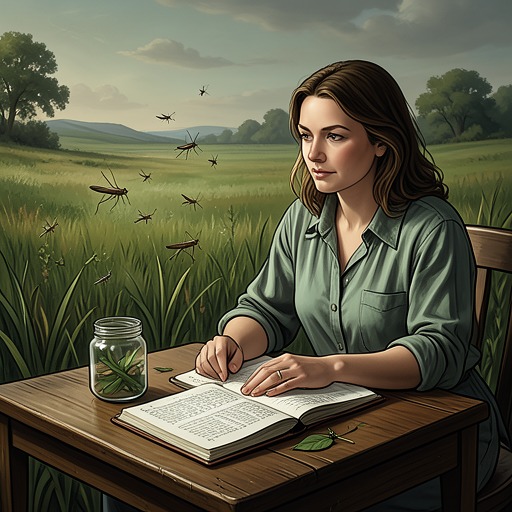
Wen is in the yard catching grasshoppers and recording them in a palm-sized notebook. She has given her first catch the number one, estimated its size—incorrectly—as two inches, recorded its green color and high energy, and named it Caroline. Four more similar-sized grasshoppers follow, named Liv, Orvin, Sara, and Gita. As she searches for a sixth, the sound of footsteps on the dirt road interrupts her work. Wen remembers timing the drive along that road two days earlier: it took twenty-one minutes and forty-nine seconds, largely, she thinks, because Eric drove too slowly.
At first she cannot see whoever is approaching through the trees. The heavy, grinding steps suggest something enormous, perhaps a bear. Eric has told her to yell for her fathers and run inside if she sees an animal larger than a squirrel. Wen considers whether she is fast enough to reach the cabin, but curiosity competes with alarm: she hopes the animal is a bear and thinks she might play dead if necessary. Her attention shifts from excitement to irritation when the approaching presence threatens to disrupt her important project.
The figure that rounds the bend is a man, briskly walking down the driveway. Wen cannot judge adult height precisely, but he is taller than either of her fathers and perhaps taller than anyone she has seen; he is also broad enough to suggest several tree trunks together. He waves and smiles. For Wen, a smile is not automatically reassuring. After many lip-reconstruction procedures, she has learned to watch faces closely: some smiles have seemed cruel or mocking, while others have conveyed pity. The newcomer’s expression is therefore something she studies, not simply accepts.
Help offered, trust formed
The man introduces himself as Leonard. His voice, unexpectedly small beside his imposing frame, sounds to Wen like that of a teenager or an after-school student counselor. He asks whether he and Wen can talk before he speaks with her parents. She has not yet given him her name and is about to suggest getting her fathers, but the conversation shifts to the grasshoppers she is studying.
Wen explains that she wants to learn whether the insects are healthy because she hopes to help animals when she grows up. She speaks so quickly that she feels light-headed; teachers have told her to slow down, and one substitute teacher’s comparison of her words to something leaking from her mouth had put Wen off. Leonard responds that he is impressed and asks whether he can help catch more. He acknowledges that he has grown much larger since childhood, then insists that he is still gentle. Wen accepts the offer, specifying that the insects must be small because there is not enough room in the jar. She retrieves it and returns to Leonard, who is already bent over the lawn searching.
Her decision to continue the project matters because she has an easy alternative: while fetching the jar, she looks through the cabin windows for her fathers. They are not in the kitchen or living room, and she guesses they may be relaxing on the back deck. She considers going to tell them about Leonard, but does not. For the moment, his attention to her interests and his willingness to follow her instructions keep the encounter within the familiar scale of her work.
The approach changes
As they talk, Leonard turns to look behind him. At first Wen sees only the SUV, the driveway, and the trees; then both of them hear faint sounds from the woods or road. Leonard tells Wen that having a scar does not mean something is wrong with her. She sighs and clarifies that this is not what she means. He says that he has no scars like hers or her father’s, but that, if she could see his heart, she would see it was broken. His face has lost its smile and looks genuinely sad to Wen, who asks why it is broken.
The footsteps become unmistakable: many people, or perhaps many versions of Leonard, approaching along the dirt road. Wen asks whether more people are coming, whether they are Leonard’s friends, and whether they are nice. Leonard confirms their arrival but qualifies the word friends: he does not know them very well. He tells Wen that she is his friend now and says that he will not lie about the newcomers. They have an important job to do, he explains, the most important job in the history of the world, and he hopes she can understand.
The disclosure marks the encounter’s turn from companionship toward danger. Wen stands and says she has to go. The sounds are now close to the end of the driveway, though the approaching people have not yet rounded the bend. She would rather not see them; imagining monsters or dinosaurs briefly gives shape to what she cannot yet understand. Leonard crawls from his sitting position onto one knee and, with tears in his eyes, asks her to listen because what he is about to say is important.
The visitors and the warning
Three people—two women and a man—turn onto the driveway. Wen notices their jeans and colored button-down shirts, and registers what seems to be a coordinated pattern between their clothes and Leonard’s. She intends to tell her fathers about it, as well as about the strangers’ long-handled tools. The weapons look to her like nightmarish versions of scythes, their rough, improvised ends replacing smooth blades. One has a cluster of rusty hand-tool blades fixed to a pole and a dented, chipped sledgehammer head at the other end. Even while backing toward the cabin, Wen studies the screws and nail heads around the weapon’s ends.
Leonard tells her that she is beautiful inside and out, that her family is beautiful too, and that what is coming is not about her but about everyone. Kneeling with his arms outstretched, he stresses that nothing about the coming events is her fault: she has done nothing wrong, but her family will have to make difficult and terrible decisions. Wen continues up the stairs backward, her eyes fixed on the strangers’ tools. Leonard then raises his voice so she can hear him across the growing distance. Her fathers will not want to let the visitors in, he warns, but they have to; Wen should tell them so. He insists that the group is not there to hurt her and asks for her help in saving the world.
The encounter’s force lies in the gap between its intimate beginning and its immense claim. Leonard has listened to Wen describe a small, carefully observed world of insects, and she has accepted his help before knowing why he came. Yet the friendly conversation does not dissolve the danger announced by the footsteps, the armed visitors, and the choices he predicts. His gentleness gives Wen a personal point of contact with the approaching group, while his urgent appeal makes her the first person in the cabin whom he asks to carry their demand to her fathers.