Redmond
The Cabin at the End of the WorldRedmond is one of the four intruders who force their way into Andrew and Eric’s cabin, and his arc brings the story’s private history of anti-gay violence into the siege itself. He alternates between joking self-disclosure and participation in the group’s ritualized brutality: after introducing himself as an ordinary local man, he helps make the cabin’s violence into a performance, then becomes its victim. Andrew later connects him to the man who assaulted him, but the identification remains unsettled in the surviving exchange with Eric.
Identity and Entrance
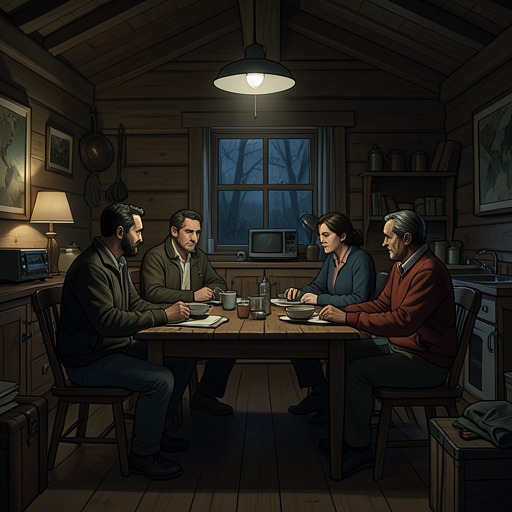
Redmond is introduced by name as the intruder who calls out while Andrew and Eric are still talking. He tells them to do what Leonard says and open the door, adding that the group will enter regardless. The command establishes his role in the immediate threat, although Leonard is the one whose instructions he invokes. Redmond’s manner is confident enough to address the family directly, and his enjoyment of the encounter is apparent to the narrator at this first appearance.
During the cabin’s introductions, Redmond presents himself as a local from Medford, Massachusetts, employed by a gas company to keep houses and apartment buildings from exploding. He says he is single and describes a past involving what he calls questionable behavior when he was younger. He claims to have improved and insists on the sincerity of that change. These details give him a recognizable civilian identity—resident, worker, and man with a past—without undoing the violence of his present role among the intruders.
Performance and Self-Presentation
Redmond turns the round of introductions into a comic routine. He exaggerates a Boston accent, makes a joke about his single status, and laughs at his own remarks. When Leonard steps forcefully toward him, Redmond raises his hands in a gesture of surrender and says it is his turn to speak. The quick shift from joking to apparent submission makes his self-presentation difficult to settle: he can act deferential in the face of Leonard’s authority while remaining part of the group holding the family captive.
His account of his father complicates that performance. Redmond compares the treatment he has just received from Andrew to the beatings he says he suffered as a child, and says he did not deserve them. He imagines giving his younger self the weapon he now holds. The comparison briefly casts him as someone marked by earlier violence, but the scene does not establish that this history explains or excuses his conduct. Instead, Redmond tells it while displaying a weapon and addressing the person who has just beaten him, placing vulnerability, bravado, and threat side by side.
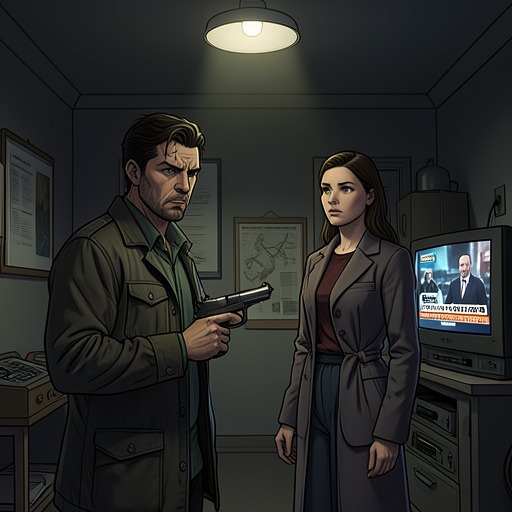
Redmond also admits that Andrew had correctly recognized his bluff about having a gun. He calls the deception obvious and begins to explain what he found funny about it, but Leonard interrupts him by calling his name. This exchange shows Redmond watching Andrew closely and willing to taunt him, even though Redmond himself has been bluffing. His humor does not remove the danger; it becomes one of the ways he manages and stages it.
Role in the Ritual and Death
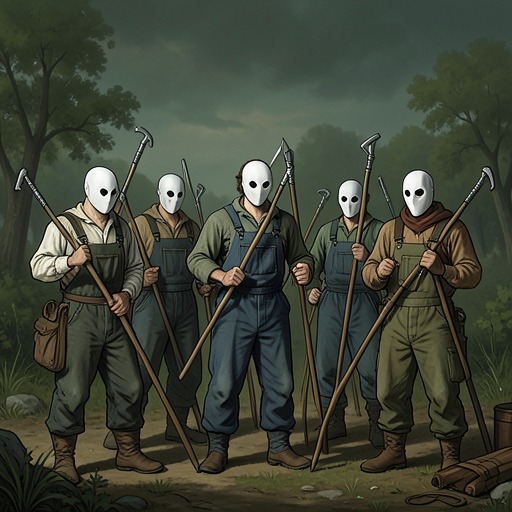
The intruders’ violence takes on an explicitly choreographed form when Redmond bangs the sledgehammer end of his double-ended staff on the floor and hands the weapon to Leonard without speaking. Leonard turns the weapon so its shovel and trowel blades point down. Redmond then kneels on the hardwood floor, making a triangle with Eric and Andrew. These deliberate movements make the group’s act appear organized rather than spontaneous, with Redmond participating in the arrangement before becoming its target.
As the ritual proceeds, Redmond’s behavior is markedly less composed. He fidgets with empty hands, claps, wipes his face, laughs, shakes his head, and grunts as if preparing for a great exertion. The mixture of hesitation and preparation gives the moment an unsettled rhythm: he seems to brace himself for what is coming, while the group’s actions continue around him. Leonard waits for an opening, then brings down the sledgehammer end of the weapon in the fatal blow. Redmond’s death is the culmination of the group’s ritualized attack, not a later consequence of the cabin’s siege.
Connection to Andrew and Jeff O’Bannon
Afterward, Andrew identifies the intruders as men who came to terrorize him and Eric because they are gay, and says that the man who had previously hate-crimed him broke into their cabin. His account makes Redmond’s presence more than a general threat: it links the current siege to an earlier attack on Andrew. Andrew treats the association as an explanation for why the intruders came, while Eric responds with the qualification that the assailant’s identity may not be certain.
The uncertainty remains explicit when Eric says that if Redmond really was Jeff O’Bannon, the events might support a religious interpretation of the disasters. Andrew rejects the leap from possibility to proof. The narrative therefore connects Redmond to O’Bannon without presenting the identification as finally verified in this exchange. That distinction matters: Redmond is the intruder Andrew recognizes as connected to his past, but Eric’s doubt prevents the connection from serving as uncomplicated confirmation of the group’s apocalyptic claims.
Aftermath and Narrative Significance
Eric later recalls that, just before Redmond was killed, he sensed a presence in the room. He describes the space as displaced, as if something had appeared and joined the circle around Redmond before the beating began. Eric says he initially tried to explain the experience as a flash of light or as a hallucination associated with his concussion and stress. He has not seen the figure again, but believes it remained nearby after Adriane and Wen died; he says he shut the cabin’s front door to keep it outside. Redmond’s death thus becomes the point around which Eric’s account of a possible supernatural presence first gathers, though the experience is reported through Eric and is not independently confirmed.
Later, Andrew hopes to find the keys on O’Bannon’s body. If they are there, he reasons, he can show Eric that Sabrina and the others have been lying and weaken their account of the apocalypse. The expectation makes the identity question practical as well as personal: the body may hold evidence about who Redmond was and whether the intruders’ story can be challenged. Redmond’s role consequently spans three kinds of threat in the book—the physical violence of the siege, the remembered hate crime Andrew associates with him, and the unresolved possibility that his death coincided with an encounter beyond ordinary explanation.