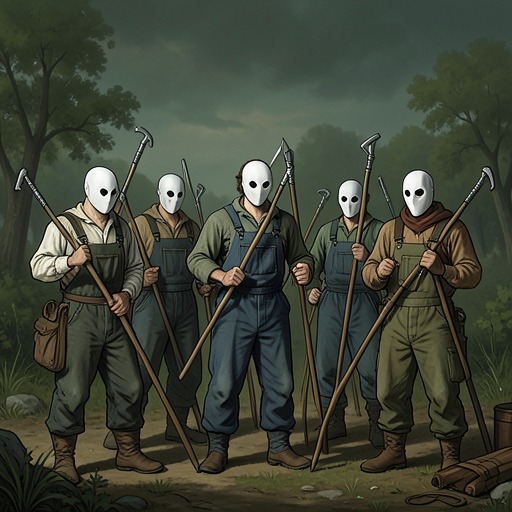
Redmond's white cloth mask
The Cabin at the End of the WorldRedmond’s white cloth mask changes the cabin’s confrontation from a standoff into a ritual whose meaning the family cannot control. A thin, close-fitting piece of fabric, it hides Redmond’s face while making his presence more charged: Andrew feels watched by the blank surface, and Wen fears what it might conceal. The mask’s whiteness, the red mark that appears on it, and its survival through the violence that follows make it both a physical object and a sign of identity being obscured.
Appearance and Use
Redmond takes the cloth from the front pocket of his jeans and unfolds it in front of his red shirt. It is larger than the dressing on the back of Eric’s head, thin, and ribbed or waffled like thermal underwear. He raises it above his head, stretches it between his hands, and pulls it over his head and face, bringing it halfway down his neck. The material fits closely, like a sock, rather than hanging loose as a conventional covering might.
The mask does not erase every feature. Redmond’s nose protrudes beneath his brow and between the hollows of his eye sockets; the cloth leaves his underlying shape legible but inaccessible. A red mark blooms over his split lip. The contrast between pale fabric and that spot gives the covering an unsettlingly simple visual pattern, one that later changes as the mask becomes marked and discolored. Its plainness is central to its effect: the cloth offers no expression that the people around Redmond can read, while its close fit makes it seem less like a disguise that can be casually removed than a surface pressed onto him.
The Masked Redmond in the Cabin
The change in Redmond’s appearance alters the family’s reading of the encounter. Before covering his face, he winks at Andrew and grins; once masked, his expression is unavailable, yet Andrew still feels the force of Redmond’s stare. The blankness does not end the exchange between them. Instead, the mask makes the gaze more difficult to answer, converting an ordinary visible face into an obscured presence that Andrew experiences as increasingly weighty.
Redmond speaks through the cloth and repeats, “Thank you.” His mouth moves out of rhythm with the words, and his voice sounds garbled and modulated. The mismatch between speech and visible movement makes the mask seem to interfere with ordinary communication: the words remain audible, but the face that would usually help make a speaker recognizable is covered. Wen covers her ears, unwilling to hear more. The same object thus affects the family differently: Andrew is fixed on the stare, while Wen responds to the voice and to the frightening possibility that the concealed face is changing.
Wen imagines the mask as Redmond’s new skin and wonders whether it hides only bone. She also pictures Leonard removing it to reveal a monstrous face, an imagined outcome rather than an event that occurs. Her fear draws on the mask’s ambiguous status: it is visibly cloth, yet its close fit and the altered voice make it seem, to her, capable of becoming something more permanent. The contrast with her earlier hope that Leonard might prove himself good is sharp. Looking at him behind Redmond, she finds the same unreadable, blank expression she sees on the other intruders, and the mask becomes part of a scene in which familiar human expressions have ceased to offer reassurance.
Ritual and Shifting Meaning
The mask appears at the moment Redmond raises it over his head and offers his thanks. In Eric’s perception, the sunlight enters the cabin and Redmond, still kneeling in a supplicant’s pose, seems transformed; the red of his shirt appears to extend into the surrounding air. That vision belongs to Eric’s experience of the scene, not to an objective change in the cloth. Yet the mask is the concrete focus around which the transformation gathers: its blank whiteness holds the dark red mark, while the sunlight and Redmond’s posture make the concealed figure seem newly charged with significance.
The words “Thank you” recur as the others assemble around Redmond. Their repetition, paired with the covered face and the group’s deliberate formation, makes the mask part of a coordinated ritual rather than a private disguise. Redmond’s face is hidden at the same time that his companions’ attention and actions make him the center of the room. The cloth therefore conceals the person even as it marks him out. Its apparent simplicity sharpens the difference between what the family can see—the fabric, the posture, the movements—and what they cannot know about the ritual’s meaning.
The Mask Under Assault
When the attack begins, the mask remains in place. It is caught by the claws of Adriane’s weapon and stretches as she pulls, but does not come away. Sabrina strikes Redmond as well, and the assault continues while the covering stays over his face. By the time the beating subsides, the white cloth is punctured and stained pink and red, leaving Redmond’s features still hidden beneath it. The object survives as a covering, though its original blank whiteness has been altered.
That persistence gives the mask a grim final function in this scene. Wen’s imagined revelation—that Leonard will remove it to expose a terrible face—never takes place; the cloth stays on, denying the watchers the ordinary visual confirmation of who Redmond is beneath it. Instead, its altered surface records the violence without restoring his face to view. The mask has moved from a piece of fabric drawn from a pocket, to the focus of the family’s fear, to a marked covering that remains after the group’s attack. Its narrative force lies in that refusal to disclose: Redmond is made conspicuous, addressed, and harmed, yet the face that might return him to familiar human terms remains out of sight.