The Approaching Apocalypse
The Cabin at the End of the WorldThe Approaching Apocalypse is the chain of reported disasters that turns the visitors’ demand for a sacrifice into a claim with increasingly visible stakes. An earthquake in the Aleutian Islands, tsunamis in Hawaii and Oregon, a spreading bird flu, and reports of crashed airplanes appear in the order the visitors associate with their vision. They treat each development as confirmation that the family’s refusal has brought the world closer to its end; the television makes that argument harder to ignore without resolving whether the disasters obey the visitors’ asserted rule.
Prophecy and the Sacrifice Rule
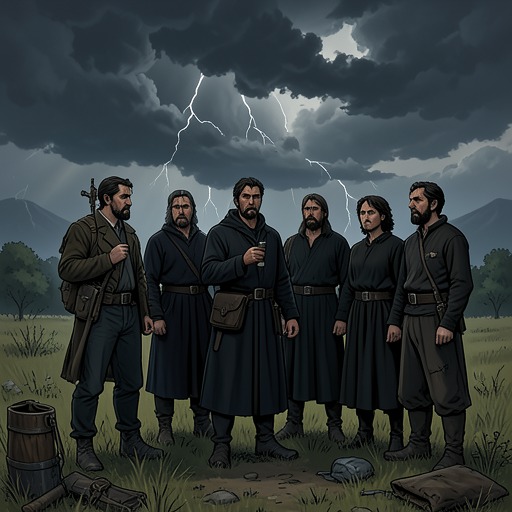
Leonard describes the four visitors as strangers from different parts of the country who received the same message at 11:50 p.m. the previous Monday. He says a common vision united them and became a command they could not ignore. Their account gives the approaching apocalypse a conditional structure: the family must willingly choose one of its three members and carry out the sacrifice, or the rest of humanity will perish. Leonard says the three family members would survive long enough to witness the aftermath, but be left alone in a devastated world. The visitors therefore present the family not merely with a prediction, but with an imposed responsibility for preventing it.
Leonard identifies God as the source of the command. Saying the word brings him both relief and terror, a reaction that suggests how difficult it is for him to voice the authority on which his actions depend. His certainty is not evidence that the family shares his belief. Andrew resists the visitors’ account, while Eric calls the apparent connection between their warnings and the disasters a coincidence, though his lack of conviction is noticeable. The family’s doubt persists alongside the visitors’ insistence that only a sacrifice can stop what is coming.
Disasters on the Television
A televised report establishes the first major disaster in the sequence: a magnitude 7.9 earthquake centered in the Aleutian Islands. The U.S. National Tsunami Warning Center issues an advisory for British Columbia and more than a thousand miles of the Pacific Northwest coast, while the Pacific Tsunami Warning Center issues its strongest warning for Hawaii. Viewers see footage of a tsunami reaching Kauai, flooding a resort that has already been evacuated and damaging coastal areas. The broadcaster reports no injuries or deaths at that point, a detail that complicates the visitors’ presentation of the wave as proof of catastrophe: the destruction is real, but warnings and evacuation have also limited its human toll.
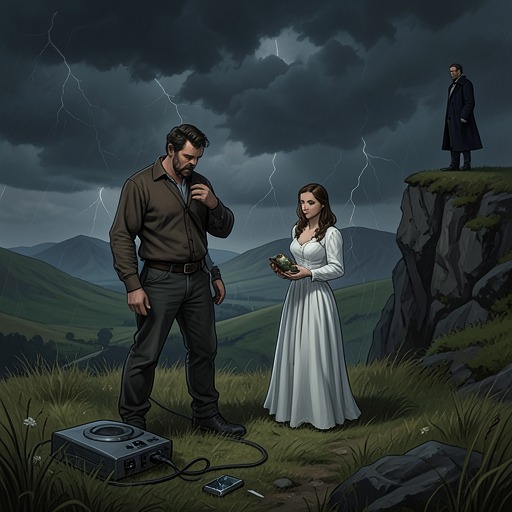
The coverage then reports a second, magnitude 8.6 earthquake near Oregon, in the Cascadia Subduction Zone. Scientists discuss the possibility of a tsunami between twenty and fifty feet high and warn that residents may have only minutes to reach safer ground. The newscaster confirms that a tsunami has struck the Oregon shoreline and introduces footage from Cannon Beach, including Haystack Rock. Adriane recognizes the location from her recurring dreams of a tidal wave and says she had feared she was losing her sanity. Her recognition makes the vision personal as well as prophetic, while Sabrina’s response that the footage is not what she saw preserves a difference between the visitors’ experiences rather than making them entirely identical.
The family’s captors connect these events directly to the refusal to choose. Adriane points to the coverage of the West Coast and argues that the family had another chance to prevent more deaths by making the demanded choice. Eric calls the disasters a coincidence, but his uncertain delivery gives the visitors reason to believe that the footage has shaken his confidence. Their disagreement is not simply about whether an earthquake or tsunami occurred; it is about whether the family’s decision can be treated as the cause of suffering far beyond the cabin.
Escalation After the Visitors’ Deaths
The visitors describe the sequence as advancing whenever one of their group dies. Sabrina explains the pattern by counting down on her fingers: after Redmond’s death came the earthquake and tsunami; after Adriane’s death came the bird flu. She warns that if the family continues to refuse, Leonard and Sabrina will be next, followed by further calamities. In this account, the deaths are not the end of the visitors’ mission but stages in an approaching progression. The claim gives each death a new consequence and makes the remaining visitors’ lives part of the family’s increasingly urgent calculation.
Leonard asks Andrew and Eric to turn on the television after Adriane’s death, as they had done after Redmond’s, to see whether events outside have changed. He then makes the implication explicit: they must find out whether Wen’s death would count as the required sacrifice. For Leonard, the rule requires a willing choice by the family; a death the visitors arrange themselves may not satisfy it. This distinction exposes a weakness in the supposed mechanism even as it intensifies the threat: the visitors profess to know the conditions, but cannot be sure that a death outside those conditions will prevent the apocalypse.
When the television is turned on, it shows a rapidly changing collage of airports, hospitals, crowded streets, markets, and packed subways, with many people wearing surgical masks. Leonard interprets the images as the plague he had predicted and says it is happening. The report then gives the sequence a further image: multiple crashed airplanes, with wreckage in fields and a plane partly submerged offshore. The crashes recall the visitors’ forecast that the skies would fall, but the available coverage does not establish their cause or confirm the final stage of the prophecy.
Meaning and Uncertainty
The apocalypse advances through a tension between prediction and interpretation. The visitors’ warnings precede the reported disasters, and their sequence—earthquakes and rising water, plague, then falling skies and final darkness—gives seemingly separate news reports a common shape. Their confidence grows as the television supplies images that resemble their account. Yet the footage also retains limits: the tsunami warnings allowed evacuations, the resort reports initially mention no casualties, and the airplane images do not by themselves prove that the visitors’ command caused the crashes.
The television thus works as both evidence and an instrument of pressure. The family sees disasters beyond the cabin, while the visitors frame each broadcast as confirmation that refusal has consequences. Their account turns uncertainty into a demand for action, but the promised outcome remains unverified: the further disasters are predicted, not shown to have reached a final conclusion. The approaching apocalypse matters not only as a possible end of the world, but as the logic by which the visitors try to make a family choose whom to lose.