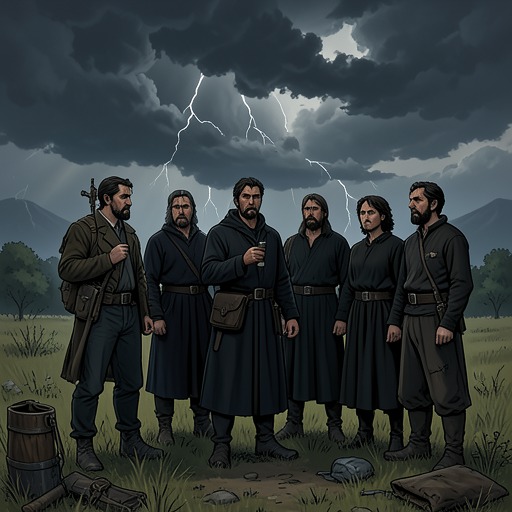
The Family Refuses to Sacrifice One of Their Own to Stop the Apocalypse
The Cabin at the End of the WorldThe Family Refuses to Sacrifice One of Their Own to Stop the Apocalypse is the family’s defining answer to the intruders’ ultimatum: Andrew and Eric will not choose a member of their family to be killed, even when told that the rest of humanity will die if they refuse. Their position turns a supposed choice about saving the world into a test of whether love can be made conditional on obedience. The answer remains no under pressure, amid catastrophe, and even as the family begins to consider whether the intruders’ account could be true.
The ultimatum and its claimed authority
Leonard presents the intruders as strangers united by a shared revelation. The four, he says, came from different parts of the country and had not known one another before receiving the same message. He gives its precise arrival time as 11:50 p.m. the previous Monday, and describes their common vision as a command they cannot ignore. In this account, the family is not merely being asked for help: the world’s survival is said to depend on its decision.
Leonard’s terms are exact and brutal in their consequences. Andrew, Eric, and Wen must willingly select one of the three and then kill that person. If they do not make and carry out that choice, Leonard says, the three will live long enough to witness the end of the world, while more than seven billion other people perish. He promises that the intruders will not kill the family themselves or harm them further, but says they must remain in the cabin until they choose or their allotted time runs out. The reassurance does not undo the pressure of the demand: the family is confined, given a deadline, and made responsible for a claimed global catastrophe.
Leonard eventually identifies the authority behind the command as God. His quiet, uneasy delivery registers both relief and terror at saying the word aloud. The answer supplies a source for the intruders’ certainty, but does not make the required killing acceptable to Andrew or Eric. Their refusal is not based on accepting Leonard’s religious interpretation; Andrew explicitly says he does not believe the world is at stake, while still stating what he would do even if he did.
Andrew and Eric make their answer explicit
Andrew first tells the intruders that the family already knows its answer. When the question is put plainly, he says that they will not choose anyone and will not sacrifice anyone, now or ever. Sabrina asks whether he would maintain that position even if it meant the death of everyone else in the world. Andrew answers yes, then stops before finishing the thought: he cannot bring himself to complete the sentence. The refusal is both a decision and a boundary around what he is willing to imagine doing to his family.
Eric independently makes the same position unmistakable. He says they will never choose anyone and will not hurt one another or anyone else; he insists that there can be no clearer answer. His agreement matters because Leonard has addressed the family collectively, but Andrew does not presume to speak for Eric without him. Each father states the refusal in his own turn, making it a shared commitment rather than a concession extracted from one member.
The intruders’ promise to leave them unharmed if they remain in the cabin, and their insistence that the family must decide before time runs out, do not change that commitment. Andrew tries to reach Wen with his tied hands, hoping she might understand that he wants help with the restraints, but she moves away, startled. The moment shows how little practical freedom the family has to act on its refusal: even a small attempt to communicate is uncertain, while the intruders continue to control the room and the schedule.
Delay, disaster, and renewed pressure
The demand does not end after the family answers. Leonard later says they will receive the same choice again the next morning, describing it as a gift and presenting sacrifice as a difficult, selfless act that could save the world. Until then, he says, the intruders will tend to the family’s needs within reason and leave them to reflect and talk. Andrew replies that they need not wait until morning to decide, because their minds will not change. Repetition turns the ultimatum into an ongoing ordeal, but not into a negotiation that alters the family’s answer.
The apparent disasters make the choice harder to dismiss as an empty threat. News coverage of a devastating earthquake and tsunami leaves Eric shaken. Later, Sabrina sets out the intruders’ claimed pattern by counting on her fingers: after Redmond’s death came an earthquake and tsunami; after Adriane’s death came the spread of bird flu. She warns that if the family continues to refuse, Leonard and she will become the remaining sacrifices, and that each further death will be followed by another calamity. Eric supplies the next image from the prophecy, describing the sky falling and breaking like glass. The family’s refusal is therefore made in the presence of events that appear to support the intruders’ explanation, even though that appearance does not establish that killing a family member is necessary.
Eric also tries to keep the intruders talking. When Adriane appears to be preparing for what comes next, he asks about the restaurants where she used to work and urges everyone to continue the conversation. The request is an attempt to delay the immediate decision and recover some human connection by asking about an ordinary part of her life. The others do not take up the invitation and instead cluster together. His effort does not dissolve the ultimatum, but it shows that the family’s resistance includes attempts to slow the violence rather than answer it on the intruders’ terms.
Refusal under doubt
The refusal persists even when Andrew’s certainty is unsettled. In a later conversation with Eric, he asks directly whether Eric thinks one of them has to be killed by another to keep the world from ending. Eric points to the intruders’ conduct and asks why they would invent the story and put the family through this. Andrew presses him to answer the original question. The exchange distinguishes doubt about the explanation from consent to the proposed act: evidence of disaster may strain Andrew’s disbelief, but it does not make him declare that one family member should kill another.
The episode’s central conflict is thus not simply faith against skepticism. Leonard casts the family’s decision as a selfless obligation to the world; Andrew and Eric refuse the premise that love for humanity requires them to choose a victim within their own family. Their answer is made under confinement, a deadline, and escalating claims about catastrophe, so the demanded consent cannot be treated as an ordinary free choice. By holding to the same boundary through repeated appeals and new evidence, the family rejects the intruders’ attempt to turn kinship into an instrument of their command.