The cabin television
The Cabin at the End of the WorldThe cabin television is both a source of apparent proof and an object of suspicion during the family’s captivity. Its broadcasts show disasters that resemble the visions and predictions described by Leonard’s group, giving those predictions a public, visible counterpart. But the screen also offers material that Andrew can interpret as preprogrammed rather than immediate. As the channel moves from breaking reports to recorded-looking footage, cartoons, and a titled program about bird flu, the television amplifies the crisis without resolving whether its images confirm the group’s claims or have been folded into their narrative.
Breaking News and the First Disasters
The television first presents catastrophe through the conventions of a continuous news broadcast. After commercials, the coverage returns with a breaking-news banner and reports a 7.9-magnitude earthquake in the Aleutian Islands, which had struck more than four hours earlier. The report gives the event a location and measurable scale, while its ticker supplies a broader stream of public disruption: refugees, unemployment, a celebrity’s death, and a falling Dow Jones average. The disaster arrives as one item in a relentlessly expanding news landscape.
The coverage then distinguishes between two warning systems and their audiences. The U.S. National Tsunami Warning Center has issued an advisory for British Columbia and more than a thousand miles of the American Pacific Northwest, including Seattle and Portland. The Pacific Tsunami Warning Center has issued its strongest warning for Hawaii, where residents and tourists on north-facing shores must evacuate to higher ground. A spokesperson explains that detection buoys have registered a wave estimated at fifteen to twenty feet. The report soon shifts from forecast to apparent event: footage of a resort on Kauai shows a gray, debris-filled surge overwhelming its beach, pool, courtyard, and lower-level rooms. Other clips show boats overturned, marinas flooded, docks destroyed, and coastal roads washed out. The spokesperson reports extensive expected property damage but says the early-warning system provided enough time for evacuations; no injuries or deaths have yet been reported.
The broadcast escalates from the Hawaiian tsunami to a second earthquake. During a rough transition back to the lead broadcaster, he announces an 8.6-magnitude quake seventy miles off Oregon, in the Cascadia Subduction Zone. The television relays scientists’ discussion of the danger: the first earthquake may have triggered the second, which lasted almost five minutes, and a nearby tsunami could reach the coast within minutes. Estimates place the wave between twenty and fifty feet high; residents are advised to seek ground eighty to one hundred feet above sea level, since even fifty-foot bluffs may not be safe. The station then announces that a tsunami has struck the Oregon shoreline and shows footage from Cannon Beach.
Visions Made Visible
The Cannon Beach images turn the television into more than a news source for the people watching in the cabin. A shaky wide shot shows dark rocks scattered across the beach, with Haystack Rock dominating the view. Adriane recognizes the formation from the film The Goonies and says she had dreamed of it being overwhelmed by a tidal wave. She describes staying awake after a nightmare, drinking black tea rather than risk falling asleep and seeing the scene again. Her account makes the footage a point of recognition between a private, recurring vision and a disaster appearing on the screen.
The broadcast’s images grow more terrifying as the camera moves away from the rock and the horizon rises toward it. The footage shows people running as a wall of water approaches; the sounds of shouting and cries for help reach the cabin through the broadcast. Sabrina steps in front of Wen to block her view and offers to take her to play with her toys, but Leonard insists that the family must watch. The television thus becomes part of the captors’ pressure: they do not simply cite the disasters but demand that their captives witness them.
When Sabrina finally changes the channel to Cartoon Network, Andrew suggests that Wen sit with Eric. She watches Adventure Time, seated cross-legged on Eric’s feet, while the episode’s argument over spilled beans offers a sharp contrast to the disaster footage. Leonard uses the pause to restate the choice he has presented: the family can sacrifice one of their own or refuse and let the clock move closer to midnight. The television has become the setting for this ultimatum, but it is also a screen that can be turned away from catastrophe, at least temporarily.
Repetition, Doubt, and the Next Broadcast
The television’s role recurs after the captives refuse to choose a sacrifice. Adriane points toward the screen as evidence that the disasters occurred after their refusal, arguing that the family has seen people drown and should believe the group. Andrew rejects the supposed connection, while Eric calls the events a coincidence without conviction. The broadcast has changed what the characters can claim to know, but it has not produced agreement about cause: the same images support the captors’ interpretation and the family’s resistance to it.
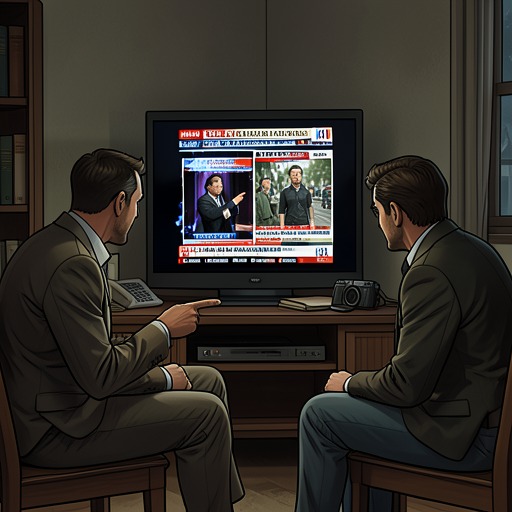
After Adriane dies, Leonard argues that they must turn on the television, as they did after Redmond’s death, to see whether events outside the cabin have changed. He specifically wonders whether Wen’s death will be enough to stop the end of the world. Eric then activates the set by pressing a small, nearly invisible power button on its inside edge. The television answers after a short delay with a rapid collage: airport views, a hospital, crowded sidewalks, markets, packed subways, and people wearing surgical masks. Its presentation is disorienting rather than immediately explanatory, and Eric backs away from the screen as the images overwhelm him.
The next sequence identifies the subject as an H7N9 outbreak in Hong Kong. Among the images is the Blue House in Wan Chai, a building Andrew remembers from a trip with Eric; the narration also recalls their framed photographs of the Blue House and Jardine House at home. The reporter appears at Kowloon City Wet Market with her surgical mask lowered around her neck. A red title box identifies the program as City Zero: Hong Kong and the Fight Against Bird Flu. The report describes rising human cases, a mortality rate approaching forty percent, the culling of millions of chickens and ducks, possible neighborhood quarantines and market closures, and infected birds discovered in several places beyond Hong Kong. In this sequence, the screen joins an international emergency to the couple’s personal memories of the city.
The Screen as Evidence and Suspect
The title of the bird-flu program becomes crucial because it exposes a difference between a report’s alarming content and its apparent timing. Eric treats the outbreak as fulfillment of Leonard’s prediction of a plague. Andrew counters that he has been reading about bird-flu cases for months and that the segment is not live: its title, he argues, makes it look like a preprogrammed television show rather than breaking news. He further suspects Leonard and the others knew the program’s schedule and incorporated it into their story. The television therefore supplies evidence that appears to fit the prophecy, but its format gives Andrew a reason to doubt how that evidence was selected or presented.
Later, the screen shows breaking coverage interrupting the bird-flu program, now displaying wrecked aircraft, smoking crash sites, and debris scattered across fields and offshore water. Eric describes the images as carrying a message and recalls Leonard’s prediction that the skies would fall and a final darkness descend. This return to apparently unfolding disaster renews the television’s power over the cabin: the images can be read as confirmation even after Andrew has challenged the credibility of an earlier segment. Across the broadcasts, the television is not a neutral answer machine. Its changing programs, delays, titles, and images make it a contested witness whose apparent immediacy intensifies the characters’ fear while leaving the meaning of what they see unresolved.