The hidden Glock
The Cabin at the End of the WorldThe hidden Glock is a concealed semiautomatic handgun that turns a hidden contingency into an immediate moral and physical threat. Buried near the road with the vehicle keys, it appears to have been kept as a reserve if the visitors’ plan at the cabin went wrong. When Sabrina finds it, however, its meaning changes: she uses it to kill herself, and Eric takes it from her, leaving the weapon in his hands as he considers whether he can still save everyone.
Concealment and Intended Purpose
The weapon is hidden beneath a sizable flat stone near a broad pine, inside a dark blue vinyl drawstring bag buried in the undergrowth. Sabrina knows the keys are under the stone but insists she had not seen the bag or gun. She wonders aloud whether Redmond concealed them, or whether Leonard buried them before the group reached the cabin. Neither possibility is confirmed. The discovery therefore establishes the gun’s location and its apparent association with the visitors, but not who placed it there or when.
Andrew interprets the hiding place as a contingency: if events at the cabin went wrong, the visitors would still have a hidden weapon. Eric reaches a related conclusion, seeing it as Sabrina’s chance to carry out the final sacrifice if the family does not choose someone. These are the men’s readings of the gun’s purpose, not a proven account of its history. Its concealment alongside the keys nevertheless makes the hiding place more than a simple cache: it holds both a possible route away from the cabin and a means of renewing the threat that the escape is meant to leave behind.
Discovery on the Road
As Andrew and Eric follow Sabrina into the woods, she kneels only a few steps from the road, flips the flat stone aside, and searches beneath the vegetation. She emerges with the car keys on a red keychain and tosses them onto the road. Her other arm remains inside the bag. When Andrew demands to know what she is holding, she pulls it away and reveals the larger-than-Andrew’s handgun, which appears to be a semiautomatic Glock.
The distinction between the keys and the gun matters in the scene. Sabrina hands over the keys and says the truck is about another mile down the road, giving Andrew and Eric a practical chance to continue. But the gun interrupts that apparent act of assistance. Andrew points his own weapon at her, yet cannot bring himself to put his finger on its trigger, remembering the sensation of having fired it before. Sabrina, meanwhile, says she never saw Redmond carrying the bag and did not know the gun was there. Her disjointed speculation about who hid it does not resolve whether the object is an intended trap, an emergency reserve, or something she has only now encountered.
From Contingency to Suicide
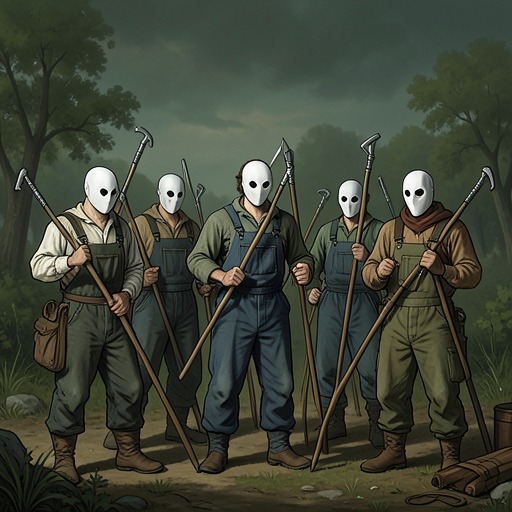
Sabrina holds the Glock low, pointed toward the ground, while Andrew tells her to drop it. She says she wants to help but cannot, and pulls a white mesh mask over her head, leaving her mouth and the tip of her nose uncovered. The mask makes her action resemble an unfinished return to the visitors’ ritual, while the handgun gives that ritual a means of continuing beyond the cabin. Eric recognizes that Sabrina may use it to become the final sacrifice if the others refuse to choose.
The danger becomes unmistakable when Sabrina raises the gun in a smooth motion and presses its muzzle to her temple. Andrew aims at her shoulder and cocks his own gun, ordering her to stop, but she does not lower the Glock. She tells Eric he still has time to save everyone, even after what has happened, then contradicts herself before the gun goes off. She dies against a fir tree. Her suicide is not presented as a deliberate, settled declaration: her arm moves as if it does not belong to her, while her other hand makes confused gestures of refusal and appeal. The object that Andrew had understood as the visitors’ safeguard thus becomes the means of Sabrina’s death, without settling whether she acts by choice or under the pressure she describes.
Eric Takes the Weapon
After Sabrina’s death, Eric walks through the brush and takes the Glock from her open hand. The gun is lighter than he expected. Flies gather over Sabrina’s body, and the surrounding darkness deepens as Eric understands that the sound he had taken for thunder is something else, a grinding and clicking like ancient gears turning into place. He then tells Andrew that Sabrina said he could still save everyone. Andrew turns and finds Eric standing by her body, holding the handgun with his arm angled across his chest.
The transfer leaves the weapon’s next use unresolved in this moment. Eric has taken it, and his words connect Sabrina’s last claim to the possibility of his own action, but the scene does not establish that he fires it. Instead, the hidden Glock carries the threat forward: first concealed for a contingency whose author remains uncertain, then used in Sabrina’s death, and finally held by Eric as he confronts the demand that someone must be sacrificed.
Narrative Significance
The Glock’s importance lies in the way its physical concealment makes the visitors’ violence persist beyond their immediate control. The keys suggest escape, while the buried handgun preserves a capacity for further violence; finding both together forces Andrew and Eric to confront how little the apparent route to safety has simplified their choices. The men’s different interpretations of its purpose also leave the weapon’s origin unsettled without making its consequences ambiguous. Sabrina dies by it, and Eric inherits it at the instant he voices hope that he can still save everyone. Its movement from hidden reserve to suicide weapon to Eric’s hand condenses the scene’s central conflict: the family’s escape from the cabin does not, by itself, free them from the sacrifice they have been asked to make.