The impending apocalypse
The Cabin at the End of the WorldThe impending apocalypse is the threat that turns a family’s confinement into an alleged choice between a loved one’s death and humanity’s destruction. Leonard presents the catastrophe as both foreseen and preventable: according to him, Andrew, Eric, and Wenling (Wen) must choose one of their three to sacrifice, or the world will end. As news reports begin to resemble the visitors’ visions, the danger becomes harder to dismiss, but the events do not by themselves settle whether the visitors’ interpretation is true or whether sacrifice could avert what they predict.
The Message and the Sacrifice Mandate
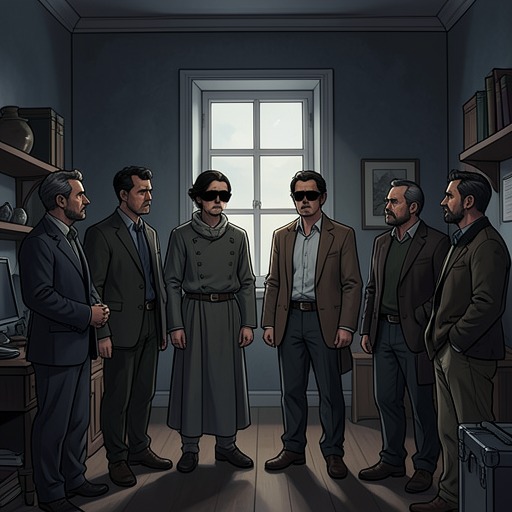
The visitors describe the crisis as beginning with a shared message received the previous Monday at 11:50 p.m. Leonard says that he and Sabrina, Adriane, and Redmond came from different parts of the country and did not know one another beforehand. In his account, they were brought together by a common vision that became a command. He portrays the four not as authors of the demand but as its messengers, compelled to carry it to the family.
Leonard’s explanation makes Andrew’s family central to a catastrophe said to threaten everyone. He insists that the family must willingly choose one of its three members and then carry out the sacrifice. If they do not choose, or do not follow through, Leonard predicts that more than seven billion people will die while the three family members survive to witness the aftermath. This is not presented as a request for practical assistance: it makes the family’s decision, rather than the visitors’ actions, the stated condition on which the world’s survival depends.
The visitors also frame the crisis as a choice made under an imposed deadline. Leonard promises that the family will not be harmed further by the group and says they will remain in the cabin until a choice is made or the allotted time runs out. After the family refuses, he renews the ultimatum, describing the opportunity to sacrifice as a gift and setting the next morning as another point at which they can decide. The language of willing choice thus exists alongside confinement, a deadline, and the threat of global death; the distinction between agreement and submission remains central to the crisis.
Visions, Belief, and Doubt
Leonard says the visions began as nightmares and later came while he was awake. He describes them as specific and difficult to escape, and says Sabrina, Adriane, and Redmond saw the same things. Their shared experience serves as the visitors’ explanation for how they found one another and came to the cabin. It also gives their demand a source beyond ordinary prediction, although the family has no independent access to the visions as evidence.
When asked who is making the visitors act, Leonard answers that God is. The answer brings him both relief and terror, suggesting that naming the authority behind the command does not make its meaning or consequences easier to bear. The visitors’ account therefore rests on two linked claims: that they have witnessed the same coming disasters, and that a divine command assigns the family the power to prevent them through sacrifice.
Eric’s response to the emerging evidence remains unsettled. As the news coverage accumulates, he wonders whether the visitors saw the same figure of light that he recalls seeing. The question connects his private experience to their claims without confirming that they share the same vision or understand it in the same way. Later, Andrew asks Eric directly whether he believes one of them must be killed by another to keep the world from ending. Eric asks why the visitors would invent the story and subject the family to it, but that question does not establish that their interpretation is correct. The distinction between observed disasters and the meaning assigned to them remains unresolved.
Disasters on the News
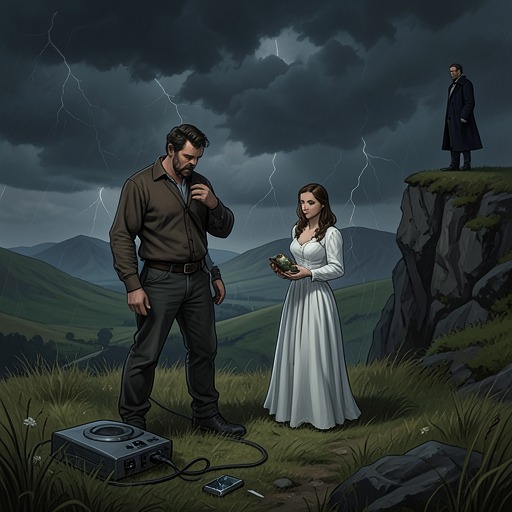
The first major public event shown in the cabin is a 7.9-magnitude earthquake in the Aleutian Islands, reported as having struck more than four hours before the broadcast. The U.S. National Tsunami Warning Center issues an advisory for British Columbia and more than a thousand miles of the American Pacific Northwest coast, including Seattle and Portland. The Pacific Tsunami Warning Center issues its strongest warning for Hawaii, where residents and tourists on north-facing coasts are ordered to evacuate to higher ground. The warnings give the visitors’ prediction an immediate, geographically extensive public context.
The coverage then reports an 8.6-magnitude earthquake whose epicenter lies seventy miles off the Oregon coast in the Cascadia Subduction Zone. A broadcaster announces the quake unexpectedly during a live report. Scientists suggest that the earlier Aleutian earthquake may have triggered it and report that it lasted almost five minutes. They warn that the short time before a tsunami reaches shore, damage to infrastructure, and the scale of the wave could make evacuation impossible in some low-lying areas. One estimate puts the tsunami at twenty to fifty feet high; residents are advised to seek ground eighty to one hundred feet above sea level because coastal bluffs around fifty feet high may not be safe.
The report moves from warning to confirmation when the broadcaster announces that a tsunami has struck the Oregon shoreline and introduces footage from Cannon Beach. Leonard initially treats the second earthquake as confirmation that the family failed to prevent the predicted events. He then corrects himself: he tells them that the visitors also failed, and that everyone is caught up in the same crisis. The reversal matters. The disasters appear to strengthen the visitors’ account, but Leonard’s own admission makes clear that their promised power to prevent them has not produced the outcome they claimed to seek.
Escalation and the Unresolved Rule
After Redmond dies, Sabrina links that death to the earthquake and tsunami. She then says that Adriane’s death is followed by the spread of bird flu, and warns that the remaining visitors will be the next sacrifices if Andrew’s family does not choose one of its own. She presents each death as a step associated with another calamity and the approach of apocalypse. The sequence turns the visitors’ earlier general warning into a recurring pattern that Sabrina uses to renew the demand.
The disasters are therefore both events in the world and evidence inside the cabin: they appear on television, are described by scientists and reporters, and are interpreted by the visitors as confirmation of their visions. Their order gives the threat momentum, but the causal rule still comes from the visitors’ account. The family sees catastrophic events follow the refusals and deaths; it is not shown a means of testing whether a sacrifice would have prevented them. The story sustains that gap between increasingly concrete disaster and uncertain explanation, making the impending apocalypse not only a forecast of destruction but the pressure under which every claim about choice, faith, and responsibility must be judged.