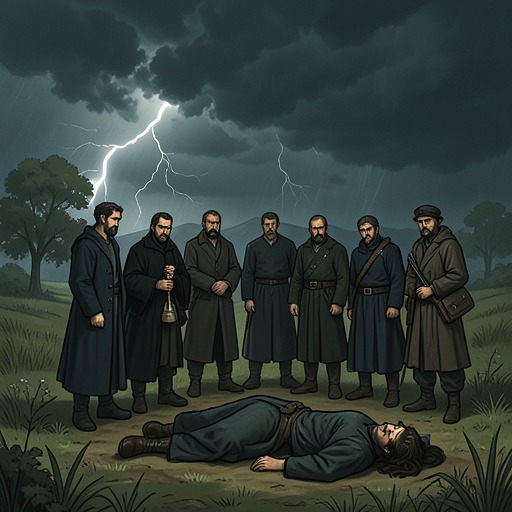
The skies will fall and crash to the earth like pieces of glass
The Cabin at the End of the WorldThe skies will fall and crash to the earth like pieces of glass is the most vivid formulation of the prophecy that binds Leonard’s apocalyptic warning to the disasters witnessed by Andrew and Eric. It sounds at once like a prediction and an image open to interpretation: as planes fall, Eric hears its fulfillment, while Andrew insists that the words do not specify what will fall. That gap between apparent confirmation and textual ambiguity makes the expression a pressure point in the family’s struggle to decide whether the message should be believed.
The Expression and Its Prophetic Setting
Leonard describes the four strangers as people from different parts of the country who did not know one another before receiving the same message at 11:50 p.m. the previous Monday. He says the message united them through a shared vision that had become a command they could not ignore. In this account, the words are not merely a forecast: they authorize the strangers to act as messengers and place the family inside the prophecy’s terms.
Leonard’s account makes the family’s decision decisive. He says the apocalypse can be prevented only with their help, and that they must willingly choose and kill one of their three family members. If they refuse either to choose or to carry out the sacrifice, he claims, the rest of humanity will perish, while the family survives only to witness the end. The image of the falling sky belongs to a message whose stakes are therefore personal as well as universal: it gives cosmic scale to a demand made inside the cabin.
From Warning to Apparent Fulfillment
After Redmond dies, Sabrina recounts the calamities as a sequence: an earthquake and tsunami followed his death, and the bird flu spread after Adriane died. She counts down the remaining members of the group and warns that each subsequent death will bring another disaster, moving the apocalypse closer. Eric supplies the falling-sky image as if answering a line in a call-and-response prayer. In this exchange, the expression becomes part of a pattern the strangers use to connect sacrifice with catastrophe.
The phrase returns with particular force when Eric watches breaking news of multiple airplane crashes. Still holding Wen, he steps back from the couch to see the television more clearly; the paper-towel pad taped to the back of his head hangs loose. He repeats Leonard’s prediction that the skies will fall and crash to the earth like pieces of glass, adding that an everlasting darkness will follow. The visible wreckage gives the prophecy an immediate, frightening referent, and Eric’s repetition shows how the message has entered his own language.
Dispute over What the Words Mean
Andrew challenges the connection between the prophecy and the planes. He points out that Leonard spoke of the sky falling into pieces, not of airplanes, and argues that the image could be made to fit many different events: a collapsing skyscraper, severe weather, mass bird deaths, or falling objects from space. In Andrew’s reading, the phrase is broad enough to invite a listener to supply the details after something terrible happens. His skepticism is not untouched by fear: he remembers the wrecked planes and his own impulse to destroy the television so he would not have to see them.
Eric counters that planes literally fell from the sky in pieces, making the connection more than a metaphorical leap. When Andrew says that planes crash all the time, Eric insists that the disasters are not vague: drowned cities, plague, and a falling sky have all become realities. Their disagreement exposes the difference between an image that resembles an event and a specific prediction of it. The expression can feel fulfilled without having named the event in advance, and that uncertainty leaves neither interpretation easily settled.
Narrative and Thematic Significance
The expression’s power comes partly from its instability. Leonard’s words are presented as a command and as a warning, but their broad imagery leaves room for competing explanations. Eric treats the crashes as evidence that the message is coming true; Andrew sees the retrospective fit as a reason for caution. The same phrase thus moves from the strangers’ shared revelation into a family argument, changing from an instrument of authority into an object of scrutiny.
The falling-sky image also links the intimate choice demanded in the cabin to disasters beyond it. It makes each catastrophe seem like another stage in a sequence, while the vagueness Andrew identifies prevents that sequence from serving as unambiguous proof. The book leaves the expression suspended between prophecy and interpretation: its force is real in the characters’ fear and decisions, even as its precise meaning remains contested.