We will go on
The Cabin at the End of the World“We will go on” is the closing declaration of Andrew and Eric’s refusal to let fear or catastrophe dictate that they harm one another. The words begin as an answer to an immediate crisis and widen into a promise to carry Wen, leave the cabin, and face whatever lies ahead. They offer resolve, not reassurance: the storm still surrounds them, and the future remains uncertain.
From Impasse to Decision
The phrase answers a stark exchange. Eric asks, “What will we do? We can’t go on.” Andrew answers, “We’ll go on.” The difference is only a contraction, but the movement it marks is decisive: what had been stated as an impossibility becomes a course of action. Eric’s question gives the line its pressure. This is not a detached motto or a general claim about endurance; it is spoken when the two men cannot see how to proceed and must decide whether despair will settle the matter for them.
The decision takes shape amid an argument about the reality of the crisis. Eric asks, “What if it’s all real?” Andrew does not claim that it is false or promise that they will be safe. His answer begins, “If it is. Then it is,” and returns to the boundary they have chosen: “We’re still not going to hurt each other.” In that context, going on does not mean that Andrew has solved the question of what is happening. It means that uncertainty will not become permission to sacrifice one another. The line’s conviction rests on that limited but consequential choice.
The Promise Made Physical
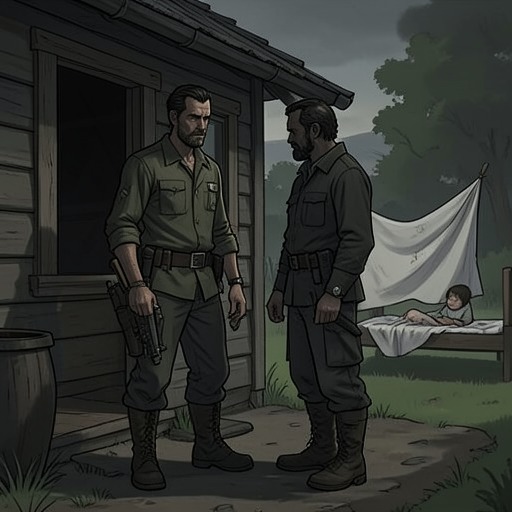
The scene gives the decision a physical form. Eric has the gun against Andrew’s chest, and Eric wants to take it from him and put it under his own chin. Instead, the gun remains where it is until Eric pulls it away, lowers his arm, and drops it to the forest floor. Andrew leans into Eric; Eric leans into Andrew. Their heads rest cheek to cheek, and their fingers find one another’s. The movement from weapon to touch makes the spoken resolve visible: they do not choose a new target for the gun, but let it fall.
Their closeness does not erase the danger around them. The sky is black, lightning splits it, and wind and thunder move through the forest. The storm may be different from those they have endured before, or it may not be. That uncertainty matters: the declaration does not depend on knowing how the scene will end. The men stand in the storm without turning its threatening appearance into proof that they must give up. Their joined posture offers a modest, immediate counterpoint to the surrounding scale of possible destruction.
What Going On Requires
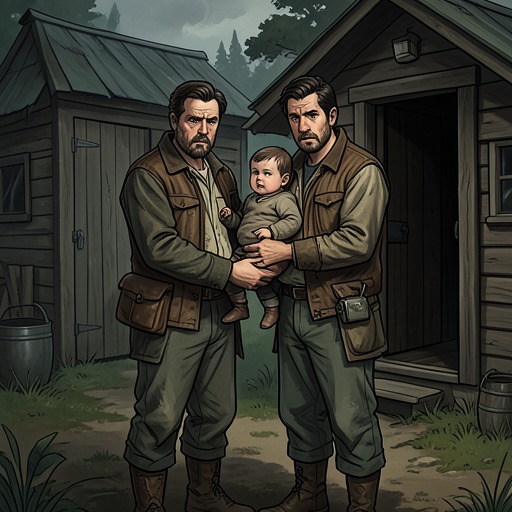
The final promise is expressed through concrete future actions rather than an abstract assurance. Andrew and Eric intend to pick the truck keys out of the mud, lift Wen into their arms, carry her, remember her, and love her as they love themselves. The sequence holds practical care and grief together: Wen is to be carried, and remembered. Continuing does not mean leaving her behind in their thoughts or pretending that their loss has not occurred.
The road ahead is imagined through obstacles, not a guaranteed safe passage. They say they will walk even if raging water floods the road, fallen trees block it, or fissures open beneath their feet; they will also walk the perilous roads beyond it. These conditional dangers enlarge the promise without resolving the story’s uncertainty. The men commit themselves to the next necessary acts, and then to what follows, while acknowledging that the way may be obstructed or perilous. The repeated future tense turns the phrase into a plan whose steps are care, memory, movement, and continued life.
Closing Function
The line returns in the final words, “We will go on.” Its shift from “We’ll go on” to the uncontracted form gives the closing declaration a deliberate fullness. Earlier, the answer interrupts an expression of hopelessness; at the end, it gathers the decision into a shared commitment. The passage’s plural voice also matters. Andrew and Eric lean together, hold on, and speak of a future in which they will carry and remember Wen. Going on is not framed as solitary triumph but as something they will attempt together.
The declaration leaves the central uncertainty open. The storm continues, and the words do not establish that the danger has ended or that the road will be passable. Their force comes instead from the distinction between knowing what will happen and deciding what they will do: Andrew and Eric cannot secure the world, but they can refuse to hurt each other and commit to the next acts of care. “We will go on” closes on that choice, making endurance neither certainty nor victory, but a future they undertake together.