Wenling (Wen)
The Cabin at the End of the WorldWenling (Wen) is the eight-year-old daughter of Andrew and Eric, a perceptive and determined child whose ordinary summer routines are interrupted by the crisis at the cabin on Gaudet Lake. Her attention to the welfare of the grasshoppers she collects, her complicated feelings about a childhood partly lost to memory, and her encounter with Leonard establish both her independent judgment and the vulnerability that the apocalypse claim places under pressure.
Identity and Background
Wen’s eighth birthday is six days away, but even that simple fact carries uncertainty: her fathers privately wonder whether the date is her actual birthday or one assigned by the orphanage in China’s Hubei Province. At her last pediatrician visit, six months earlier, she was in the fifty-sixth percentile for height and the forty-second for weight. She wanted the context of those figures explained and, pleased to be above the midpoint in height, was angry to fall below it in weight. The numbers matter to her not as abstractions but as a measure she can question and judge for herself.
A thin white scar beside her philtrum marks a cleft lip repaired through multiple surgeries between the ages of two and four. Wen remembers the first and final hospital trips, but not those in between; the missing memories trouble her. She is outgoing and goofy, athletic and wiry, and often wins contests of will with her fathers, including their scripted wrestling matches on the bed. Yet she is not entirely comfortable with her reconstructed smile. Her smiles, the narration observes, have to be earned.
A Child’s Care and Judgment
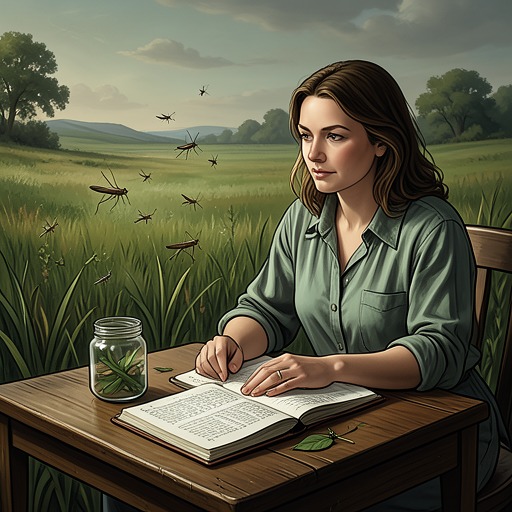
Before Leonard approaches, Wen is occupied with a homemade terrarium. She has promised Andrew to release the grasshoppers before they become trapped in heat, and she revises her plan with care: the jar should stay out of direct sunlight, and smaller grasshoppers may have more room and be less likely to injure themselves on the sharp metal edges of the lid’s punched holes. She plans to speak to them softly so they will be less likely to panic. After gathering grass with its roots, she arranges it inside the jar and wipes her hands on her gray Wonder Woman T-shirt. Her attention to the insects gives a small, concrete view of how she responds to responsibility: she notices risks, thinks through alternatives, and tries to protect vulnerable creatures.
The setting makes her later decision understandable without making it safe. On a cloudless summer day in northern New Hampshire, a handful of miles from the Canadian border, Wen leaves the jar in shade beside the cabin’s front stairs and searches the grass for more insects. Andrew taught her to sweep her foot through the grass like a scythe; when she did not know the word, he explained the tool and looked up images on his smartphone, until they remembered that the cabin had no cell service. The lesson belongs to their ordinary intimacy, a remembered piece of her father’s knowledge that shapes her play.
When Leonard stands near the driveway, Wen knows the stranger-danger lessons her fathers have repeated: she should say nothing more, turn around, and go inside quickly. She understands why vigilance matters in a crowded city, where a dangerous person might be hidden among many ordinary people. Here, among the woods, lake, grass, and quiet trees, she feels safe and believes Leonard looks all right. She introduces herself as Wenling, explaining that her fathers, friends, and everyone at school call her Wen. Leonard asks what she is doing and why she is not swimming; she replies that the lake is too cold and that she is catching grasshoppers. Her choice to speak grows out of a child’s reading of the setting and the stranger, not an absence of the warnings she has received.
The Stranger and the Apocalypse Claim
Leonard’s appearance initially reinforces Wen’s impression that he might be harmless. His moppy, wheat-colored hair, round brown eyes, pale face, and lack of beard stubble make him seem younger than her fathers; she wonders if he is in college and considers asking where, so she can mention that Andrew teaches at Boston University. Yet Leonard’s adult-sounding question gives her reason to reconsider what she knows about him. Their exchange begins with an ordinary introduction and a conversation about swimming, but its significance changes when the cabin’s crisis becomes explicit.
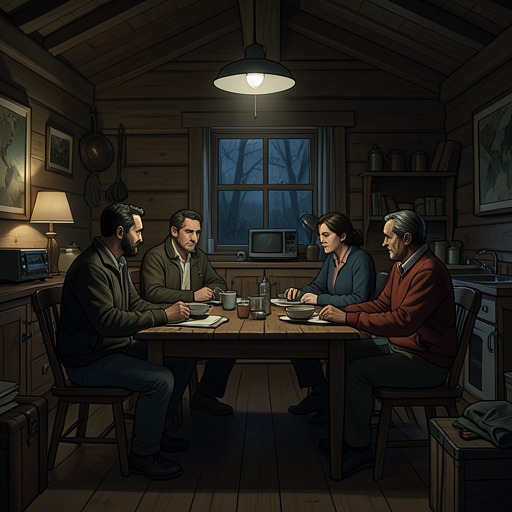
During the confrontation, Andrew shouts for Wen not to talk to Leonard. Eric calls to her and tells her she will be all right. Wen is standing behind Andrew’s chair, holding her position rather than moving toward Eric, and feels terrible that she chose that place instead of sheltering behind him. The detail makes her fear personal and immediate: even amid the danger, she is concerned about having made the wrong choice between her two fathers.
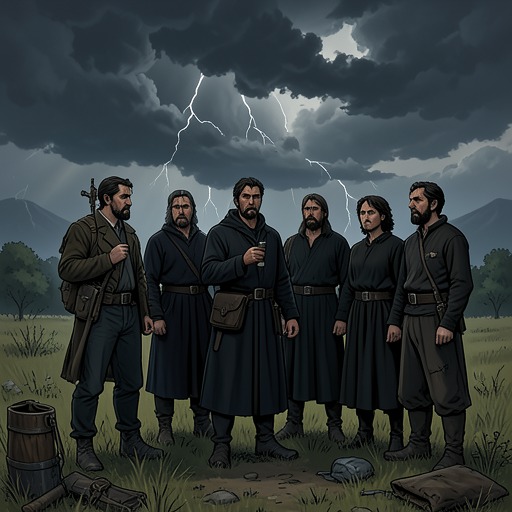
Leonard then tells the people in the cabin that he and his companions have come to prevent the apocalypse, and that whether the world ends depends on the three people he addresses: Wen and her fathers. He acknowledges that the burden is horrible and says he, too, initially tried to ignore the message before accepting it as true. The others nod, and a quiet assent comes from somewhere in the room. Eric rejects the account, but Leonard presents the group as messengers or a mechanism through which the message must pass. His claim turns Wen from a child catching insects beside the lake into one of the people made responsible for deciding the world’s fate.
Narrative Significance
Wen’s introduction places tenderness and threat side by side. She worries about grasshoppers injuring themselves on the jar’s metal edges, while the adults around her become caught in a demand that puts her own safety and the world’s survival into the same impossible frame. Her childhood is specific rather than idealized: she can be competitive about growth-chart percentiles, uneasy about her scar and smile, and confident enough to approach someone she believes is safe.
The uncertain birthday and the missing memories between her cleft-lip surgeries give her history gaps she cannot resolve simply by asking questions. Against that background, Leonard’s insistence that the apocalypse is real presents another uncertainty as a burden placed on her. The contrast between her considered care for small creatures and the adults’ catastrophic ultimatum sharpens the scene’s central imbalance: Wen can exercise judgment, but she is still a child being asked to carry consequences far beyond her control.