Adler's Furnishings
The CageAdler's Furnishings is a furniture shop whose ordinary routines become entangled with the investigation of The Phantom. Its sales paperwork, staffroom conversations, and delivery work put customers and employees in contact with information that matters to the case: a docket exposes Zoe Hardy's address to Martin Smith, and Josie Trott later gives police Ken Carlton's name and home address. The shop is not merely a backdrop to the investigation; it is where everyday commercial details and workplace relationships become clues, suspicions, and, at first, misdirection.
Shop and working spaces
The shop is presented through its working areas rather than through an exterior description. Customers browse the floor while staff sell furniture; behind it, employees pass through an office and a staffroom used for tea breaks and conversations. The staffroom has kitchen units, a kettle and microwave, a sink beneath a window, a fridge, and a central table surrounded by eight chairs. This practical, shared space gives the shop a social centre: colleagues arrive, take breaks, exchange news, and watch one another react.
The sales floor is similarly ordinary and specific. Martin Smith completes a sale of a bed and a pair of bedside cabinets to a young couple setting up home, then looks across the shop at customers considering specialist chairs, television tables, suites, and dining-room furniture. The varied purchases establish the shop as a place of routine service and domestic planning. That routine gains a darker implication when a customer's paperwork carries information beyond the sale itself: a delivery address can travel from the docket into an employee's private knowledge.
Staff and the rhythm of work
The staffroom's repeated use gives the shop a clear daily rhythm. Josie Trott works early shifts during one week, arriving before the shop opens at seven and eating toast with tea while cleaners work on the floor. Martin and Alice May are expected later, and Ken Carlton, the delivery driver, usually arrives around quarter to eight. The staggered starts make the staffroom a place where different shifts overlap, and where news can spread from one person to another before the day's work is fully underway.
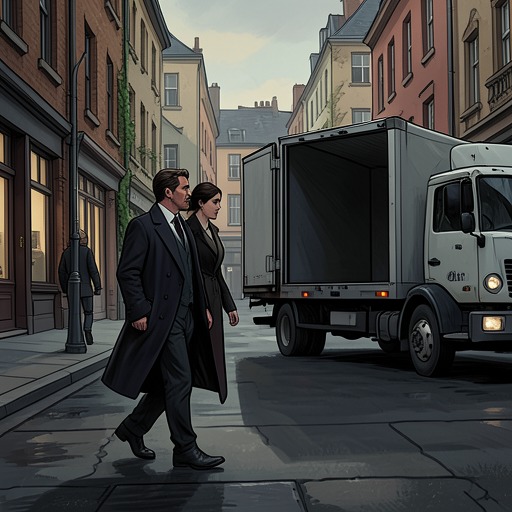
The shop's work is divided between selling furniture and delivering it. Martin and Ian Watts serve customers and handle sales paperwork, while Ken makes deliveries with Dan Waters as his mate. At one point, the two delivery workers return early and settle into the staffroom; on another day, they are in the front of the delivery van on their way to a first delivery. The van extends the shop's presence beyond the premises, taking its employees into customers' neighborhoods and giving the store a direct connection to the addresses recorded on sales documents.
The case enters the staffroom
The abductions become part of the shop's daily talk through newspapers, radio reports, and phone screens. Josie and Alice discuss the name The Phantom and the apparent lack of progress in the investigation. Later, Josie asks whether the same man could be responsible for Felicity Wanless and the Briggs twins; Alice resists the comparison, distinguishing the missing schoolgirls from a working woman taken from the street. The discussion shows how the public case is processed in fragments at work, with uncertainty and differing interpretations rather than police knowledge.
Martin also contributes to that conversation. He describes The Phantom as clever, organised, and careful, and speculates that he probably lives alone. His interest becomes conspicuous to Josie, who needles him about being the killer's biggest fan after Felicity Wanless is found. Martin rejects her accusation and warns her that he is losing patience. The exchange makes the staffroom more than a neutral place to hear news: it is where a colleague's attention to the case becomes visible to others, though it does not by itself establish what that attention means.
News continues to reach the shop as the investigation develops. Ian Watts brings in a radio report that Felicity Wanless has been found; later, Alice arrives in the staffroom holding out her phone with news of another abduction. Ian recognizes Zoe Hardy as someone to whom he recently sold furniture and hopes she will be found safe. The repetition of such announcements turns the ordinary break room into a place where the case repeatedly interrupts work and brings the missing women into the employees' immediate social world.
Sales records, suspicion, and identification
The most consequential link between the shop and Zoe Hardy's case is a sales docket. Ian makes a sale to Zoe, and Martin later checks the paper copy, notices that her address is not far from where he lives, and has no work-related reason to examine it. Josie later tells police that Martin's mother had moved into a home and his sister had married the previous year, leaving him living alone. She also reports that he is off work on the day of Zoe's abduction and the day before, that he had borrowed the shop's van, and that he had looked at Zoe's address on the docket. She places his home in a cul-de-sac near a nursery, just off Thomson Road. These details make the shop's records and lending arrangements part of the initial suspicion surrounding Martin, even though suspicion is not proof.
The store's delivery work also intersects with police efforts to understand how women were taken. Investigators review CCTV showing Jill Richards walking toward Roker Avenue, disappearing briefly from view, and reappearing at a bus stop. She checks the timetable and then flags down a vehicle shaped like a black cab, without a sign on its roof. That image supports the police warning to hail only white cars bearing a taxi sign. The shop's own van is not identified as the vehicle in that footage; rather, the scene underlines how ordinary-looking transport and familiar journeys become important to the investigation.
The decisive turn inside the shop comes when police contact Josie again and show her a grainy image. She recognizes the man as Ken Carlton, the delivery driver, then reads his address from his staff record. After the call, she concludes that Ken is The Phantom because the police are looking for him. Her conclusion is a character's inference, not an independently confirmed fact in that moment, but the exchange makes the workplace's records and Josie's familiarity with its employees immediately useful to the inquiry. Adler's Furnishings thus gathers the novel's central contrasts into one setting: routine sales beside private intrusion, helpful workplace knowledge beside dangerous access, and an apparently ordinary delivery job beside the fear surrounding the abductions.