Bill Nicol
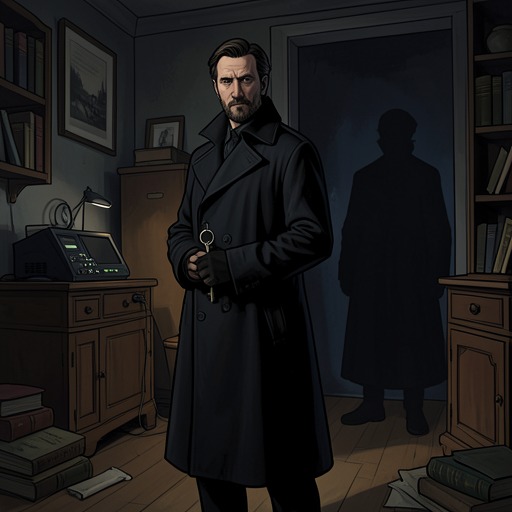
The CageDS Bill Nicol is Eve Strong’s close colleague in the investigation of The Phantom, contributing practical scene work, sustained attention to investigative details, and decisive action in the search for the women still at risk. His role develops from examining the killer’s repeated signs to helping turn a clue about a locksmith into a rescue lead; at the cage, he is the officer who unties Zoe Hardy and Jill Richards.
Identity and Investigative Approach
Bill works alongside Eve Strong in the murder investigation, sharing her attention to how victims were found and what their cases might have in common. At a crime scene, he crouches to examine the victim’s partly concealed hand and identifies the missing top joint of her little finger as the killer’s customary token. The observation adds a specific recurring detail to the team’s understanding of the murders. Eve also notes the marked difference in their height: Bill is six feet tall, while she is six inches shorter. Their partnership is conveyed through practical exchanges rather than hierarchy; they compare what they can see and use one another’s questions to keep the investigation moving.
Bill’s work is concrete and cumulative. At the murder board, he joins Eve as they revisit the evidence, and later the pair try to identify a pattern in how the victims were approached. Their review distinguishes the women’s separate last-known movements: Becky Allsopp had travelled back through Newcastle Central Station and then disappeared from view after leaving the Metro; Cath Caslaw had left after a row with her boyfriend; Louise Usher might walk home, take a bus, or occasionally use a taxi; and Felicity Wanless had left a pub before her friends and never arrived home. The cases had not produced reports of a public struggle. Bill’s participation in this comparison places him within an inquiry that tests possible common methods against different ordinary journeys, rather than treating the victims’ disappearances as unrelated.
Following the Fake Cab Lead
A key investigative turn comes from CCTV showing Jill Richards after she leaves a supermarket. The footage follows her past McDonald’s and towards Roker Avenue, then records her at a bus stop checking the timetable. She subsequently flags down a vehicle that resembles a black cab but has no roof sign. Bill brings this sequence to Eve, including the location of the showroom CCTV that captured it and the absence of an identifying sign. The details give the team a concrete lead on how Jill may have been taken.
Eve immediately connects the footage to the police warning that people should hail only white cars, and only when the vehicle displays a taxi sign. The apparent cab therefore does more than offer a possible route: it conflicts with the safety advice already issued and supports the team’s suspicion that the abductor used a fake taxi. Bill’s report prompts Eve to contact the press office so the warning can be reinforced and the public alerted to the vehicle. His contribution helps convert a general theory about victims being taken into a practical public-safety response.
Working with Eve and the Wider Case
Bill and Eve’s collaboration continues through difficult interviews and changing leads. Eve visits the Wanless family herself, while Bill remains part of the team’s effort to handle the investigation’s consequences. The case also exposes an imbalance in whose disappearances attract attention. Linda Briggs argues that her daughters, Terri Briggs and Berri Briggs, have received less concern because they are poor and working class, while the girls’ photographs have circulated widely in news coverage of the case. Reports of possible sightings arrive from around the country, adding to the work required to assess leads.
The family and neighbours respond with a practical campaign of their own. Iris brings Linda a box of T-shirts printed with a photograph of the twins and the missing-persons hotline number. Linda gives shirts to Gary Baxter to distribute, and Iris says one will also be sent to the man associated with the Phantom coverage, so the twins will be given public visibility. Bill is not the speaker of Linda’s criticism, but his place in the investigation brings him into contact with this contrast between media attention, public recognition, and the effort to keep the twins’ disappearance in view.
Connecting Keith Warner to Zoe Hardy
The investigation’s attention turns to Keith Warner after police bring him to the station. While he is being booked in, Eve meets Bill in the incident room. Bill recalls a report from a woman whose home had been entered and whose belongings had gone missing. He had asked Sheila Ormiston to revisit the house; her report yielded fingerprints and a cast of a shoeprint. Bill also identifies a detail that makes the report newly significant: Zoe Hardy had changed the locks when she moved in. When Eve asks who had done the work, Bill explains that he contacted Zoe and learned that Keith had changed both the front and back locks and fitted locks to the downstairs windows.
This connection gives the earlier intrusion report a direct link to Keith, rather than leaving it as an isolated complaint. Later, when Zoe’s details trigger the ongoing enquiry after she goes missing, Bill receives the call and urgently tells Eve that Zoe has disappeared. The team has come in to work despite it being Saturday, and the call is answered promptly. The sequence shows how a previously recorded report can change the meaning of a new disappearance: the officers now have reason to connect Zoe’s absence with the suspected intrusion and the person who had worked on her locks.
The Search and Rescue
Bill joins the urgent search at Keith’s mother’s house with Gina Cross and Keith, while Eve and other officers are already waiting outside. Inside, he sends Keith to the front room with Gina and confers with Eve as officers search upstairs. When Bill says Keith reacted strongly to mention of the house, he makes clear that the suspect’s behaviour has sharpened his concern about what they may find. The search first turns up a spare bedroom containing adult nappies and tunics like those worn by the women who have been found, then leads the officers towards the loft.
The entry to the property is enabled by a key Keith has left beneath a flowerpot beside the back door. In the loft, Eve discovers the cage. Jill calls for help and says Zoe needs an ambulance; Zoe is unconscious beside the cage. Bill unties Zoe and then frees Jill’s wrists from the sides of the cage. That immediate work is followed by Eve’s call for medical help and backup, and food is requested for the rescued women. Bill’s actions mark the change from searching for evidence to physically releasing the survivors.
The rescue remains dangerous. During the response, Ken Carlton attacks Eve and holds her at knifepoint. Bill and Paul Forrester rush towards the room after hearing the commotion; when they arrive, Bill raises his hands as Ken threatens Eve, and Paul follows his lead. The scene underscores the risk faced by the officers even after Jill and Zoe have been found. Bill’s part in the operation therefore includes both the hands-on rescue and the immediate response to the threat that follows.
Narrative Role
Bill functions as a steady investigative counterpart to Eve: he examines physical clues, brings relevant results back to the team, and helps connect separate lines of inquiry. His work on the missing finger, the cab footage, and Keith’s locksmith connection spans the investigation’s movement from pattern recognition to a suspect and then to the search for Zoe and Jill. The evidence also gives his role a clear endpoint in action rather than deduction alone: at the cage, he unties the women whose safety had become the team’s urgent priority.