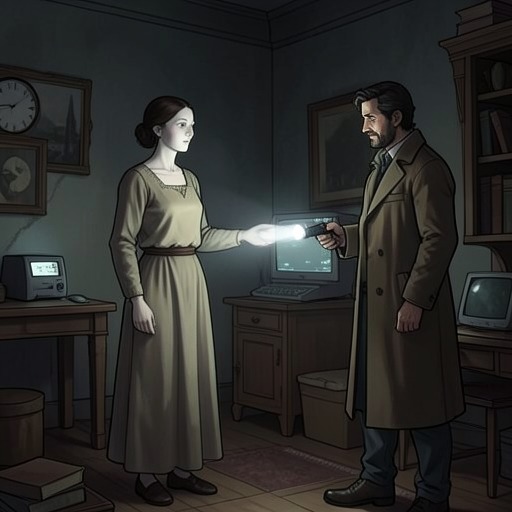
Eve Strong
The CageDetective Inspector Eve Strong is the Sunderland investigator at the centre of the search for a killer targeting women. She approaches crime scenes with disciplined attention to what has been left undisturbed, leads a team through an evolving pattern of murders and disappearances, and helps find the hidden place where Jill Richards and Zoe Hardy are held. Her work is complicated by her own earlier abduction: she is investigating experiences she survived, and the case repeatedly brings that history into the present.
Identity and Investigative Method
Eve is introduced at Louise Usher’s murder scene, where she stands still rather than immediately moving objects or entering the space more fully. She wants to see the scene as it was found, before colleagues alter it, and concentrates on observing details and trying to understand what happened. The attention is professional, but not emotionally detached: she feels pity for the dead woman and disgust at what has been done to her. Her first response holds both the investigator’s need for evidence and the human cost of the case in view.
Her practical habits are visible in small choices. Eve wears flat shoes rather than heels because she prefers footwear she can run in if necessary. After leaving the autopsy room, she thinks Louise is in capable hands with Felix Carver, whose analysis may give the investigation evidence to pursue. She then returns to the police work: Louise is the third woman killed in just over seven weeks, a concentration of deaths that makes the year feel grim from its beginning. At the station, Eve gathers uniformed and plain-clothes officers and brings them up to date, establishing her role as the person who must turn separate observations into a shared investigation.
Building the Case
Eve’s team compares the last known movements of Becky Allsopp, Catherine Caslaw, Louise Usher, and Felicity Wanless rather than treating their cases as interchangeable. Becky had travelled from Newcastle Central Station to Sunderland and disappeared after leaving the Stadium of Light area, beyond the reach of the CCTV cameras discussed by the team. Catherine had gone to the pictures and then for a drink with her boyfriend before leaving after an argument. Louise sometimes walked home from the gym, sometimes took a bus, and only occasionally used a taxi. Felicity left a pub before her friends and never reached home. These different journeys suggest that the investigation must identify not only who the women were, but where and how the perpetrator could have approached them.
The team has no reported shouting or screeching tyres to explain how the women were taken. Eve therefore weighs the possibility that a vehicle was involved without assuming that the abduction would have been conspicuous. Later CCTV provides a more specific lead in Jill Richards’s disappearance: after leaving a supermarket, Jill walks past McDonald’s towards Roker Avenue, disappears from view briefly, and reappears at a bus stop outside the Salvation Army. A car showroom across the road records her checking the timetable and then flagging down a vehicle that looks like a black cab, but has no sign on its roof. Eve immediately connects this footage to the police warning to hail only white cars displaying a taxi sign. The detail gives the team reason to test its suspicion that an apparent cab could be part of the method, while also showing why ordinary routines and gaps in observation matter to the inquiry.
Eve’s work also takes place amid unequal public attention. A newspaper speculates about the missing Briggs twins, suggesting possibilities ranging from a link to the other cases to the girls having run away. It labels them in dismissive terms and prints an unflattering image of their mother, Linda Briggs. Linda argues that the press gives more attention to missing people who are pretty or have money, and says that her working-class family would matter more to the public if it seemed more respectable. Eve encounters this account while the investigation is under pressure from publicity. The contrast between the newspaper’s treatment of the family and the officers’ effort to establish what happened makes media representation part of the case’s surroundings, not a reliable substitute for evidence.
Trauma and Professional Resolve
The investigation affects Eve in ways that are tied to her own past. During an earlier case, she was abducted and held against her will. Now, working on cases involving women who experienced similar violence but did not survive, she finds that professional proximity to their circumstances takes a toll. Counselling has helped only up to a point. At night, an ordinary creak from a board or joist can wake her with her heart pounding, and after a difficult stretch at work she locks herself inside her car and waits for her hands to stop shaking before driving away.
The symptoms do not erase her judgement or her ability to act, but they complicate the boundary between work and private life. Eve knows the case through evidence and procedure, while her bodily vigilance also reflects an experience she cannot simply leave behind when a shift ends. Her flat shoes, attention to exits and sounds, and concern with the practical conditions of a scene belong to her work; the book also places them beside a persistent alertness shaped by captivity. The result is not a portrait of invulnerability, but of a detective continuing to lead while carrying a personal cost.
Leads, Mistakes, and the Hidden Loft
A hesitant caller gives Eve and her colleagues a precise name and occupation: Keith Warner, who runs a key-cutting shop and fits locks. Because the reported intrusions and missing belongings might be connected to how someone entered houses, Eve decides to visit Warner with Paul Forrester and speak with him directly. When she returns to the station, a message from Bill Nicol brings another development about a woman who had complained that someone entered her home and took possessions. Eve’s response is to follow the lead and assemble its implications, not to treat a caller’s claim as a conclusion.
A separate raid on Martin Smith’s house fails to identify the perpetrator. Driving back to the station, Eve acknowledges that Smith had seemed a plausible candidate and shares Bill’s disappointment, made more urgent by the knowledge that the officers are racing against time. Then a call reports CCTV footage of a delivery van and its driver arriving at Zoe Hardy’s house. Once Eve gets the driver’s address, she orders the team to move quickly and asks Gary Baxter to arrange support. She still takes care not to announce the approach by racing up to the house: with traffic light, she slows on the street and looks for the right property. Urgency and restraint operate together.
Inside the house, an unusual small bathroom offers concrete evidence of confinement: it contains only a toilet and washbasin, has a groove beneath the door, and has a window nailed shut and painted over. Eve notices a long metal pole with a hook on the landing and a metal loop attached to a large loft hatch. Using the pole, she draws down the hatch and lowers its ladder. Above, a cage dominates the loft. Jill asks for help and says Zoe needs an ambulance; Bill unties the unconscious Zoe and then frees Jill’s wrists. Eve’s path from a strange bathroom to the concealed loft turns observations about the building into the discovery of the missing women.
Leadership Under Immediate Threat
The discovery does not end the danger. Jill tells Eve that the man has gone out to get something to teach her a lesson and is expected back. Eve signals for silence. She judges that Ken Carlton may be wary when he sees the open hatch and ladder, and that he might flee, but recognizes that the officers have an advantage until he comes upstairs. The ladder creaks as weight shifts across its steps, so a silent descent is impossible; Eve chooses speed instead.
She indicates the order in which she, Paul, and Bill should descend, then moves first. By the time Bill reaches the landing, Eve is already moving through the house. She checks the kitchen and dining room, using the open door to ensure no one is concealed behind it. In the shaded dining room, the curtains are drawn despite the daylight. Eve notices the change and checks the room rather than assuming it is empty. Her method at the beginning of the book—observe before disturbing a scene—has become urgent action: she reads small changes in the house while moving toward the returning danger. Eve’s significance rests in that combination of close observation and decisive leadership, as well as in the tension between the case she directs and the captivity she herself remembers.