Felicity Wanless murder
The CageFelicity Wanless murder is the point at which The Phantom’s replacement rule becomes brutally visible: once Jill Richards has taken Felicity’s place in the cage, Felicity is no longer needed. The killing is not hidden from the new captive. Jill is made to witness it, then watches the killer turn Felicity’s body into a source of trophies. The murder thus marks both the end of Felicity’s captivity and the beginning of Jill’s forced education in how survival under The Phantom’s control may depend on staying unobtrusive.
Background and the pattern of disappearances
Before the killing, Felicity had been out with friends and left the pub earlier than they did; she never arrived home. Investigators placed her disappearance alongside those of other women, but the precise moment of her abduction was unknown. Becky Allsopp had travelled from Newcastle Central Station to Sunderland by Metro and disappeared after leaving the Stadium of Light, beyond the reach of CCTV. Louise Usher had finished at the gym and sometimes walked home, sometimes took a bus, and only occasionally used a taxi. The different circumstances left the police without a single confirmed point at which any of the women had been seized.
The working assumption was that the women had been bundled into a vehicle, but investigators had no reports of shouting or screeching tyres. That absence suggested how little public disturbance the abductions might involve, without establishing exactly how Felicity was taken. Later, CCTV showed Jill Richards checking a bus timetable near Roker Avenue before flagging down a car that appeared to be a black cab. The vehicle had no sign on its roof, despite the police warning that people should hail only white cars bearing a taxi sign. This evidence sharpened the investigation’s concern about deceptive transport, but it does not identify Felicity’s own abduction vehicle.
The killing in the loft
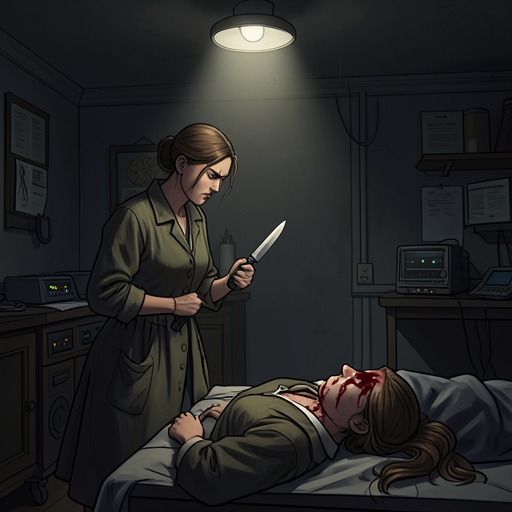
Felicity is already bound when The Phantom enters the loft carrying a Tupperware box and an old-fashioned cut-throat razor. He unties her hands and feet, drags her out of the cage by the rope, and binds her wrists behind her back. When she asks whether he has come to kill her, he explains that she has been replaced and that Jill is the new captive. Her life, he says, had effectively ended when he acquired Jill. The exchange makes the substitution more than a change in victims: it is the killer’s stated justification for disposing of one woman once another is available.
Jill pleads with him not to proceed. The Phantom orders her to keep quiet and watch, then kneels and strangles Felicity with his bare hands. Jill sees Felicity struggle for air, her face change colour and her eyes bulge, while the killer strains and sweats. Eventually Felicity goes limp; he releases her and lets her fall. The scene gives Jill no distance from the murder. Her bodily terror is made explicit when she realizes that she has lost control of her bladder while watching, and she is left to understand that the empty cage will now be her home for an unknown length of time.
Trophies and the threat to Jill
The Phantom does not stop with the killing. He lifts Felicity’s tunic, uses the razor to cut through the side of her adult nappy, and makes four cuts around the tattoo on her hip to outline a frame. He excises the skin bearing the image of a happy little penguin, holds it up to the light, and shows it to Jill. He calls the piece a token by which to remember Felicity and places it in the clear liquid inside the Tupperware box, saying he may frame it. The ordinary, cheerful tattoo is thereby converted into a preserved fragment of the victim, displayed as evidence of the killer’s possession.
He then takes secateurs from his pocket, grasps Felicity’s left hand, and cuts off the top joint of her little finger. He drops it into the box beside the tattooed skin and snaps the lid shut. Before leaving, he tells Jill that her eyes are pretty and suggests they might become the token he takes from her. The remark carries the violence forward: Felicity’s death is not only a completed murder but a threat directed at the woman left behind. Jill is alone in the dark with Felicity’s corpse after the hatch closes, measuring her prospects against the earlier captives. She knows Felicity had lasted less than a week, while Louise Usher had lasted a couple of weeks, and wonders whether she can endure long enough for the police to find her.
Disposal and public attention
In the very early hours of Sunday 25 February, a black cab stops on Park Avenue in Roker beside the lychgate of St Andrew’s Church, Roker. It leaves minutes later, lighter by one body. Felicity’s eyes stare sightlessly beneath the gate. Her hair is damp from a thorough cleaning, and she has been dressed in a freshly laundered tunic before being carried downstairs, driven to the church and abandoned. Several hours later, an early-morning dog walker’s elderly black Labrador noses through the gate, then whines and paws at what it has found. The body’s careful washing and clean clothing contrast with the violence in the loft, while the short, anonymous stop turns the church entrance into the place where Felicity is discovered.
The wider response to missing women also exposes a contrast in whose disappearance attracts attention. A newspaper speculates about whether the missing Briggs twins were connected to the same man, involved in a grooming gang, or had simply run away; it calls them little tearaways and publishes a photograph of their mother, Linda Briggs, alongside an unkempt house and garden. Linda later tells Gary Baxter that the press gives more attention to victims who are pretty and have money, while poor working-class families are treated as unworthy of concern. She points to the volume of reported sightings as another practical difficulty for police trying to follow up leads.
In response, Linda, her neighbours and the twins’ friends fund T-shirts bearing the twins’ image and a missing-persons hotline number. Iris says one will also be sent to Warren Wilson, urging that the twins be made as important as The Phantom and his victims. Linda gives shirts to Gary to distribute. This campaign does not resolve Felicity’s murder, but it places the case within a story about unequal public recognition: missing people are not automatically granted the same visibility, and the families left searching must sometimes make that visibility themselves.