Ken Carlton
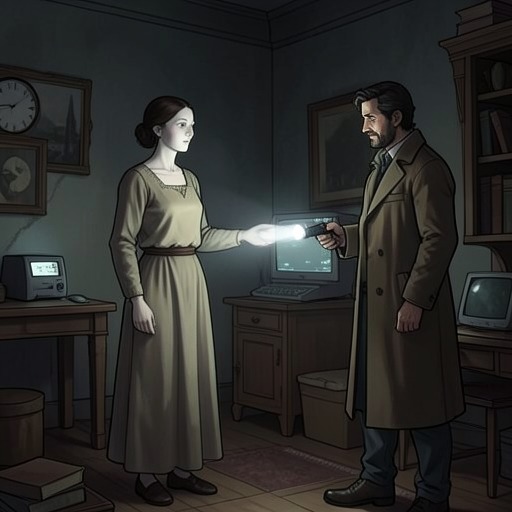
The CageKen Carlton is The Phantom, a serial abductor and killer whose ordinary work as a furniture-delivery driver gives him both a public cover and practical means to seize women. His pursuit of Zoe Hardy brings those two sides together: after becoming fixated on her, he uses the pretext of a furniture-related visit to enter her home and abduct her, turning a routine service call into the beginning of her captivity.
Identity and Working Cover
For much of the investigation, The Phantom’s identity remains unknown to the police and the public. Carlton’s everyday role is that of a delivery driver, and his work brings him into people’s homes without the encounter initially appearing out of place. The contrast is central to his method: the familiarity of a scheduled delivery can disguise the danger that comes with the person at the door.
A remark by his colleague Dan Waters gives an early glimpse of Carlton’s fixation on Zoe. After a delivery, Dan calls the woman with differently coloured eyes gorgeous. Carlton asks which woman despite knowing whom Dan means. His feigned ignorance masks how closely he has attended to Zoe, while Dan’s casual admiration inadvertently sharpens Carlton’s sense of her as someone he wants to possess.
Carlton’s preparation for the abduction draws directly on the equipment and routines of his work. He gathers an empty tea chest, packing materials, twine, and beeswax, then drives the delivery van to Zoe’s house on Thomson Road. The items are not incidental: the crate and packing materials allow him to conceal and transport her, while the van offers a plausible vehicle for moving a person under the appearance of ordinary work.
At the house, Carlton presents the beeswax as the reason for his visit and asks Zoe for a cloth so he can demonstrate its use. When she turns toward the kitchen, he strikes her on the back of the head with the tin, then hits her again at the temple when she remains conscious. He drags her into the rear dining room and draws the curtains, taking care to reduce the chance that anyone outside will see her. He then leaves the front door open while he brings the empty crate inside, creating the appearance of packing materials being carried in during a delivery-related task.
Once he has returned Zoe to the hall, Carlton ties her wrists and ankles with the twine he brought, gags her with packing material, and places her in the crate. The sequence shows how he converts the familiar props of delivery work into instruments of assault, restraint, and concealment. His disguise is not merely a vehicle or uniform: it is the ordinary explanation his job supplies for being at a woman’s home and handling bulky containers.
The Pattern and His Identification
The investigation gradually connected the disappearances to the ordinary journeys of women moving alone through Sunderland. Becky Allsopp had returned from Newcastle via Newcastle Central Station and travelled onward by Metro, but the trail disappeared when she left the Stadium of Light and walked beyond CCTV coverage. Louise Usher sometimes walked home from the gym, sometimes took a bus, and only occasionally used a taxi. The investigators believed the women had been bundled into a vehicle, yet had no reports of shouting or screeching tyres. That absence pointed toward an approach that could happen without attracting notice, rather than a conspicuous struggle in the street.
Jill Richards’s journey brought that possibility into sharper focus. CCTV showed her leaving a supermarket, passing McDonald’s toward Roker Avenue, and reappearing at the bus stop outside the Salvation Army after a brief period out of sight. Across the road, a car-sales showroom camera recorded her checking the timetable and then flagging down a car shaped like a black cab. It had no sign on its roof. The detail mattered because police had already warned the public to hail only white cars bearing taxi signs; Jill’s recorded choice suggested that an unmarked vehicle could exploit the familiarity of a cab while evading the safeguards the warning described. The footage did not by itself identify its owner, but it strengthened the investigators’ suspicion that a vehicle was central to the abductions.
That method matches Carlton’s own later assessment of the cab: it had served when he wanted a change of face rather than a particular woman, but it had become useless once he set his sights on Zoe. The difference is revealing. The cab offered a means of opportunistic selection, while his interest in Zoe required a more deliberate approach through his delivery work. The police, meanwhile, had to work backward from fragments—a route, a gap in surveillance, and a car with the right shape but no identifying roof sign—to the person who controlled the vehicle and could make an abduction appear routine.
Carlton’s identity surfaced not through a direct confession but through the workplace that had concealed his access to Zoe. When police sought him, Josie Trott recognized his image and gave his name and address from his staff record. She inferred that Ken Carlton was The Phantom, although the officers had not told her that conclusion outright. The inference was then supported at his home: Bill Nicol pointed out a key hidden beneath a flowerpot by the back door, and, upstairs, Paul Forrester found adult nappies beside a box containing the distinctive tunics worn by the captive women. Eve Strong recognized the tunic as proof that they had reached the right place. The objects connected the delivery driver’s private home to the victims’ captivity, converting suspicion about an unseen abductor into physical evidence against Carlton.
Trophies and the Captivity Cycle
Carlton’s private collection makes clear that captivity, for him, is not simply a way to remove women from public view. While a frozen lasagne heats in the microwave, he checks his tokens and admires a piece of tattooed skin drying. He considers what to take from the woman in the loft next, weighing an organ such as a kidney and even imagining killing her before removing it in the bath. The domestic ordinariness of the meal and the methodical attention to his keepsakes sit beside the planned mutilation without disrupting his routine: the victims have become materials to preserve and choices to make.
His thoughts about the new captive expose the logic behind his repeated selections. Dan Waters’s admiration had helped focus Carlton’s desire on Zoe, and Carlton imagines the satisfaction of possessing the woman Dan wanted but could never have. He treats that possession as a reward for audacity and for making another person do what she does not want. The word he privately uses for a captive, “doll,” reduces a person to an object for his collection, while the imagined rivalry with Dan turns abduction into a claim of ownership.
The pattern is not wholly impersonal or frictionless. Carlton recalls that the woman taken near the Salvation Army had cost him the use of his cab and, like the captive before her, had fought back. He wants resistance only within limits: he likes the women to struggle, but not to fight, and wants fear rather than defiance. That distinction reveals the control he seeks. A captive’s resistance may affirm his power so long as it remains something he can contain; active opposition unsettles the fantasy of submission on which his treatment of them depends.
That demand for submission appears again when Jill Richards tells Eve Strong that Carlton has gone to get something with which to teach her a lesson, promising that they will learn what pain is. The threat places his violence within the same possessive system as his trophies: resistance calls forth punishment, while the captive is treated as something he can train. But the women are not the compliant objects he imagines. His recollection that earlier captives fought back foreshadows the decisive failure of his control when Jill intervenes during his attack on Eve.
Resistance, Arrest, and Physical Evidence
When Jill Richards told Eve Strong that Ken Carlton had gone to fetch something to teach her a lesson, the threat was immediate: he had said the captives were going to learn what pain was. As Eve and her colleagues moved to leave the loft, Carlton was already back inside the house. Eve descended first, with Paul Forrester and Bill Nicol following, and searched the rooms while the open hatch and ladder risked warning him that the police were there. In the dining room, the curtains were drawn despite the daylight. As Eve reached to pull them open, Carlton burst from the deep windowsill where he had been hiding, drove her to the floor, and punched her. By the time Bill and Paul reached the room, Carlton had Eve by her hair and a carving knife at her throat.
Carlton tried to force Eve through the hall and toward the black cab outside, a vehicle she feared would take her beyond the reach of her team. She pretended to stumble, then struck him in the face with the back of her head when he grabbed her. He dropped the knife, but the struggle continued: he put his hands around her throat before either officer could get close. Jill then entered the room, took an object from the worktop, and struck the back of his head with all the strength she had left. Carlton fell, hitting his head on the worktop’s edge, and lay still. His arrest came not through the police overpowering him alone but through the intervention of a captive he had tried to make fearful and compliant.
The search of Carlton’s house also exposed the bodily trophies behind his private collection. In an open sideboard drawer, Eve found a vial labelled with Louise Usher’s name and the date 18 February 2018. Bill Nicol recognized what floated in the liquid as Louise’s fingertips. The labelled container joined a victim’s identity to the remains Carlton had preserved, making his collecting practice concrete evidence of what he had done to the women he abducted. The ordinary household drawer could no longer conceal the violence beneath his respectable working life.