Ken Carlton’s black cab
The CageKen Carlton’s black cab is the practical instrument of The Phantom’s crimes: it lets him present himself as a possible taxi, move victims without attracting immediate notice, and threaten to carry a captive beyond the reach of the police. Its lack of a roof sign makes the vehicle look enough like a cab to be hailed, but not enough like a legitimate taxi to meet the warning the police have issued. Its meaning changes as the investigation catches up with it: first a fleeting image on CCTV, then a likely lead, and finally the vehicle waiting close enough to Ken Carlton’s house to become part of Eve Strong’s attempt to resist him.
Appearance and deceptive use
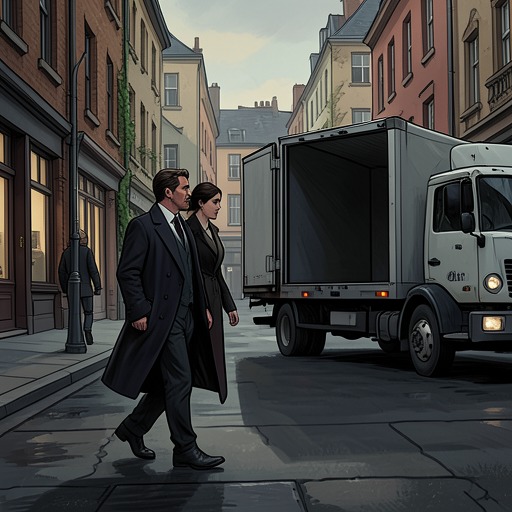
The cab’s defining feature is not a distinctive marking but the absence of one. CCTV footage shows Jill Richards leaving a supermarket, walking past McDonald’s towards Roker Avenue, disappearing from view briefly, and appearing again at a bus stop outside the Salvation Army. Across the road, a car showroom’s camera records her checking the timetable and then flagging down a vehicle that appears to be a black cab. It has no sign on top. That apparently small detail makes the footage significant: the car has the shape of a cab, but not the visible indication that would identify it as one.
The distinction matters because Eve Strong’s team has already warned people to hail only white cars, and only when they carry a taxi sign on top. Jill’s apparent decision to enter the black cab therefore exposes how the vehicle could exploit ordinary habits of travel while bypassing the reassurance offered by official taxi markings. The story does not establish that every victim entered the vehicle in the same way. The investigation has assumed that women were seized and bundled into a vehicle, while noting the lack of reported shouting or screeching tyres. The cab is thus one concrete element in a broader pattern whose exact circumstances remain uncertain.
Abduction, transport, and concealment
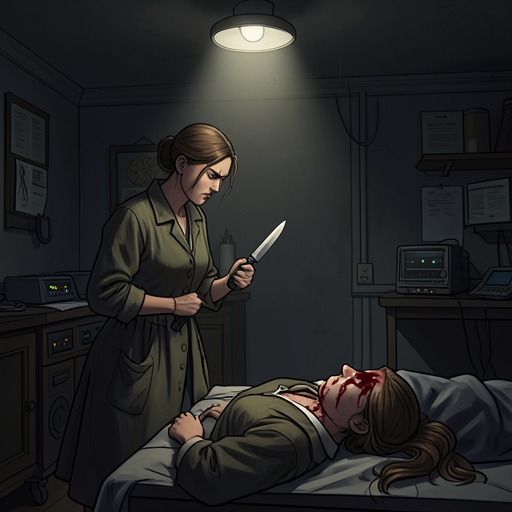
The cab is associated with more than the moment of pickup. In the early hours of Sunday 25 February, a black cab stops beside the lychgate of St Andrew’s Church, Roker, and leaves a short time later lighter by one body. The young woman has been thoroughly cleaned, dressed in a freshly laundered tunic, taken downstairs, driven to the church, and abandoned. Several hours pass before a dog walker’s elderly Labrador leads him to the body. The scene gives the vehicle a double function: it transports the victim to a secluded final location, while the cleaning and changed clothing show that the journey is part of a larger process of concealment.
Another body is found propped against a wall among bushes beside an electricity supply box, at a site-access road near the cenotaph in Mowbray Park and Sunderland Civic Centre. The entrance opens onto Burdon Road, near the Fawcett Street Station memorial drinking fountain. The place is not wholly hidden: it is close to a busy daytime thoroughfare and has a streetlight. But parking spaces offer a driver a plausible reason to pull in briefly, and the body is set off the main road where a passing person may not be looking for anything wrong. The discussion of the location emphasizes not a remote hiding place but the cab’s capacity to make a brief stop look unremarkable.
The vehicle becomes a police lead
Once footage of Jill entering the cab is shown on television, the vehicle becomes public evidence as well as a police lead. Zoe Hardy hears that the police know about the taxi and have broadcast the footage of Jill getting into it. She realizes that this explains why The Phantom took her by a different method. The cab’s visibility has therefore changed the killer’s choices: the same vehicle that had helped him approach a victim now risks identifying his pattern and prompts him to vary his method.
The investigation later spots what appears to be a black cab under a carport behind a house. Paul Forrester asks whether it is the vehicle they are seeking; Bill Nicol notes that it has no roof sign, and Eve judges that it is probably the one. There is no sign of life at the house. The scene does not yet amount to proof, but it brings the cab’s defining absence—the missing sign—into focus again, now as a clue connecting the vehicle to a possible suspect rather than as a detail in surveillance footage.
At Ken Carlton’s house
The cab’s role becomes immediate when Ken Carlton pushes Eve out of the dining room, across the hall, and into the kitchen. Through the back door she sees the black cab only steps away. She fears that if he gets her into it, he will take her beyond the reach of her team. Instead of complying, she pretends to stumble; when Ken grabs her, she slams her head backwards into his face. The cab is not simply parked outside during the confrontation: its nearness turns the threat of renewed transportation into a concrete possibility that Eve has to prevent.
The vehicle also contains evidence of how thoroughly Ken has controlled a captive’s ability to seek help. Jill’s old phone is recovered from the glove box, while her clothes and bag are found in the house. She recalls trying to call for help when she was unable to get out of the cab, but receiving no signal. Bill explains that Ken had placed a signal jammer in the vehicle. A device hidden in an ordinary car has made the cab a moving extension of the loft’s confinement, blocking communication at the moment a captive might reach for assistance.
Significance
The black cab links several stages of The Phantom’s method: apparent availability as transport, the removal of women from public routes, the movement of a body to a place of concealment, and the suppression of a captive’s phone signal. Its use depends on a mismatch between appearance and legitimacy. At first, its cab-like shape helps Jill mistake it for a usable ride; later, the missing roof sign is part of what helps investigators recognize that something is wrong.
That reversal gives the object a structural importance beyond its mechanical function. The cab helps Ken Carlton control where his victims can go and whether they can call for help, but it also leaves traces: CCTV records a passenger entering it, a televised report warns Zoe, and the vehicle’s presence at Ken’s house brings the threat close to the police investigation. By the time Eve sees it from the kitchen door, the cab’s earlier promise of concealment has become a visible instrument of danger—and one she acts to keep out of Ken’s reach.