Linda Briggs
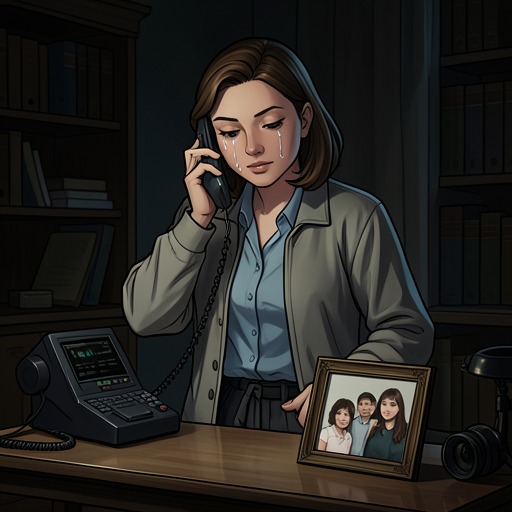
The CageLinda Briggs is the mother of Theresa and Bernadette Briggs, known as Terri and Berri, whose disappearance and deaths turn an ordinary school morning into a prolonged search and, finally, a loss she must face directly. Her role is both intimate and public: she is the parent who first discovers that the twins are gone, the person who appeals for their return, and a grieving mother whose criticism of class-based differences in media attention becomes part of the story’s account of whose absence is noticed.
Identity and Introduction
On the morning the twins disappear, Linda is at home preparing breakfast and calling upstairs for Terri and Berri to get out of bed. Her actions establish a familiar domestic routine: she puts toast on plates for them and goes to their room when they do not come down. She expects to prod them into getting ready for school, not to find that anything has changed. The bedroom is untidy but otherwise ordinary; the decisive discovery is that both beds are empty and both daughters are missing.
The abruptness of that discovery gives Linda’s first appearance its force. Before the absence becomes a police matter or a news story, it is a fact she encounters in the private space of her home. The girls’ failure to come downstairs changes the meaning of the morning’s small tasks: the breakfast is ready, but there is no one to eat it. The narration moves from the routine of getting two teenagers to school to the shock of finding them gone, making Linda the first person through whom the disappearance is experienced.
The Search and Public Appeal
When Gary Baxter and Jane Bowman speak with her, Linda explains that she called the twins to get up and went to their room when they did not appear. She does not know what might have led them to leave, and the uncertainty is visible in her response: as she describes what happened, her hand shakes when she moves her cigarette. Her account gives the investigation its starting point, while its gaps reflect how little she can tell the officers about the girls’ departure.
Linda also cannot answer questions about what the twins may have discussed with other young people. Asked whether they had talked about boys or online contacts, she says she does not know; a schoolmate recalls that conversation was not allowed during detention, where the girls had to write an essay. The exchange underlines the distance between a parent’s need to reconstruct events and the limited information available to her. Linda is central to the search, but she is not presented as possessing a hidden explanation for the disappearance.
Later, at a police-station meeting with the press, Linda appeals directly to the twins. She asks them to come home and assures them that she is worried rather than angry, and that whatever caused them to go away can be dealt with. Her voice fails and she begins to sob. Gary and Jane respond by taking her somewhere more private. The appeal makes her hope legible to the public, but its emotional cost is also apparent: she has to address her daughters through a message to strangers because she cannot reach them herself.
Class, Visibility, and Community Action
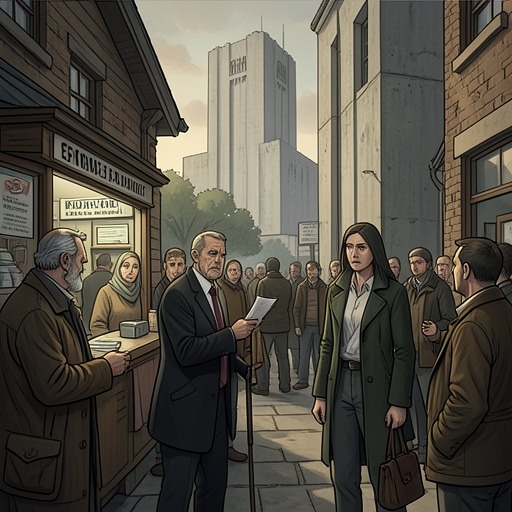
When Gary and Jane visit again, Linda notes that the news has also reported the discovery of Felicity Wanless and asks about Jill Richards, who has been taken. Gary cannot tell her what will happen, and Linda turns from the uncertainty of the investigation to a broader complaint: she believes the twins have received less attention because the family is poor and working class. In her view, pictures of a more affluent missing person attract more press interest, while people like her and her daughters are treated as unimportant. This is Linda’s stated understanding of the coverage, not a conclusion the investigation resolves; the scene gives her a pointed way to describe the perceived inequality surrounding the search.
That criticism does not make her passive. A woman brings a box of T-shirts printed with the twins’ photograph and a missing-person appeal, and Linda’s friend Iris is involved in the family’s efforts to circulate information. When Wendy Sawyer later tells Linda that police have found the smartphone the girls were using and are waiting to question someone, Linda is holding Iris’s hand. Both women are wearing the T-shirts. They have spent time delivering them to neighbors and sharing what they know, turning the twins’ image into a practical means of keeping the search visible. Linda’s public advocacy is therefore not limited to the press appearance: it continues through local outreach with Iris and the family liaison officer’s updates.
Confirmation and Loss
When Gary and Jane arrive at the Briggs house, Wendy opens the door and sees from their expressions that something is wrong. Gary tells her that the girls have been found. Linda’s first concern is whether they are alive. Gary explains that the police did not believe a man’s denial and had him followed to a lock-up unit he had not previously disclosed; the twins were there. Linda asks whether they were found, and Gary confirms that they were. The news does not bring the reunion she has been waiting for. He tells her that the police were too late and that both girls are dead.
On Monday, 5 March, Linda travels with Iris and Wendy to Sunderland Royal Hospital and is taken to the mortuary. Two covered bodies lie in the room beyond the viewing area. Felix Carver turns back the sheets so Linda can see the faces, and she identifies the twins as Theresa and Bernadette. She wants to see them more fully and give them a final embrace, but Wendy explains that this must wait until the forensic post-mortem is complete; the viewing is for identification. Linda’s confirmation is quiet, followed by her and Iris holding one another and sobbing.
Narrative Role and Ending
Linda’s trajectory runs from a parent carrying out an everyday morning routine to the witness who confirms the identities of her dead daughters. Between those points, the novel gives her distinct forms of action: she reports the disappearance, answers investigators as best she can, makes a direct public appeal, questions the social distribution of attention, and helps circulate the girls’ pictures in the neighborhood. These actions do not give her control over the outcome, but they keep her present in the search rather than reducing her to a name attached to the missing-person case.
Her relationship with Iris becomes especially visible as the search proceeds: Iris holds her hand when the phone is found, joins her in wearing the appeal T-shirts, and accompanies her to the hospital. Wendy, as family liaison officer, also remains beside her through the transition from updates to identification. The final scene does not offer Linda a resolution in the usual sense. She has certainty about what happened to Terri and Berri, but that certainty confirms the loss rather than ending it. Her last appearance is defined by recognition, the interrupted wish to embrace her daughters, and the support of Iris and Wendy as she confronts their deaths.