Louise Usher
The CageLouise Usher’s story is revealed in two fragments: the discovery of her mutilated body and her final effort to prepare Felicity Wanless for the same captivity. Though Louise does not survive, the warning she passes on becomes a fragile form of resistance to the killer’s cycle of replacing one captive with another.
Identity and Identification
When the police examine a slumped body, Eve Strong initially cannot identify the woman with certainty. The body’s apparent height and build suggest Louise, who has been missing for two weeks, and a star-pattern tattoo on one foot offers a possible clue, though Eve notes that the design is common in the North East. A covering around the head further delays recognition and makes the discovery unlike the earlier cases.
Felix Carver carefully removes the covering and a bag from the woman’s head. Eve confirms that the dead woman is Louise. Her skull is broken and her flesh ripped; her hair has been cut unevenly and cropped close to her head. Two weeks earlier, Louise had waist-length blonde hair. The contrast makes the violence visible not only in the injuries but in the deliberate alteration of a distinctive part of her appearance.
Eve keeps her eyes on the body as it is uncovered, treating her attention as a duty to the dead woman: someone must remain present as Louise’s story begins to emerge. That identification links the corpse to the earlier disappearance and to the investigation’s growing pattern of women vanishing after ordinary journeys. Louise had gone to the gym after work. Her father said she sometimes walked home, a distance of about a mile, sometimes took the bus, and only very occasionally used a taxi.
Captivity and the Warning
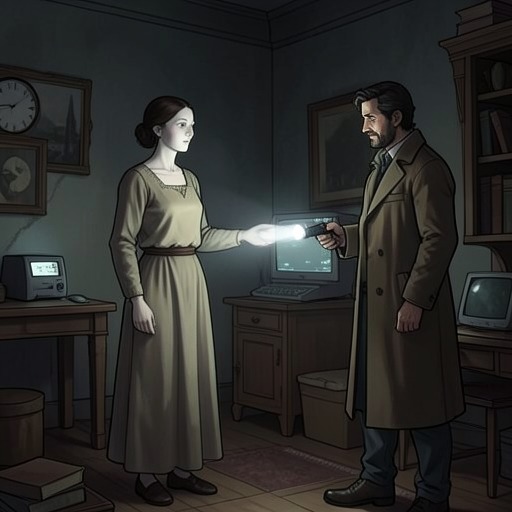
In the loft, Louise is already trapped when Felicity Wanless is brought in. Felicity sees her companion bound inside the cage: long-haired, blonde, tattooed, and visibly frightened, with dark circles around her eyes. After the man finishes what he is doing, he leaves without speaking, switches off the overhead light, descends the ladder, pushes it back into place, and shuts the hatch. The women are left in darkness. Their first exchange is a simple introduction: Felicity gives her name, and the captive identifies herself as Louise.
Louise estimates that she has been there for about two weeks. The length of her captivity matters because she has learned the pattern behind the apparent succession of captives, and she tries to explain it before the man returns. When Louise first arrived, another girl was already in the cage. The man tied Louise up outside it and left them alone briefly; when he came back, he removed the other girl and killed her while Louise watched. Before she died, that girl had told Louise that the same thing had happened to her. A new arrival, Louise understands, means the existing captive is killed.
Felicity is struggling to take in the warning. Fear repeatedly interrupts her concentration, and Louise notices that she is not listening. Rather than merely describe the danger, Louise presses her fingers and insists that Felicity pay attention: he will come for her soon, and one of them must escape and get the police. If Louise is killed first, Felicity must tell the next girl everything and warn her. The plan offers no promise that either captive can break out immediately; its hope lies in passing knowledge forward until someone gets away.
Louise’s warning turns her knowledge of the killer’s replacement cycle into a small act of resistance. She cannot prevent the next murder or ensure her own survival, but she refuses to let the pattern remain secret. Her appeal to Felicity is also an instruction for whoever may be trapped after them: remember, warn the next captive, and keep the possibility of escape alive.
The Investigation's Pattern and Limits
The investigation places Louise’s disappearance beside several other women’s journeys without making their circumstances identical. Becky Allsopp had returned from a business meeting, travelled from Newcastle Central Station to Sunderland by Metro, and disappeared after leaving the Stadium of Light and walking beyond CCTV coverage. Cath Caslaw vanished after leaving a cinema and a drink with her boyfriend following an argument; Felicity Wanless left a pub before her friends and never reached home. Louise’s routine was different again: after work she went to the gym, and her father said she might walk the mile home, take a bus, or, very occasionally, use a taxi. What connected the cases was not a shared destination or a confirmed last ride, but the investigators’ suspicion that each woman had been picked up and forced into a vehicle.
The absence of reports of shouting, screeching tyres, or other disturbance sharpened that suspicion while leaving the precise method uncertain. Later CCTV of Jill Richards supplied a telling comparison: after leaving a supermarket and walking towards Roker Avenue, she reappeared at a bus stop by the Salvation Army, checked the timetable, and flagged down what looked like a black cab. The vehicle had no sign on its roof, despite police advice to hail only white cars bearing a taxi sign. That footage strengthened the investigators’ belief that an apparently ordinary ride could conceal an abduction, but it did not establish that Louise had taken a taxi. Her father’s account leaves that possibility open, not proven.
Private Testimony and Public Recognition
Louise’s warning to Felicity is an intimate, precarious form of testimony: passed in a locked loft, it depends on one captive remembering enough to warn the next. Elsewhere, the investigation shows how public attention is also shaped by the language used to describe missing women. A newspaper article about Terri and Berri Briggs speculates that they may have been taken by the same man, groomed by a gang, or simply run away, and calls them “little tearaways.” Its photograph of Linda Briggs, cigarette in mouth, and its unflattering view of the family home frame the twins through judgments about their family as well as concern for their disappearance. The contrast is not evidence that Louise received the same treatment; it places her individual fate within a story attentive to how the missing are represented.
Linda argues that the press gives more attention to victims who are pretty and have money, and that poor, working-class families are treated as though they matter less. While police struggle to keep up with reports of sightings from across the country, the twins’ neighbors and friends raise money for T-shirts carrying their photograph and a hotline number. Linda offers shirts to Gary Baxter to distribute, and Iris insists that the girls should be made as important as The Phantom and his victims. Against that public campaign, Louise’s instruction to preserve the truth for the next captive carries a different scale of resistance: it cannot command headlines or guarantee rescue, but it keeps a victim’s knowledge from disappearing with her.