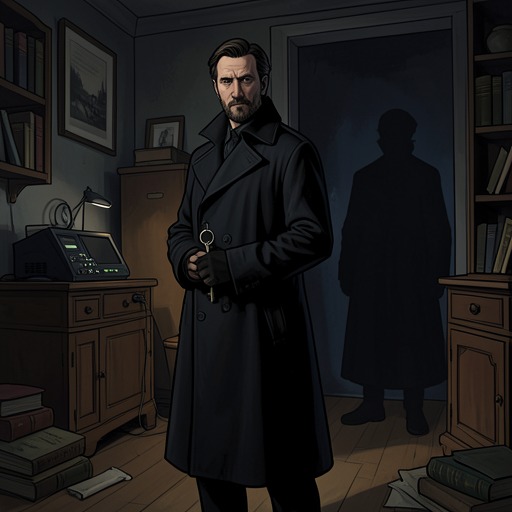
Martin Smith
The CageMartin Smith is a store-based furniture salesperson whose brief appearances place routine work beside the unresolved horror of The Phantom’s crimes. He moves between tea and newspapers in the staffroom, customer service on the shop floor, and speculation about the killer’s methods; his observations contribute to the story’s atmosphere of uncertainty without establishing that he knows more than his colleagues do.
Identity and Workplace
Martin works in furniture sales and is in his mid-thirties. He is seated in the staffroom with a newspaper open in front of him and a fresh cup of tea nearby when Josie Trott and Alice May join him. Ken Carlton, the older delivery driver, sits beside him nursing the remains of a drink. The contrast between the two men is physical as well as occupational: shifting furniture has made Ken markedly more imposing than the store-based Martin, despite Ken being in his late forties and Martin in his mid-thirties.
The staffroom’s ordinary details frame Martin’s working life: kitchen units, a kettle and microwave, a sink and fridge, and a central table surrounded by eight chairs. He offers the arriving colleagues tea, a small gesture of workplace sociability that sits uneasily beside the subject they discuss. The shop and staffroom remain places of routine even as the disappearances make the killer an increasingly present topic among the staff.
Thinking About The Phantom
After Josie leaves, Martin wonders what The Phantom does to his victims during the interval between taking them and dumping them. Alice answers that the killer kills them, then shudders; Martin’s question, however, is specifically about the days or weeks in between. It focuses attention not only on the known deaths but on the hidden period of captivity, which the staff cannot explain.
Later, Martin calls The Phantom clever, organised, and careful while staring into the middle distance. His assessment is an inference about how the killer operates, not a disclosure of inside knowledge. Josie and Alice exchange a look after he speaks, and Martin adds the possibility that the killer lives alone. The exchange shows the colleagues trying to reason from the limited facts available to them: the killer’s apparent planning invites conjecture, but his identity and circumstances remain unknown to them in these scenes.
Sales Work and an Unnamed Customer
Back on the shop floor, Martin has just completed a sale of a bed and a pair of bedside cabinets to a young couple setting up home together. After waving them off, he surveys the other customers: an elderly couple examining chairs designed to help people stand, a middle-aged couple looking at television tables, a man considering suites, and a woman in her late twenties browsing dining furniture. Martin is about to approach the woman when his colleague Ian Watts gets there first.
Ian makes the sale. Martin later takes Ian’s paper copy from the docket and checks the customer’s address out of interest. He sees that she lives not far from him. In the surrounding conversation, Ian has remarked on her differently coloured eyes and identified the condition as heterochromia; the docket gives Martin an ordinary, practical point of information about where the customer lives, but the text does not establish any further connection between them. He returns the paperwork to its proper place when Josie comes into the office and asks how things are going.
Narrative Role
Martin’s scenes juxtapose the mechanics of selling furniture with the staff’s attempts to imagine a killer they cannot see. A completed sale, a customer’s address, and a cup of tea are concrete details of daily life; discussion of captivity, murder, and a possible solitary existence opens onto what remains unknown. Martin participates in that speculation as a colleague and observer, and the evidence presented here gives no confirmation that his conjectures identify the killer or explain the crimes.