Paul Forrester
The CagePaul Forrester is a detective constable on Eve Strong’s team, still regarded as the new member after around six months on the job. His place in the investigation is defined less by personal revelation than by sustained practical work: reviewing footage, following leads, recording details, and acting under pressure. As the inquiry moves from patterns in the victims’ journeys to evidence at Ken Carlton’s home, Paul repeatedly helps convert uncertainty into a next step.
Identity and Introduction
Paul is introduced at Eve Strong’s desk after visiting the family of Louise Usher. He recounts how difficult it was to tell them that Louise had died: her twelve-year-old sister curled up and covered her ears, while her parents broke down. They had feared the news, he says, but hearing it confirmed was different. His account establishes the human cost of investigative work without presenting him as hardened by it; he recognizes the family’s distress and names the notification as one of the worst parts of the job.
The narrative also marks Paul as relatively junior within the team. He has been working with them for about six months but is still thought of as the new guy. That position shapes his early appearances: he contributes as a diligent investigator, while Eve Strong directs the work and colleagues share information across the case. The evidence gives no detailed personal background beyond his police role and tenure.
Building the Investigation
The case initially links women whose journeys home left different opportunities for someone to approach them. Becky Allsopp had travelled from Newcastle Central Station toward Sunderland and disappeared from view after leaving the Metro at Stadium of Light, beyond the CCTV cameras. Louise Usher sometimes walked home from the gym, sometimes took the bus, and only occasionally used a taxi. The team suspects the women were taken into a vehicle, but has no reports of a public struggle. In response to the possibility that an offender could have posed as a taxi driver, Eve asks Paul to review CCTV for cars displaying a sign on top.
Paul’s work on footage becomes a continuing part of his role. Later, after spending hours reviewing recordings, he reports to Eve that he has square eyes. The remark conveys the repetitive labor behind the investigation: finding a useful image means examining large quantities of material, rather than waiting for a clue to announce itself. The team’s attention to vehicles also has practical stakes. A person who believed a car was a taxi might have entered it voluntarily, so the absence of reports of shouting or screeching tyres does not rule out an abduction.
Paul also passes information between investigators. When Jane Bowman is speaking by phone with Maddie, Gary Baxter receives a call from Paul reporting that the twins have been spotted: they took the Metro to Newcastle. The call supplies a location and direction for the inquiry, although the account does not establish that Paul himself first identified them on the footage. His contribution is to ensure the new information reaches Gary while the search is active.
Tracing Jill Richards and Keith Warner
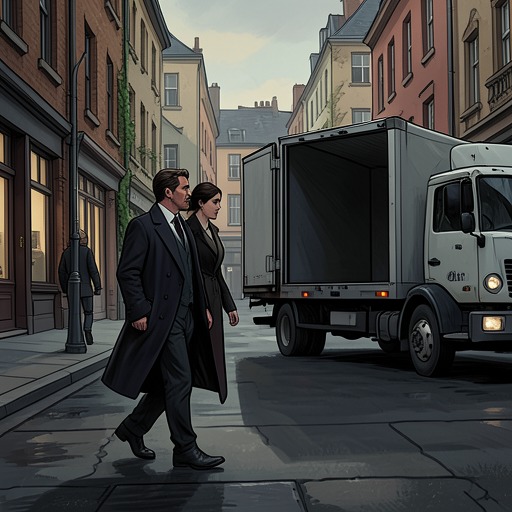
In a later CCTV review, Paul reconstructs part of Jill Richards’s route. He sees her leaving a supermarket, walking past McDonald’s toward Roker Avenue, disappearing from view briefly, then appearing at a bus stop outside the Salvation Army. A car showroom across the road has also recorded her. The footage shows Jill checking the timetable before flagging down a car that looks like a black cab. Paul notes a crucial distinction: it has the shape of a taxi, but no sign on its roof. This conflicts with the police warning, which had advised people to hail only white cars displaying a taxi sign. For Eve, the recording supports the team’s suspicion that a false or unmarked cab may be involved; for the investigation, it offers a possible route toward identifying the vehicle’s owner.
Paul’s familiarity with Warner’s Locksmiths gives him another point of reference when the team considers a tip about Keith Warner. He has been inside the shop and describes it as a small, appealing business. Eve and Paul go there together to speak with Warner. During their visit, Paul makes a note of the name of Warner’s associate, Peter Belton, as Eve arranges to speak with Warner privately. The exchange shows Paul attending to details that may matter later, even while Eve manages the interview.
The inquiry also connects Warner’s trade to the reported entries into Zoe Hardy’s home. Jess Thomas suggests that a locksmith might be able to open locks easily; the possibility makes Warner’s occupation relevant, but is not by itself proof of wrongdoing. After Bill Nicol confirms that Warner changed the front and back door locks and fitted locks to downstairs windows at another property, Eve tells Paul to obtain Warner’s fingerprints quickly. Paul is with Warner when that request comes through. The sequence illustrates how the team tests a lead against specific, verifiable details rather than treating suspicion as a conclusion.
From False Lead to Physical Evidence
When Eve and Bill return from searching Martin Smith’s house, they learn of security footage showing a van and its driver arriving at Zoe Hardy’s home. Paul has prepared the recording for the team to view. As it plays, the image establishes that the driver is not Martin Smith, undercutting the apparent lead at a point when the investigation is short of time. Paul’s contribution is both technical and procedural: he has the footage ready, allowing the team to revise its understanding promptly rather than continue on an unsupported assumption.
The driver’s appearance is not clear enough for immediate identification. Paul reports that Maddie is already working to produce a better image and that she understands the urgency. When she brings the resulting print and emails a digital copy, Eve decides to contact Josie Trott again to ask whether the person might be one of her colleagues. The sequence links Paul’s handling of the recording to a new line of inquiry: footage becomes an image, and that image becomes something a witness may be able to recognize.
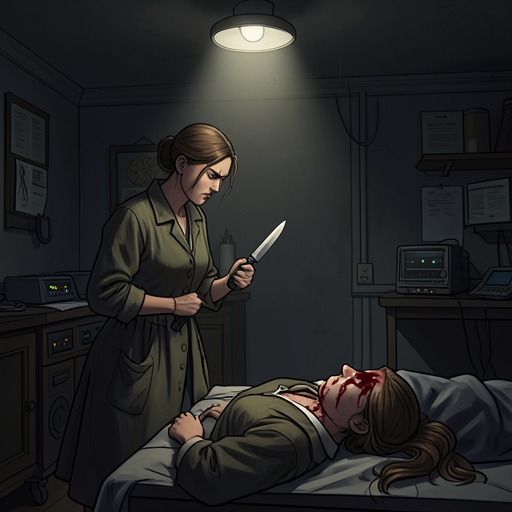
During the search of Ken Carlton’s home, Paul enters the spare bedroom and finds adult nappies beside a box containing two of the ugly tunics worn by the women the police had found. He calls Eve in and holds up one of the garments in gloved hands. Eve identifies it as proof that they have the right place and turns the search toward finding the women. The tunics are concrete evidence connecting the home to the victims’ captivity; Paul’s discovery helps shift the operation from locating a suspect’s property to locating people who may still be in danger.
Rescue and Narrative Role
At the house, Paul and Bill run toward the room after hearing the commotion. They arrive to find Ken Carlton behind Eve Strong, holding her in place and threatening her with a knife. Bill raises his hands, and Paul copies him. Neither advances, keeping the immediate confrontation from escalating while Carlton has control of the situation. Paul’s action is measured and responsive to the danger in front of him; the scene does not give him a separate speech or attempt to take command from Eve or Bill.
After Jill Richards manages to injure Carlton with an object from the worktop, Paul handcuffs him. He then puts an arm around Jill to support her and tells her she has been brave. Jill explains that she had been waiting for a chance to hurt Carlton, despite the pain in her injured wrist. Paul’s response recognizes her action, while his practical support helps her after the long period in which she had been held captive. The rescue makes his work consequential in a direct way: the investigation that began with footage and uncertain routes ends with Carlton restrained and Jill supported.
Paul’s narrative function is cumulative. Reviewing CCTV, relaying the twins’ location, noting an associate’s name, pursuing fingerprints, preparing footage, and finding the tunics are distinct contributions rather than a single dramatic intervention. They show the investigation advancing through shared attention to small pieces of evidence. Against the case’s false leads and missing information, Paul’s steady work helps the team correct its course and reach the people it is trying to protect.