Power and control
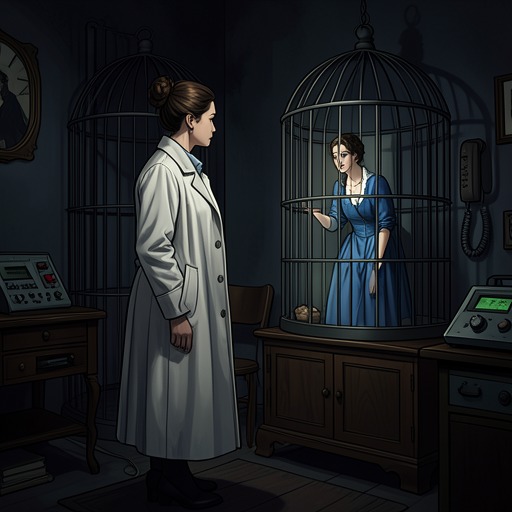
The CagePower and control in the novel are not merely motives for violence; they are a method sustained through confinement, routines, threats, and the attempted reduction of women to objects. Gary Baxter identifies the central issue as making people do what they do not want, rather than the victims’ appearance. The contrast between the captor’s practical control of their bodies and his language about power shows how coercion operates both materially and ideologically.
Control as a daily system
The loft makes domination part of ordinary procedure. When Felicity Wanless is taken from the cage, the man releases the ropes fastening her wrists and ankles, but her movement remains managed: she descends the ladder while he controls the rope and follows close behind. At the bathroom, he threads the rope under the door through a notch, ties it to the outside handle, and locks her in. Even this brief change of room is not privacy or freedom; it is a bounded interval within his routine.
The bathroom’s details give that interval its limits. Felicity estimates she has less than ten minutes. There is a lavatory, a small washbasin, soap, a towel, and a radiator, but no mirror, bath, or shower. The window above the radiator is nailed shut and painted over. After using the toilet and washing her hands and face, she sits on the floor against the radiator and waits for the captor to return. Her estimate that time in the loft stretches while bathroom time flies shows how confinement governs not only where she can go but how she experiences time. An adult nappy is another part of the bodily conditions imposed on her.
This routine makes control cumulative rather than dependent on a single assault. Ropes, locks, the monitored ladder, and the restricted bathroom visit narrow the choices available to Felicity and keep even basic needs within the captor’s schedule. The arrangement turns movement into something granted in measured portions, while the shut window and locked door deny an independent route out.
Victims’ strategies and constrained agency
The women respond to this system by trying to preserve the agency it is designed to strip away. Felicity advises another captive to stay alive, hold on to hope, and remember who she is. She explains that the captor may call a victim a slave or a doll, and urges her not to let those names change her sense of self. Her advice distinguishes the body subjected to violence from the personhood the captor cannot simply define away. It is practical counsel, too: during an assault she advises breathing and avoiding reactions she believes may provoke him to beat the victim.
Jill Richards uses a different survival tactic. She hides her hatred, remains compliant and polite, and tries to connect with her captor because she hopes he might let her live. Her effort to make him see her as a person occurs within a situation in which he treats her like a thing. That contradiction matters: her apparent accommodation is a deliberate attempt to influence the conditions of her survival, not evidence that the power relationship is mutual.
Felicity also tries to turn a bathroom interval into an opening. Before the captor returns, she removes her nappy, washes, and stretches; remembering that she attended judo classes when younger, she plans an attack. When he says it is time to go to the bedroom, she kicks at his head, misses, but hits his shoulder, sending him into the opposite wall. She grabs the dropped rope and runs downstairs toward the kitchen, which she sees as a route to freedom. The back door is locked, and she cannot find its key; she raises a pan intending to break the window, but hears him coming. The attempt shows both her resourcefulness and the way the controlled house frustrates escape even after she creates a moment of advantage.
The captor’s logic of domination
In the investigation into the Briggs twins’ disappearance, Maddie remarks that they seem ordinary-looking for the attention and trouble involved. Gary rejects appearance as the explanation. He says the issue is power: the ability to make people do what they do not want and what is not good for them. He describes the twins as young and unsophisticated, overwhelmed by attention, and suggests the man gained access to their lives and thoughts. The exchange redirects attention from whether the victims looked exceptional to how a perpetrator can exploit attention and influence.
The captor’s own thinking exposes the difference between the resistance he wants and the resistance he will tolerate. He says he likes the women to struggle but not to fight, and wants them fearful rather than feisty. Their struggle can serve his sense of possession so long as it does not become effective opposition. After earlier captives have tried to fight back, he treats a new woman’s appearance at Adler’s Furnishings as a gift and resolves not to wait before taking her. He imagines Dan Waters never knowing what he himself will take, and frames boldness and forcing people to do what they do not want as rewarding. This is not a defence of consent but a fantasy in which his ability to overrule another person is itself the prize.
Ideology, resistance, and significance
When Ken Carlton is confronted, he tries to collapse the distinction between his violence and other people’s responses to it. He accuses those around him of sharing his desires, claiming that readers and investigators will want details and that Bill Nicol must have imagined using a woman kept in a cage. He then turns to a gendered argument: he objects to men being subordinate to women and calls that arrangement contrary to the natural order. His claims expose the ideology he uses to make domination seem ordinary, while their extremity does not establish that others share it.
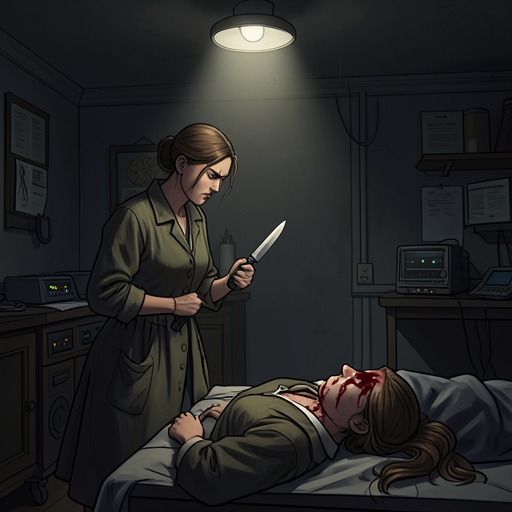
Bill refuses the invitation to identify with Ken’s violence. He says Eve Strong is the best boss he has had and that he respects her. When Ken tries again to provoke him with a degrading sexual insult about Eve, Bill starts toward the bed, but Eve puts a hand on his arm and warns him not to give Ken what he wants. Bill stops. The moment offers a counterpoint to the captor’s model of power: Ken seeks control by provoking a reaction, while Eve and Bill recognize the tactic and deny him that response.
Across these scenes, control appears in locks and ropes, in the management of basic needs, in language that reduces women to dolls, and in a wider claim that men are entitled to command women. The novel places those mechanisms beside the victims’ efforts to plan, endure, resist, and preserve an inner sense of self. Its account of power therefore includes not only what the captor can physically compel, but also the limits of his effort to dictate how his victims understand themselves or how others respond to his violence.