Sunderland Royal Hospital
The CageSunderland Royal Hospital is where the investigation’s discoveries become physical and personal: Louise Usher is identified there, the Briggs twins’ bodies are brought to its mortuary, and Jill Richards and Zoe Hardy are taken there after their rescue. Its recurring role connects forensic work with the care of survivors and the painful processes facing bereaved families.
Forensic examination and identification
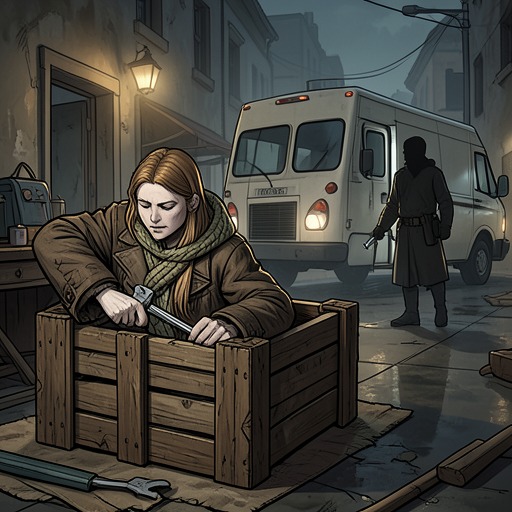
That afternoon, Eve Strong meets pathologist Felix Carver at Sunderland Royal Hospital to examine the woman recovered from the dump site. Carver has already made his initial observations; his measured manner and alertness to anomalies establish the examination as a careful effort to determine what the body can reveal. Before uncovering the face, he steadies the procedure by working through the layers bound around the head: an old jacquard shawl, then a plastic bag bearing the name Joplings.
Eve keeps her eyes on the body even though she wants to look away. Her attention is presented as an act of witness: someone must remain present as the dead woman’s story begins to emerge. Carver folds the shawl aside, checks that the bag can be removed without damaging the body, and lifts it away. Eve confirms that the woman is Louise Usher. The hospital scene therefore turns an investigative expectation into identification, while also making the condition of the body part of the evidence: Louise’s skull is broken, her flesh is ripped, and her hair has been cropped unevenly close to her head. Carver’s question about whether her hair was normally like that marks the cut as a detail requiring investigation, rather than an incidental feature.
The scene’s handling of the coverings matters as much as the reveal. The shawl and dated plastic bag are not simply discarded obstacles: Carver removes them carefully, preserving the body from further damage. At the same time, Eve’s decision to keep looking resists allowing the examination to become merely technical. Sunderland Royal Hospital is where the investigation identifies Louise, but the scene insists that identification involves both the pathologist’s method and a living person’s attention to the dead.
The Briggs twins and the mortuary
The hospital also becomes the destination for the Briggs twins’ bodies after they are found in a lock-up. Before arranging their transportation to the mortuary at Sunderland Royal Hospital, Felix Carver arrives to see them in situ. The distinction between seeing the bodies at the discovery site and moving them to the hospital marks two stages of the response: the scene must first be examined where the bodies were found, then the bodies can be transported for further procedures.
Gary Baxter asks how long it will take before Linda Briggs can identify her daughters or Carver can perform the post-mortem. Carver estimates about forty-eight hours, explaining that their small size will help. The estimate gives the hospital’s forensic work a concrete timetable, but Gary’s next request shifts attention from procedure to the family waiting for its results. Linda is a widow, he says, and her daughters were her life; he asks Carver to make them look as normal as he can. Carver agrees to do his best. The exchange places the practical demands of examination beside a specific concern for how the bodies will appear to their mother.
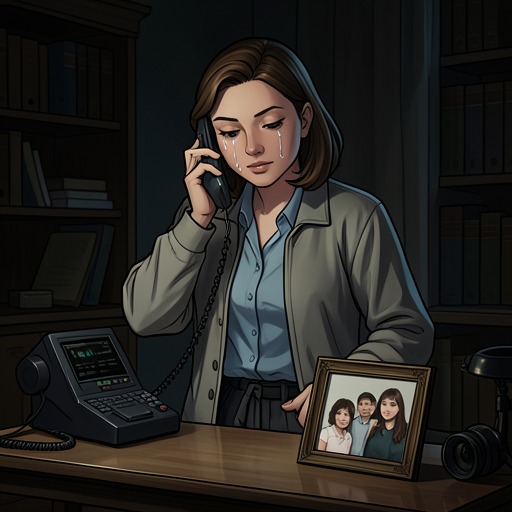
On Monday 5 March, Linda arrives at Sunderland Royal Hospital with her friend Iris and family liaison officer Wendy Sawyer. They are directed to the mortuary and taken into a viewing room with four chairs facing a curtained window. Wendy asks Linda if she is ready. The scene establishes the arrangements for viewing without supplying the outcome in this moment: the hospital provides a private setting for Linda to face the loss, with Iris and Wendy accompanying her. Its mortuary is thus not only part of the investigative process but also the place where the family’s encounter with the deaths is prepared.
Hospital care after the rescue
After Ken Carlton is apprehended, Jill, Zoe, and Ken are taken to Sunderland Royal Hospital. The immediate aftermath is divided between those receiving care and the officers securing the house and collecting evidence for the case. Eve Strong declines to go, insisting that she will be fine, while Sheila Ormiston and her team preserve evidence and uniformed officers search the property. The contrast keeps the hospital’s role specific: the rescued women and their captor are taken there, as the investigation continues at the house.
Several hours later, Bill Nicol and Eve drive to the hospital to see how Jill and Zoe are holding up. The women share a room, and a police officer guards its door against reporters and other unwanted visitors. The guarded entrance makes the hospital room a protected space even after the immediate rescue: privacy and security remain necessary while the women are recovering and the case is attracting attention.
Jill is sitting up in bed and looks much better after a shower, a change of clothes, and a good meal. A drip is still in her arm, and bandages cover her wrists. These details show improvement without suggesting that the effects of captivity have vanished. The hospital provides immediate care and a chance to wash, eat, and change, while the drip and bandages register that her body still needs attention. Zoe is present in the same room, but the account gives no comparable description of her condition; the shared space establishes their proximity without making their recovery identical.
A recurring point between investigation and aftermath
Across these episodes, Sunderland Royal Hospital receives people and evidence from distinct stages of the case. Louise’s examination identifies a murder victim and records injuries and possible clues. The Briggs twins’ transfer to the mortuary leads toward post-mortem work and their mother’s viewing. After the rescue, the hospital houses Jill and Zoe under a police guard while officers build the case against Ken Carlton. The location therefore links forensic procedure, physical recovery, and family grief without making them interchangeable.
The hospital scenes also place different forms of waiting alongside one another. Carver estimates that the twins’ post-mortem will take about forty-eight hours; Linda is accompanied to the viewing room; Jill and Zoe remain under guard as they recover. In Louise’s examination, Eve waits for the face beneath the coverings and stays to witness its revelation. In each instance, what happens at Sunderland Royal Hospital depends on care taken with a body, the people connected to it, or both. Its significance lies in this repeated passage from discovery toward recognition and response.