The killer’s use of “dolls” for his victims
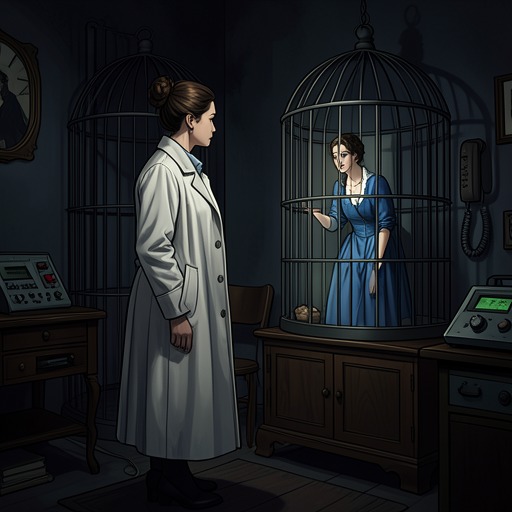
The CageThe killer’s use of “dolls” for his victims is more than a cruel nickname: it expresses the logic of his captivity regime, in which women are treated as controlled bodies, collectible possessions, and ultimately replaceable occupants of the loft cage. Against that imposed identity, Felicity Wanless and Louise Usher insist on the victims’ continuing sense of self, while the killer’s repeated language makes replacement sound like another act of ownership.
The Name and Its Meaning
Louise Usher prepares Felicity Wanless for the captor’s language as well as his violence. She warns that he will treat Felicity as though she is not human and may call her either a slave or a doll. Her response is not to deny the physical danger, but to distinguish the captor’s treatment of Felicity’s body from the person he cannot reach: Felicity must remember who she is and resist letting him change her. The contrast gives “doll” its central tension. It is the captor’s label for a victim he seeks to reduce to an object, not a truth about the woman bearing it.
The conditions of Felicity’s captivity make that distinction concrete. The captor keeps her in a cage, binds her wrists and ankles, and controls even her brief movement to the bathroom by trailing a rope under the door and tying it outside. Her time away from the loft is limited; the window is nailed shut and painted over, and the room contains only a lavatory and small washbasin. These details are not the definition of the word “doll,” but they show the material control that gives the label its force: the captor regulates where Felicity can go, how long she can be there, and how her body is secured.
Possession and Mementos
The captor explains the possessive meaning of the term when Felicity asks why he cut off another woman’s finger. He says he took her hair as well, then describes these objects as tokens that remind him of the dolls he has had. The phrasing joins the women to a collection: a severed finger and a lock of hair stand in for the person he has harmed, transformed into keepsakes under his control. Calling the victims “dolls” therefore accompanies a practice of taking and retaining parts of them, rather than merely insulting them in the moment.
The scene also shows the imbalance between his language and Felicity’s position. After tying her ankles to the cage and securing its padlock, he stares at her; she drops her eyes under his cold gaze. He then comments on her tattoo before switching off the light and leaving her alone. His attention to the tattoo sits alongside the trophies he describes: the captive’s body is something he inspects, controls, and remembers through selected details. Louise’s counsel to protect a sense of self answers precisely this reduction of a person to the captor’s possessions and observations.
Replacement as a Threat and a Practice
The word becomes a tool of intimidation when Felicity’s attempted escape fails. She has planned an attack and uses a kick to knock the captor against a wall, then runs downstairs toward the kitchen and locked back door. She cannot find a key or break through the window before he catches up with her. Back in the cage, hungry and bound again, she hears him say that she may be more trouble than she is worth and that it may be time to replace her with a new doll. Felicity understands what the threat means. “Doll” here is not only a dehumanizing name; it makes her continued survival seem conditional on the captor’s assessment of her usefulness and obedience.
The threat is later carried out. After a commotion downstairs, a young woman is brought into the loft, terrified and dressed in the same ugly beige tunic and adult nappy that mark Felicity’s captivity. The captor tells Felicity that she is done and has been replaced, then warns the newcomer that she had better be more obedient. Felicity answers the new captive with a watery smile and a bleak greeting. The moment places the captor’s announced rule beside its human consequence: the newcomer is assigned the same degrading role, while Felicity is cast out of it.
The language recurs when the captor brings Felicity out of the cage with a cut-throat razor and a Tupperware box. He tells her that she has been replaced and that her life ended when he acquired Jill Richards. He then turns to Jill and orders her to watch and learn while he threatens to strangle Felicity. The shift from the earlier warning to this immediate threat makes replacement a mechanism of terror directed at both women: Felicity is marked as disposable, and Jill is made to witness what the captor claims will happen to her predecessor.
Resistance and Narrative Significance
The captor’s use of “dolls” tries to make his system sound settled: one captive can be exchanged for another, and each woman can be defined by her place in the cage. But the scenes also disclose the limits of that imposed identity. Louise gives Felicity practical advice for surviving and preserving her sense of self; Felicity plans an escape, acts on it, and, when the next captive arrives, offers her a greeting rather than repeating the captor’s language. These acts do not erase the coercion or guarantee freedom, but they preserve forms of judgment and recognition that the word “doll” is designed to deny.
The motif therefore connects the captor’s everyday control to his collection of trophies and his cycle of replacement. It turns a recurring insult into a compact description of how he regards his victims: as bodies to restrain, tokens to keep, and occupants who can be discarded. The women’s efforts to remain themselves, and to acknowledge one another within that system, expose the violence concealed by the small, familiar word.