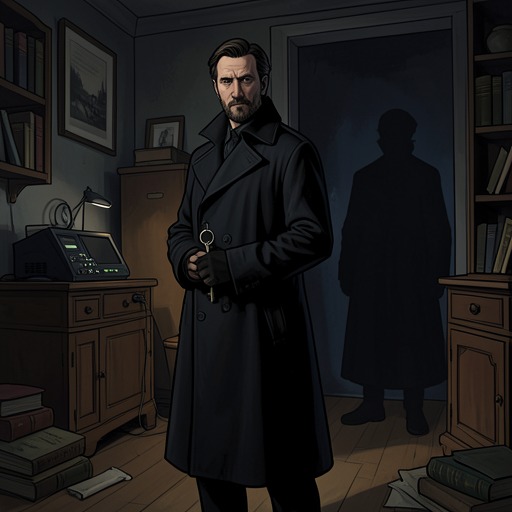
Warner’s Locksmiths
The CageWarner’s Locksmiths is the setting for a brief but consequential investigative encounter: a routine-looking visit to a shop brings Keith Warner into the police inquiry because he had changed the locks at Zoe Hardy’s home. The location links an ordinary piece of household work to the investigation, and gives Eve Strong and Paul Forrester a direct route to question the locksmith and request his fingerprints.
Setting and access
Eve Strong and Paul Forrester park in a nearby car park and walk the short distance to Warner’s Locksmiths. The shop is empty when they enter. The doorbell jingles, bringing a man through from the back-shop area, where the division between the public-facing shop and its working space shapes the first moments of the encounter. The man offers help; Eve shows her warrant card, identifies herself as DI Strong, identifies Paul as DC Forrester, and asks for Keith Warner.
The shop’s quiet at the moment of arrival gives way to the practical activity of summoning its named locksmith. The first man does not identify himself as Keith; instead, he calls into the back shop for Mr Warner. As Keith enters, the clerk whispers that the visitors are police. This sequence keeps the encounter within the ordinary arrangements of a workplace—counter, back room, staff member—while making clear that the police have brought the investigation into Warner’s working environment.
The police visit
Before entering, Eve and Paul have already considered how to handle the contact: whether to question Warner at the shop or take him in. Eve intends to speak with him there, while leaving herself room to decide how the conversation develops. When Warner arrives, she does not announce an arrest. After the clerk identifies himself as Peter Belton, Paul makes a note of the name, and Eve says Belton can hold the fort while she and Warner leave to talk.
Warner asks whether he is being arrested and insists that he has done nothing. Eve answers that he is not under arrest and is helping voluntarily with the police’s enquiries. The distinction is important to the scene: the shop is the point of contact, but the questioning is presented as voluntary rather than as an arrest at his workplace. The exchange also shows the investigators managing both sides of the visit—obtaining access to Warner while allowing the shop to remain staffed.
The connection to Zoe Hardy’s home
The reason for approaching Warner comes from the examination of Zoe Hardy’s house. Sheila Ormiston has visited it and reported fingerprints and a cast of a shoeprint. A further detail sharpens the inquiry: Zoe had the locks changed when she first moved in. Bill Nicol establishes that Warner carried out the work, changing the locks on both the front and back doors and fitting locks to the downstairs windows.
That history makes Warner’s trade relevant to the investigation without, by itself, proving that he committed an offence. The locks connect him to the house through a specific service, and the police already have physical evidence from the property to pursue. Once Bill identifies Warner as the person who did the work, Eve calls Paul, who is with Warner, and urgently asks for Warner’s fingerprints. The shop visit therefore sits between a clue gathered at the house and a requested investigative step; it does not establish what the fingerprints will show.
Role in the investigation
Warner’s Locksmiths functions as a bridge between the police inquiry and a concrete, verifiable contact with Zoe’s residence. The connection is not based on an abstract suspicion about Warner’s occupation: it rests on Bill’s identification of the person who changed specified locks at a particular home. That evidence gives Eve and Paul a reason to approach him, while the request for fingerprints shows how quickly a piece of routine work becomes part of the investigation’s evidentiary chain.
The location’s significance lies in this change of context. A locksmith’s shop is first presented as a workplace with a clerk, a back-shop area, and the need for someone to hold the fort. It becomes the place where Warner is identified to the police, asked to cooperate, and accompanied away for enquiries. The visit does not resolve the investigation in itself; its decisive contribution is to bring the person linked to Zoe’s locks within reach of the investigators and to prompt the next request for evidence.