Warning on how to ride a taxi safely
The CageThe Warning on how to ride a taxi safely is a practical distinction between two kinds of vehicle, but in the investigation it becomes more than a travel tip: it is a test of whether a car that looks like a cab can be trusted. The police warn people to hail only white cars displaying a taxi sign on top. Jill Richards is later seen getting into a dark, cab-shaped vehicle without such a sign, exposing the gap between recognizing a familiar shape and checking the identifying details that make a taxi appear legitimate.
The distinction the warning makes
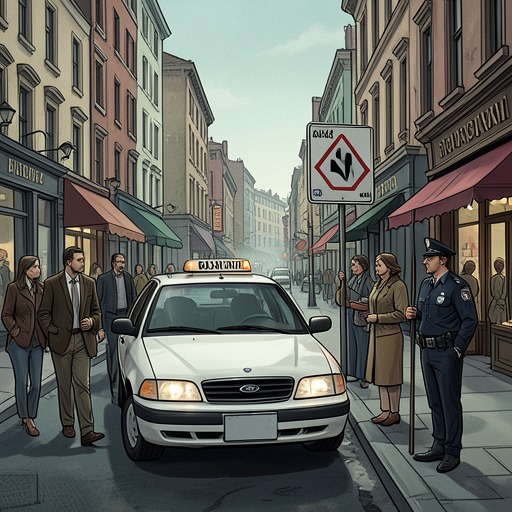
In Sunderland, Jess Thomas explains the difference between a private-hire car and a hackney carriage. A private-hire car carries the name of its firm on top, may be any colour other than white, and has to be booked in advance. A hackney carriage is white, bears a sign saying taxi on top, and can be hailed from the street. The rule therefore depends on more than whether a vehicle resembles a cab: colour, roof signage, and the way the journey is arranged all matter.
The distinction becomes relevant when Eve Strong notes that investigators found no call to a taxi firm in the call records they checked. If the woman under discussion had taken a taxi, Eve reasons, she must have hailed a hackney carriage. Jess supplies the practical explanation, while Bill Nicol identifies the danger in the public’s likely understanding of it: someone who sees what they think is a taxi and puts out a hand may get into the vehicle voluntarily. In that scenario, the driver would not need to seize the passenger to get her inside. The warning is thus aimed at the moment before a journey begins, when a mistaken identification could hand control to the driver.
From police inference to public warning
That possibility changes how the investigation approaches the vehicle evidence. Eve asks Paul Forrester to check the CCTV again, this time looking for any car with a sign on top. The detail is not incidental: roof signage may help distinguish an ordinary taxi from a vehicle merely made to look like one. The requested review turns a general concern about how a passenger might have entered a car into a specific question that surveillance footage can test.
The warning itself sets out a clear threshold: hail a white car only if it has a taxi sign on top. Its force lies in the combination of checks. A white car without the sign does not satisfy the stated rule, and a cab-like appearance alone is not enough. At the same time, the police’s reasoning recognizes why that appearance could be persuasive to someone unaware of the distinction. The guidance is meant to interrupt an apparently ordinary action—raising a hand to a passing car—before it becomes an unsafe decision.
Jill Richards and the warning’s test
Paul’s CCTV review traces Jill from a supermarket, past McDonald’s, and towards Roker Avenue. She disappears from view for a short time, then reappears at the bus stop outside the Salvation Army. A car-sales showroom across the road has also recorded her: she checks the timetable and then flags down a car that looks like a black cab. The footage supplies a visible sequence—checking for a bus, waiting at a stop, and hailing a vehicle—that makes the encounter resemble routine travel rather than an abduction carried out in plain sight.
But the vehicle has no sign on top. When Eve asks about the missing sign, the answer confirms that the car has the right general shape for a cab but lacks the feature specified by the warning. Eve responds with surprise that Jill hailed it after the police had issued advice to hail only white cars with a taxi sign. The evidence does not establish whether Jill had received or understood the warning; it does establish that the vehicle she chose did not meet its stated criteria. The contrast makes the rule’s purpose concrete without resolving why the warning did not prevent this particular boarding.
Investigation and limits
At a team briefing, Eve describes Jill as having been seen getting into a vehicle resembling a black cab but without a sign on top, at the Roker Avenue bus stop outside the Salvation Army. The owner is still unknown, and Paul is pursuing that lead. Gina Cross asks whether the police will issue an appeal; Eve confirms that the press office is preparing one. The public warning and the appeal belong to the same effort to make a suspicious vehicle identifiable, although the briefing does not establish what the appeal later discovers.
The rule’s narrative significance comes from the tension between an ordinary public convention and the details that distinguish a safe choice from a risky one. A car can look enough like a taxi to invite a raised hand, while lacking the white body and roof sign that the police identify as essential checks for a hailed hackney carriage. Jill’s recorded decision makes that vulnerability visible; the footage also gives investigators a specific vehicle description and location to pursue. The warning offers a simple safeguard, but the sequence shows why stating a rule cannot by itself ensure that everyone recognizes or follows it.