Wendy Sawyer
The CageWendy Sawyer is the family liaison officer supporting the Briggs family during the search for Theresa and Bernadette Briggs. Her role is distinct from the detectives’ investigation: she carries information between police and relatives, makes space for the family’s responses, and accompanies Linda Briggs and Iris through the formal identification of the twins. Her scenes trace the change from anxious waiting to confirmation of loss, while showing the emotional cost of doing intimate, necessary work on behalf of the bereaved.
Family liaison and the flow of information
When Gary Baxter and Jane Bowman visit the Briggs home, Wendy opens the door as the family liaison officer. Gary apologizes to Linda for not returning sooner and explains that he has had no new information to give her. Wendy’s presence places her at the point where the investigation meets the family’s prolonged uncertainty: she is there as the detectives arrive, but she is not presented as an investigator or as the source of their findings.
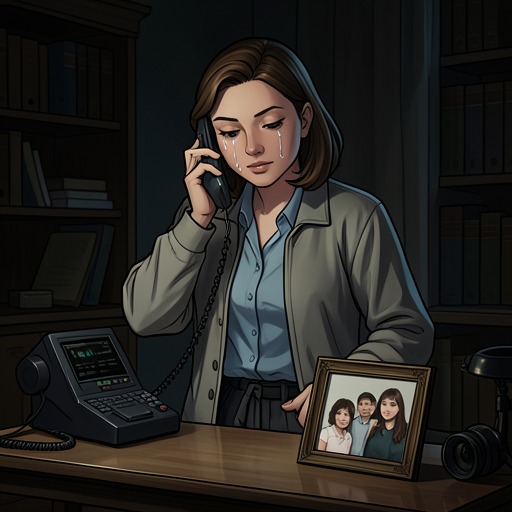
The search has a digital trail. The twins’ messages show that they had been communicating with someone they called Mario; Maddie identifies the number as belonging to Jason Dodds and explains that he had misrepresented himself, pressed them for photographs, and persuaded them to skip school and meet him in Newcastle. Wendy is not shown uncovering these messages. Instead, when she finishes a call with Gary, she returns to the sitting room and tells Linda and Iris that police have found the smartphone the girls were using and are waiting to take someone in for questioning. Her part in this sequence is to convey an important development without claiming that it has resolved the case.
The setting makes clear how the uncertainty has entered everyday life. Linda and Iris hold hands and wear T-shirts bearing the girls’ faces, made to help them update neighbours and distribute information. The detail locates Wendy’s update within a household where searching has become sustained public and communal effort, not simply a matter of waiting for the next police visit. At this point she can pass on news of a phone and questioning, but cannot offer the certainty Linda needs.
Supporting Linda and Iris
Wendy is present again when Gary and Jane return with the news that the girls have been found. She opens the door smiling, then sees their expressions and immediately recognizes that something is wrong. The change in her face registers her attentiveness before anyone explains the outcome. Gary tells her what has happened; Wendy’s first concern is whether Linda is inside. She knows Iris has scarcely left Linda’s side and anticipates how devastating the news will be.
That knowledge shapes the practical care she offers. Gary observes that Iris’s presence will matter to Linda, and Wendy steps aside to admit him and Jane, saying that she will put the kettle on. The gesture is modest, but it belongs to the same sequence of support as the harder conversation: Wendy makes room for the detectives to enter and prepares something ordinary for a family about to receive extraordinary grief. The scene does not make her responsible for delivering the news; rather, it shows her helping the household bear the moment in which the news is given.
When Linda asks what happened, Gary tells her that the twins were found in a chest freezer, wrapped in plastic and frozen. Wendy enters with a tray of mugs, gives Linda tea with extra sugar, and leans in to offer an awkward hug. Linda thanks her, then turns back to Gary to ask when she will be able to see her daughters. Wendy’s actions do not remove the limits imposed by the investigation: Linda must wait several days. They do, however, keep Wendy beside her as the search’s uncertainty becomes the practical and painful wait for identification.
Identification at Sunderland Royal Hospital
On Monday, 5 March, Wendy accompanies Linda and Iris to Sunderland Royal Hospital. A car brings the three women to the hospital, where they are directed to the mortuary and taken to a viewing room. The room contains four chairs facing a curtained window. Wendy asks Linda whether she is ready, then draws the curtains; Felix Carver turns back the sheets covering the two bodies. The sequence gives Wendy a direct, procedural role in the family’s final confirmation, while keeping the focus on Linda’s experience of seeing her daughters.
Linda identifies the twins as Theresa and Bernadette and turns to Iris; the two women cling to each other and sob. Wendy turns away. The narration makes plain that this part of her work is almost unbearable, yet her sense that she is doing something important—something someone has to do—keeps her there. Her professional purpose is not presented as a cure for grief or as emotional detachment. It is the reason she can carry out a task that hurts her, while allowing the family to face the confirmation together.
Afterward, Wendy wonders what will keep Linda going now that her daughters are dead. The question marks the limit of what liaison can accomplish: Wendy can carry information, open the door, bring tea, offer a hug, and accompany Linda to the mortuary, but she cannot repair the loss. Her arc is therefore measured less by a change in status than by the increasing gravity of the duty she performs. The earlier phone update belonged to an investigation still moving toward answers; the final visit confirms the twins’ identities and leaves Wendy confronting the human cost that those answers cannot undo.