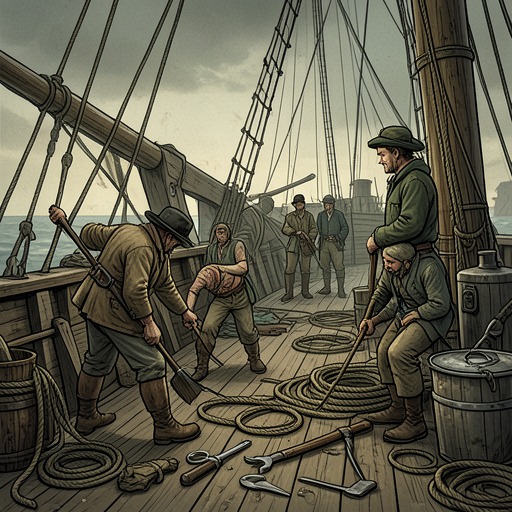
“Caine duty is the kind of duty that counts.”
The Caine Mutiny Court-MartialThe expression “Caine duty is the kind of duty that counts” gives the USS Caine’s ordinary, often unglamorous service its final meaning. Spoken by Willie Keith as the ship is decommissioned, it answers the apparent insignificance of a worn-out vessel with a claim about how victory is actually sustained: not only by spectacular operations, but by the less visible work that carries a fleet through the war.
Meaning of the Expression
The phrase names a kind of service rather than a single achievement. Willie describes a ship that was supposed to be a minesweeper but swept only six mines, performed menial fleet assignments, and spent much of its wartime career on several hundred thousand miles of dull escort duty. Those facts might make the USS Caine seem peripheral beside the forces associated with decisive victories. Willie instead argues that its routine work mattered precisely because it formed part of what had to be done to keep the country existing.
His closing formulation sharpens that argument: “The high-powered stuff just sets the date and place of the victory won by the Caines.” The contrast does not erase major military operations; it places them alongside the accumulated labor of ships like the USS Caine. The famous victory supplies its occasion and location, while lesser-known crews perform necessary work that helps make it possible.
The Ship Behind the Phrase
Willie makes the speech over the decommissioning order, facing the ship’s ragged, thin ranks on the dock. He calls the USS Caine broken-down and obsolete, notes that it has no unit citation and achieved nothing spectacular, and expects that the damaged hulk will probably be broken up. These are not concealed shortcomings: his defense begins by stating them plainly. The force of the expression comes from refusing to treat a lack of distinction as proof that the ship’s service was worthless.
He places the crew’s work in a larger, unheroic account of wartime contribution. They were landlubbers who pitted their lives and brains against the sea and the enemy, doing what they were told to do as part of keeping their country existing. Willie calls the hours aboard the USS Caine hours of glory, while acknowledging that the crew may understand their worth more fully later. The phrase therefore turns the ship’s obscurity into a shared memory whose value can deepen after the work itself is over.
Contrast with Queeg’s Standards
The expression also reverses the emphasis of Captain Queeg’s command. When he assumes authority, Queeg insists that “excellent performance is standard” and says that there are four ways of doing things aboard ship, ending with the way he wants things done. His command language makes excellence a strict standard to be enforced through obedience. Later, he rejects assumptions as dangerous and orders the ship to stand its own radio guard around the clock.
Willie’s final speech does not repeat that measure of worth. At decommissioning, the USS Caine’s record is modest by the standards of spectacular achievement, yet its sustained escorting and menial duties still count. The contrast shifts attention from a commander’s ideal of performance to the accumulated value of the crew’s actual service. The ship’s contribution is not made extraordinary by claiming it excelled at a celebrated task; it matters because it kept doing necessary work through four years of war.
Function in Willie’s Closing Speech
The expression is the speech’s culminating judgment, delivered after Willie reads the decommissioning order aloud and looks over the crew. He acknowledges that they will soon scatter onto trains and buses, then gives them a way to understand what is ending. The USS Caine may be dismantled, but the hours spent aboard it remain part of the crew’s lives and of the country’s wartime effort.
Willie’s final handling of the ship’s colors gives the speech a concrete close: after ordering the flag lowered, he takes the ragged remnant of the commission pennant and asks for the jack to be wrapped and brought to his cabin. The words about Caine duty thus accompany a physical act of keeping something from the ship as it leaves service. Their significance lies in that pairing of public recognition and private remembrance: a supposedly undistinguished duty is declared consequential just as the vessel that embodied it is about to disappear.