Battle of Kwajalein
The Caine Mutiny Court-MartialThe Battle of Kwajalein is Willie Keith’s first sustained encounter with a major Pacific invasion: an immense naval operation whose strategic advantage was established before the first landing, but whose apparent ease makes its violence difficult for him to comprehend. The narrative moves between the orderly scale of the fleet and Willie’s limited perspective aboard USS Caine, where combat initially seems remote, then becomes an absorbing spectacle, and finally reaches him through the voices of men fighting ashore.
Strategic Design and the Fleet’s Arrival
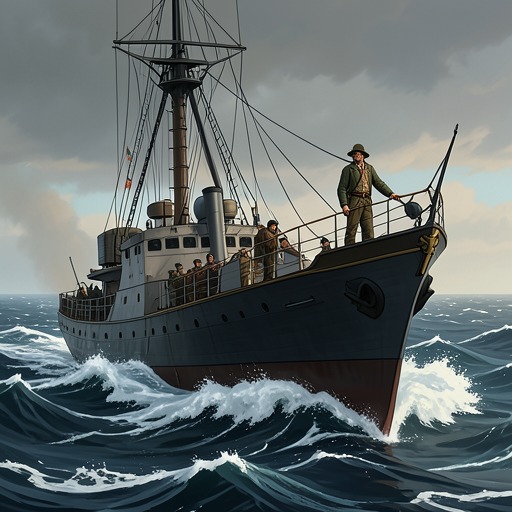
On a warm January day, a vast force of ships left Hawaii, formed a circular formation, and set course for Kwajalein Atoll. The passage across the sea was quiet. Radar helped hundreds of ships preserve their positions within an arrangement that could shift as needed, though many of the officers directing them were not professional seamen. The narrative emphasizes the contrast between the complexity of the formation and the ease with which its officers maintained it.
For Willie Keith, the operation order and the large number of participating ships made the coming battle feel both momentous and reassuring. He was excited by the knowledge that he possessed secret information, and felt protected by the scale of the Navy’s undertaking. He did not understand that Captain Queeg’s withdrawn behavior might be connected to the operation order: when Willie brought decoded messages to the captain, he saw him sleeping, eating, reading, or staring at the cabin ceiling rather than studying plans. Willie instead guessed that Queeg was troubled by private bad news.
The account’s wider perspective supplies what Willie cannot yet see. Japanese aircraft had been depleted in earlier fighting around the Solomon Islands, while the remaining warships were being held back as precious resources. The arriving American force therefore confronted an enemy with few aircraft and limited naval power. The battle was, in the narrator’s analysis, effectively decided by the strategic conditions and the fleet’s arrival, before the landing force had fired its first shot. The Japanese garrison did not surrender, however, and the operation proceeded through sustained bombardment.
From Distant Gunfire to the Landing
Willie’s first impression of combat did not match the scale of the operation. At first, the bombardment reached him as distant sound and flashes. He tried to imagine the experience of a Japanese soldier under fire, but the image seemed unreal to him, more like a story about war than an encounter with it. The distance left him with the sense of watching a small, unimportant exercise rather than witnessing an assault.
As the night gave way to morning, the fleet halted three miles offshore. Attack boats lowered from the transports gathered on the water, preparing to carry the assault forward. The islands were burning and smoking, while battleships, cruisers, and destroyers directed heavy gunfire toward shore. Aircraft also attacked, and explosions from the islands were powerful enough to jar USS Caine. Meanwhile, the transports continued to send out boats in ordered ranks.
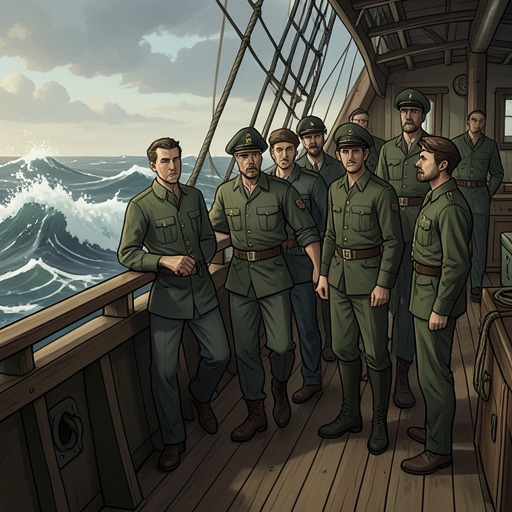
The first phase of USS Caine’s work also included a navigation error. Captain Queeg judged that the ship had passed inside the departure point, ordered a sharp turn, and directed the crew to release a dye marker. The ship reversed course, leaving the landing craft of Jacob Group Four astern and a bright stain on the water. Later, USS Caine passed through the channel between Jacob and Ivan with the larger attack force. American flags were flying on both islands, and the ship anchored in the lagoon. With transports, cargo ships, and destroyers packed around it, USS Caine had no useful line of fire toward the beach. Captain Queeg ordered armed guards along the ship’s sides and dismissed the crew from battle stations; many sailors went below to sleep after their long watch.
The Battle as Spectacle
The narrative describes Kwajalein as an unusual initiation into warfare for a young officer. By the time USS Caine anchored, the danger to the ship had receded, and Willie chose to watch the continuing action from the flying bridge despite his fatigue. The bombardment, the fires on the islands, and the tracer fire across the water held his attention. He smoked, whistled familiar tunes, and watched as though the fighting were a performance. The narrative stresses the gap between the destruction taking place and Willie’s entertained, distanced response.
That response is set against the human consequences of the attack. The account observes that American sailors often regarded the Japanese defenders as a faceless enemy, while the defenders appeared to experience the attacking fleet as an overwhelming mass. This mutual failure to recognize the people on the other side becomes part of the battle’s significance: the operation is described as exceptionally well planned and executed, yet its military success is accompanied by a disturbing emotional distance from those being killed.
At dawn the following day, a general alarm brought Willie, half dressed, to the bridge as another bombardment began. He had devised a practical way to reduce the noise: when cotton had once run short during a gunnery exercise, he had used dampened sheets of toilet paper as earplugs. USS Caine’s three-inch guns did not take part in the barrage. Captain Queeg kept the crew at battle stations until sunrise and then dismissed them, while Willie remained to observe the assault on Roi-Namur.
Roi-Namur and the Limits of Detachment
The assault boats crossed toward Roi-Namur after the island’s vegetation had been burned or withered. Willie watched through binoculars as the boats reached the beaches and tanks and Marines moved inland. He saw Marines fall. The sight excited him but also saddened him, an early sign that the spectacle could not wholly shield him from the people inside it.
Willie then switched on the ship’s special short-wave radio, the JBD 640, and listened to communications from the men ashore. Their terse, angry speech contrasted with the more formal and apologetic language used aboard the ships. He listened for nearly two hours, including as one man’s plea for naval fire against a blockhouse abruptly ended. Willie inferred that the man had died. He recognized that he was treating the exchange as an anecdote to remember and repeat, even while other men were perishing, and felt ashamed of that response. Still, he did not turn off the radio. The episode brings the fighting closer not through a direct view of the shore, but through the interruption of a voice and Willie’s awareness of his own continued listening.
Later, an explosion led Willie, Tom Keefer, and Jorgensen to look toward Namur, where a large cloud rose above the island. Keefer identified the main ammunition dump as the likely source. The officers’ reaction remained tied to the military results of the bombardment, even as the event offered another reminder of the destructive force being directed against the islands.
Aftermath and Narrative Significance
Later that day, USS Caine received orders to leave the attack force and proceed to Funafuti Atoll the next day as an escort for a group of landing ships. Willie regretted being assigned away from the battle. The fleet’s activity had meanwhile diminished: the major barrages were over, and the lagoon’s ships no longer presented the same appearance of imminent action. The reassignment gives his first experience of battle a definite end, not through a personal decision but through routine orders that redirect the ship to another duty.
The Battle of Kwajalein thus combines strategic success with a deliberately uneasy account of what that success looks like from USS Caine. The immense fleet and depleted Japanese air power make the outcome seem almost predetermined; the ship’s restricted position leaves its crew largely watching rather than firing; and Willie’s early excitement repeatedly sits beside signs of loss that he struggles to absorb. His experience does not become a simple conversion from detachment to understanding. Instead, the account shows the distance narrowing in stages—from remote bombardment, to Marines seen through binoculars, to a voice cut off over the radio—while leaving visible the limits of what Willie can feel or acknowledge.