Bayonne, New Jersey
The Caine Mutiny Court-MartialBayonne, New Jersey, is where the Caine is decommissioned and Willie Keith confronts the end of his naval career. The city’s supply depot, muddy flats, oil tanks, and working docks form an industrial setting for two endings at once: the stripping from service of a worn-out warship and Willie’s uncertain return to civilian life.
Setting and arrival
On the morning of October 27, three weeks after the Caine’s arrival, Willie sits in the ship’s cabin wearing his bridge coat and reading Pascal’s Pensées. Through an open porthole, the air is raw and dank; outside are the shabby sheds of the supply depot and the gray, muddy flats, dotted with oil tanks. The ship has been tied alongside a dock for three days. Its guns are gone, and it is empty of ammunition and fuel. The paperwork is complete, and its decommissioning ceremony is due in half an hour.
The view makes Bayonne less a triumphant destination than a place of processing and disposal. The Caine has crossed oceans and returned to the East Coast, but here its remaining military functions are removed and its career reduced to completed paperwork. Around the ship, industrial structures and mud replace the open sea that had defined Willie’s recent life.
The Caine’s decommissioning
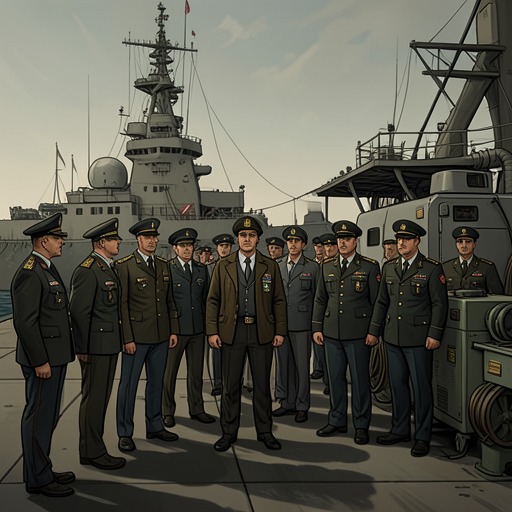
The ceremony takes place on the forecastle, where Willie returns the crew’s mass salute and faces them in the empty circle where the number-one gun had been mounted for thirty years. A stiff wind carries an oily, swampy smell across the deck and flaps the men’s pea jackets; sunlight appears weakly through smoke and harbor mist. Willie has prepared a sentimental speech, but the unfamiliar, reduced crew unsettles him. Many of the men he associates with the ship are absent, and he finds only a few familiar faces among the officers and sailors still present.
Willie reads the decommissioning order aloud in a strained voice. He then describes the Caine as an obsolete, broken-down ship that served through four years of war, swept only six mines, and spent much of its time on unglamorous fleet duties, including hundreds of thousands of miles of escorting. Its lack of spectacular achievement does not, he argues, make its service inconsequential: ordinary work helped keep the country going and contributed to victory. His address turns the discarded ship’s modest record into an argument for the importance of routine wartime service, summed up in the assertion, “Caine duty is the kind of duty that counts.”
Departure from the shipyard
After dismissing the men from quarters, Willie completes the handover of the ship’s keys and records and signs the last logs. The steward’s mates carry his bags to the dock. A sailor brings him the wrapped union jack, which Willie addresses to Horrible’s parents and asks to have mailed. These administrative and personal tasks close out his command in the same practical setting as the decommissioning itself.
When he finally leaves by the abandoned gangplank, he does not salute: there are no colors to salute and no officer of the deck. The Caine has become junk. That departure is not a ceremonial exchange of one command for another but a quiet exit from a ship stripped of its identity as an active naval vessel. Bayonne’s dock is the threshold where Willie’s role as captain ends in material as well as official terms.
Return to civilian life
A yard jeep takes Willie to the gate, where Mrs. Keith waits in a new tan Cadillac. She has been driving to Bayonne every day since the Caine arrived, and now takes him home. Willie resents the reversal: his mother had driven him to the Navy’s gates, and she is now driving him back. In his own interpretation, the boy who entered the Navy has finished playing at being a sailor.
Yet the return does not restore his earlier identity. In the weeks since leaving Pearl Harbor, Willie has experienced his passage across the country and into New York Harbor as dreamlike, especially as familiar landmarks of his childhood reappeared while he stood on the bridge as captain. By the time he reaches Bayonne, he feels that his naval self is dissolving without the old version of himself returning intact. The place therefore marks not a simple homecoming but an unsettled interval between military identity and civilian life.
Narrative significance
Bayonne’s setting binds the ship’s end to Willie’s personal transition without making either one feel complete or celebratory. The empty gun mount, stripped vessel, final logs, and un saluted gangplank give the ending its physical sequence; the gray harbor and industrial shore supply its subdued atmosphere. The Caine’s wartime worth is affirmed in Willie’s speech precisely as the ship is declared obsolete and likely to be broken up.
The city also frames the distance between public duty and private return. Willie can name the crew’s unglamorous work as part of victory, yet he leaves the ship without the familiar officers and sailors who had made its history personal to him. At the gate, his mother’s waiting car carries him away from the Navy, but his own sense of dislocation shows that crossing out of the shipyard does not immediately settle who he has become.