Burden of command
The Caine Mutiny Court-MartialBurden of command describes the loneliness and pressure of responsibility at sea, where a commander must make consequential decisions amid uncertainty and can be held accountable for disastrous mistakes. The novel develops the idea in two distinct registers: expert testimony considers whether extreme stress can impair a commander, while Thomas Keefer’s confession to Willie Keith makes that responsibility intimate and self-accusing. Together, they invite sympathy for Captain Queeg without making sympathy proof that his conduct was sound or that relieving him was justified.
Command Under Judgment
At the court-martial, Greenwald tests whether Queeg’s conduct and the board’s psychiatric finding can coexist. He asks whether a sane commander might behave harshly, ill-temperedly, oppressively, and with poor judgment; the answer is that such conduct happens, and does not contradict a finding that the officer is not mentally ill. The psychiatrist also agrees that Queeg is capable of ill temper and harshness. This distinction matters: fitness cannot be reduced to whether a commander is pleasant, fair, or consistently wise, and the presence of troubling behavior does not by itself establish mental illness.
Greenwald then presses the harder question: whether, after acknowledging those qualities, the psychiatric board still considers the executive officer’s relief of Queeg unjustified. The witness answers that, from a psychiatric standpoint, it was completely unjustified, and that the board reached this conclusion unanimously. The exchange makes the limits of expert judgment visible. The board’s conclusion concerns mental illness and the psychiatric basis for intervention; it does not certify Queeg as a perfect officer or erase the harshness and bad judgment Greenwald has placed on the record.
Captain Blakely asks whether a mild condition might leave a man capable of meeting ordinary command stresses yet produce reduced efficiency, confusion, or erroneous decisions when an emergency multiplies those stresses. Dr. Lundeen replies that extreme stress can have such effects on almost anyone. Blakely counters that commanding officers are not supposed to succumb to it, and Lundeen answers that they are human too. The exchange holds command to an exceptional standard while acknowledging the human limits of the people required to meet it. It does not settle whether Queeg experienced such a temporary disability; it establishes that the question cannot be answered simply by imagining commanders as invulnerable.
Keefer’s Account of Responsibility
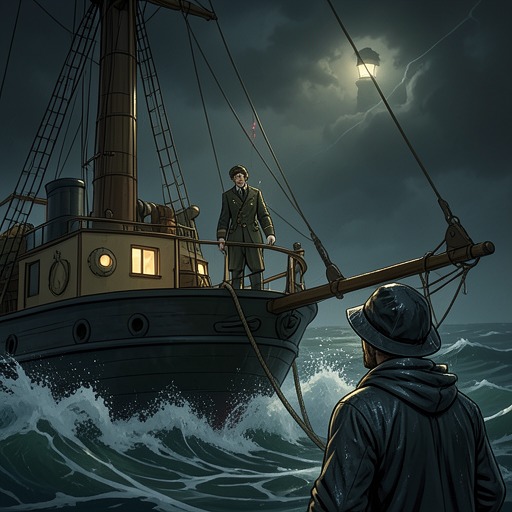
Later, Thomas Keefer gives Willie a more personal account of command. Willie admits that he had left steel balls on Keefer’s pillow after Keefer rammed a tanker coming alongside, screamed at the helmsman, and put him on report. Keefer’s response turns their encounter away from that act of mockery and toward the pressures of command. He tells Willie that he feels more sympathy for Queeg than Willie can understand unless Willie himself gets a command, because command is lonely and oppressive. In Keefer’s image, a commander follows a narrow path of correct decisions and good luck through an immense darkness of possible mistakes; at any moment, he might cause a hundred deaths through error.
That description makes responsibility a burden of anticipation as well as action. Keefer contrasts Captain de Vriess, whom he characterizes as having an ox-like sure-footedness, with Queeg, whom he describes as lacking brains but possessing nerves and ambition. In Keefer’s explanation, De Vriess neither saw the dangers in the same way nor had the imagination to be troubled by them, while Queeg’s qualities left him vulnerable to being overwhelmed. The comparison is Keefer’s judgment, not an independent diagnosis: it presents command as demanding both sound decisions and the ability to endure awareness of how many ways those decisions can fail.
Keefer also speaks of his own command as a struggle. He distinguishes being an executive officer from holding command itself, and says that he might have managed until the unexpected kamikaze attack. His voice cracks and tears come as he recalls it. When Willie tries to leave because Keefer seems unwell, Keefer asks him to stay, then regains his composure and offers him brandy. The brief physical shift—from tears to dry self-command—does not resolve his distress; it shows how closely his reflections on command have become bound to shame over what he did under pressure.
Roland and the Test of the Kamikaze
Keefer connects his failure to Roland Keefer’s death. He recalls that Roland was assigned to carriers while he was sentenced to the Caine, and that, by what he calls a diabolical chance, both brothers faced the same test of a kamikaze fire. Roland died saving his ship; Thomas jumped. Keefer wonders aloud whether the United States Navy’s apparently mysterious assignments contained an occult wisdom, as if the contrast between their postings and their actions had exposed a judgment on his character.
Willie rejects that interpretation as the imposition of meaning on a random accident, urging Keefer to pull himself together and prepare for his meeting with the commodore. The exchange leaves the contrast intact without confirming Keefer’s fatalistic conclusion. For Keefer, Roland’s death makes his own survival inseparable from the fact that he abandoned ship; command is no longer an abstract path through possible mistakes but a specific moment in which he believes his brother met the test and he did not. When Keefer says that he jumped, the admission brings the burden of command together with the burden of self-judgment.
Sympathy Without Exoneration
The concept’s force lies in the difference between understanding pressure and excusing conduct. The psychiatric testimony refuses the simple equation of bad behavior with insanity, while also acknowledging that extreme stress can make people confused and less efficient. Keefer, meanwhile, asks Willie to see command from the inside: not as a title that guarantees authority, but as an isolating responsibility in which the cost of a wrong decision can be enormous. Neither perspective makes every command decision correct, nor does either erase the effects of a commander’s actions on subordinates.
Keefer’s final appeal to Willie is also compromised by the very event he describes. His insight into Queeg’s vulnerability comes alongside his confession that he himself jumped, and his interpretation of Roland’s death turns an accident into a moral verdict on the brothers. The novel therefore presents command as both a real burden and a dangerous explanation: its loneliness may help explain failure, but it cannot by itself determine whether a particular act was justified. In placing the courtroom’s psychiatric distinctions beside Keefer’s personal remorse, the narrative makes responsibility difficult to dismiss and equally difficult to measure from sympathy alone.