Burt Gorton
The Caine Mutiny Court-MartialBurt Gorton, the Caine’s executive officer, occupies an uneasy position between operational knowledge and the authority of Captain Queeg. He can offer sound information and some support to Steve Maryk, but the lost-target episode shows that speaking plainly is not easy when Queeg controls both the decision and its account. Gorton’s hesitation is not simply a lack of knowledge: he knows a relevant precedent, yet fears raising a fact Queeg has not acknowledged. Later, a reprimand over general drills leaves him composing a written explanation, linking his precarious position to the routine demands of command as well as to moments of crisis.
Executive Officer Between Captain and Crew
When Queeg asks what should be done about the lost target, Gorton looks unhappily from Maryk to the captain. He begins to say that Steve Maryk can be relied upon if he says he can recover it, but the qualification remains unfinished. The moment gives Gorton a limited but consequential role: he is asked to assess Maryk’s assurance, and he does not openly reject it. At the same time, his halting answer offers less than an unreserved endorsement. His gaze shifts between the officer proposing the recovery and the captain whose decision governs it, making his divided position visible before he has fully spoken.
Queeg turns instead to Chief Bellison, asking how he would recover the target. That interruption leaves Gorton’s tentative judgment suspended. His response does not settle the operational question, but it establishes him as an intermediary whose advice matters while remaining subordinate to the captain’s authority. The hesitation also anticipates the more explicit difficulty he faces when asked to explain what he knows about an earlier recovery.
The Lost Target and the Withheld Precedent
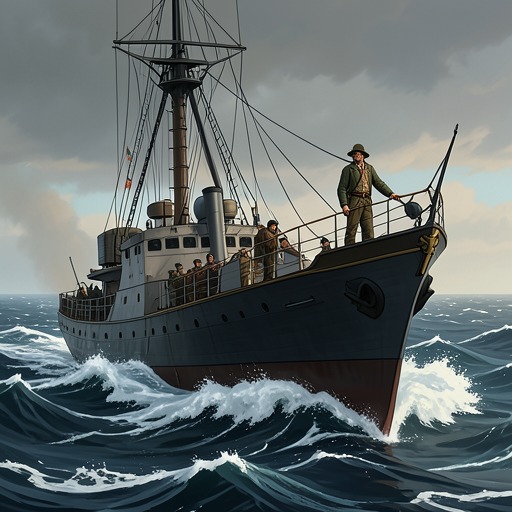
After the Caine has circled the target for an hour, ComServPac replies, “Act at discretion.” Gorton is with Queeg and Maryk on the port wing as they watch it. Queeg interprets the instruction as leaving responsibility to him and decides to return rather than risk missing the next day’s exercise or injuring a sailor. The immediate decision belongs to Queeg, but Gorton’s position becomes more exposed when an official mailgram arrives and Queeg objects to being told to submit a written report after what he calls a fiasco.
Asked whether he can identify a mistake, Gorton first stays silent. He suspects ComServPac may have heard that the towline was cut, but he is afraid to say so because Queeg has not acknowledged that it happened. Queeg invites him to speak frankly and presents the question as one a friend might answer. That appeal does not erase the practical risk Gorton perceives: the captain is asking for candor about an event whose underlying facts he has left unrecognized. Gorton’s pause thus registers the difference between being invited to advise and being free to contradict.
He eventually supplies a precise precedent. During a 1940 shooting exercise with the Moulton, that ship’s towline parted, and the crew recovered it without strain in about half an hour. The recollection directly challenges Queeg’s apparent assessment that recovery would be too difficult or dangerous. Gorton does not frame the example as an accusation; he offers the earlier operation as evidence that the lost target might have been recoverable. Queeg answers by asking why the information was not given at the time, when it would have influenced his decision. Gorton’s startled silence in response leaves the exchange unresolved: the useful fact has been stated, but only after the decision it might have changed.
Routine Discipline and Written Explanations
On a later voyage, Gorton again appears under pressure to account for his work. Queeg has found a CincPac letter requesting monthly written reports on the number of general drills conducted by each ship. The captain reprimands Gorton for not holding drills more often, and Gorton is mentally composing the opening paragraphs of a written report explaining why he has not held them. When Queeg orders a general drill, Gorton follows him onto the bridge with what the narration describes as a whipped-dog look.
The episode places Gorton’s written explanations beside Queeg’s demand for visible compliance. A request for figures from CincPac becomes the occasion for a reprimand, a report Gorton must prepare, and an immediate drill ordered by the captain. Gorton’s distress is evident, but the evidence does not specify his reasons for holding fewer drills or suggest that he openly contests the order. His role here is instead to absorb the pressure of accountability: he has to answer upward for routine shipboard practice while carrying out the captain’s direction.
Character and Narrative Function
Across these episodes, Gorton is neither a decisive challenger to Queeg nor a mere echo of him. He tentatively backs Maryk, withholds a potentially consequential fact while fearing Queeg’s response, and later provides a concrete example that bears directly on the disputed recovery. These actions define a narrow field of agency: Gorton can observe, remember, and advise, but the captain retains control over whether advice is sought, when it is heard, and how the resulting decision is explained.
His recollection of the Moulton matters because it converts an abstract disagreement about difficulty into a specific comparison: a parted towline, a prior exercise, and a recovery completed in about half an hour. Yet the timing is equally revealing. Gorton’s example emerges only after Queeg has returned to the question and pressed him to speak frankly; its practical value lies partly in what it might have changed before the decision. The contrast between that belated candor and Gorton’s later, silent preparation of a report shows the recurring tension in his position: he is expected to provide information and account for performance, but he works within a command structure in which frankness and compliance can pull in opposite directions.