Caine Duty
The Caine Mutiny Court-MartialCaine Duty is the wartime service performed by the Caine in the ordinary, often menial work of the fleet. In Willie Keith’s decommissioning speech, its importance rests not on spectacular achievements or public recognition, but on the cumulative labor that helped keep the country at war and contributed to victory. The idea turns an obsolete ship’s uncelebrated record into a measure of service that its crew may understand more fully with time.
A record of ordinary service
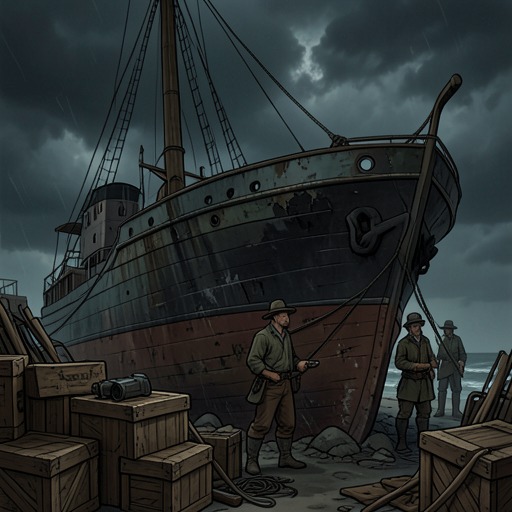
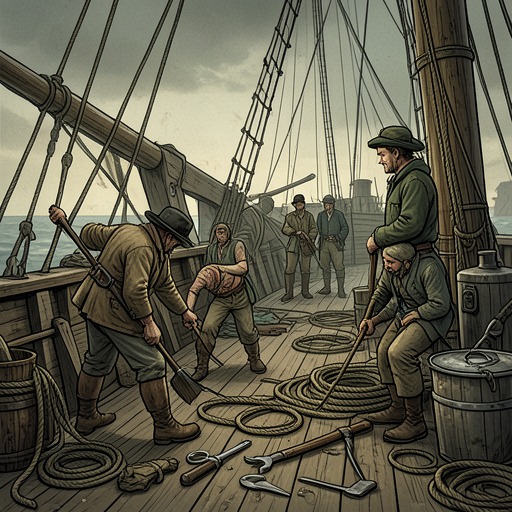
Willie presents the Caine without embellishment: it was a broken-down, obsolete ship that had steamed through four years of war, received no unit citation, and achieved nothing spectacular. Although intended as a minesweeper, it swept six mines during the entire war. Most of its work consisted of dull escorting, amounting to several hundred thousand miles, alongside other menial fleet duties. The contrast between the ship’s intended role and its actual record makes Caine Duty a broad idea of service: its value did not depend on fulfilling a single conspicuous purpose or accumulating visible honors.
The speech does not deny the Caine’s damaged condition or promise its work further recognition. Willie describes it as a damaged hulk that will probably be broken up. Instead, he measures the ship by the years of labor its crew gave and by its place in the larger effort. Caine Duty is valuable not because every task was dramatic, but because the tasks had to be done.
The crew’s part in victory
Willie links the crew’s service to the country’s survival. He describes the men as landlubbers who pitted their lives and brains against the sea and the enemy, and who did what they were told to do. Their contribution, he insists, was not to make the country better than before, but to help keep it existing as the country they loved. The emphasis falls on shared, practical service rather than individual distinction.
That argument also places routine work beside the war’s more celebrated operations. Willie says the crew’s hours aboard the Caine were hours of glory, then distinguishes their contribution from “the high-powered stuff,” which, in his formulation, only sets the date and place of a victory won by ships like the Caine. The distinction does not diminish large operations; it widens the account of how victory is achieved. Caine Duty is the indispensable labor behind the moment that can be named as victory.
Decommissioning and remembrance
The concept takes its clearest shape at the end of the ship’s service. Willie reads the decommissioning order aloud, looks over the crew’s ragged, thin ranks, and tells them they will scatter to trains and buses, most of them going home. Their immediate dispersal contrasts with the memory he predicts: even if they do not yet feel the worth of their time aboard, they will remember the Caine increasingly as the years pass. Caine Duty thus persists not as an ongoing assignment, but as a shared experience whose significance may deepen after the work is finished.
The speech’s final appeal is deliberately modest and collective: the crew should remember the old ship in which they helped win the war. Afterward, Willie orders the flag lowered, pockets the ragged remnant of the commission pennant, and asks for the jack to be wrapped and brought to his cabin for mailing. These concrete acts accompany the farewell with objects to be kept, while the speech gives the crew’s uncelebrated work a place in the story of victory.