Caine's dilapidated condition
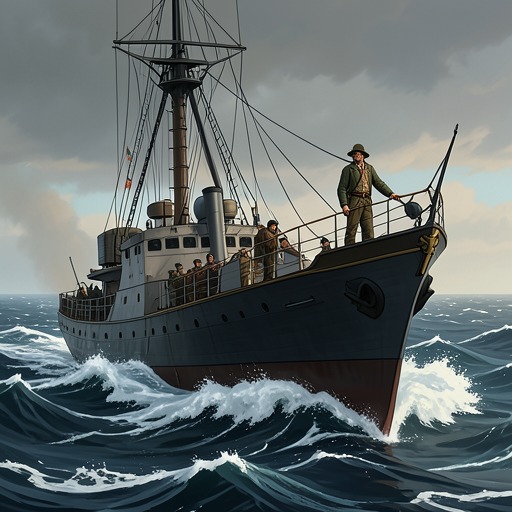
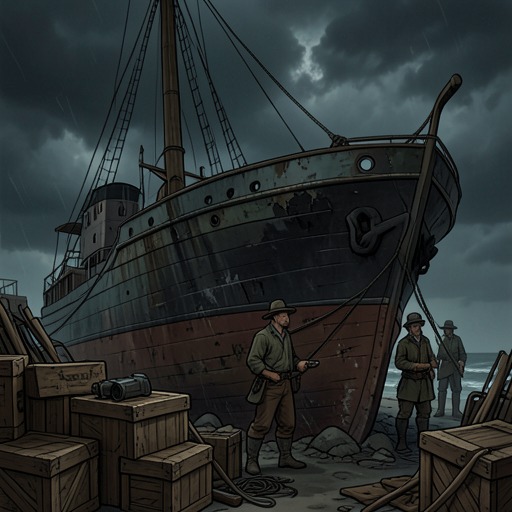
The Caine Mutiny Court-MartialThe USS Caine’s dilapidated condition is both a visible fact and a measure of the strain built into its service. Rust, disorder, worn fittings, and obsolete machinery mark a ship that can still carry out its work but does so under conditions that challenge the Navy’s prescribed standards. The contrast between its appearance and its continued usefulness becomes a point of conflict: whether the USS Caine should be remade to conform to the book, or managed according to what its battered structure can actually sustain.
Identity and First Impressions
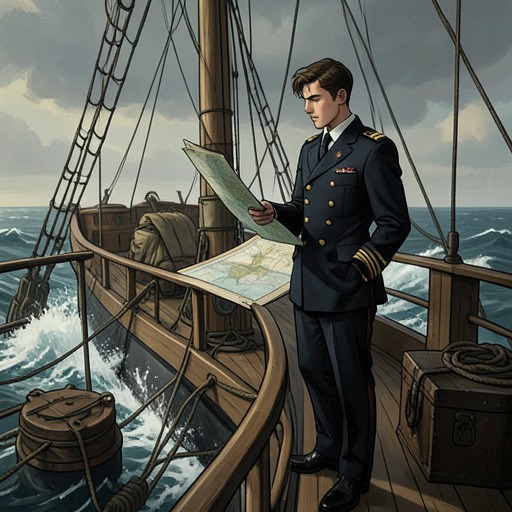
The condition of the ship registers first in the ordinary details of watchkeeping. During Willie Keith’s watch, Mackenzie is asleep on life jackets while Engstrand sits on a hatch smoking. Willie, exhausted and angry, orders Engstrand to keep Mackenzie on his feet, then watches as the sailor gets up and remains standing without apparent difficulty. The episode is not evidence of a major breakdown; it is a small, revealing instance of the lax and irregular shipboard life Willie encounters. Even routine discipline seems to require an officer’s immediate attention, while the worn equipment serves as a makeshift resting place.
The larger impression forms as Willie compares the USS Caine with the habits of the officers already aboard. He sees a filthy wreck where they may see a familiar ship, and resolves not to become blind to its condition. He intends to keep his perspective and leave the ship within six months, relying in part on the possibility that an admiral who likes him may help. His response makes the ship’s disorder personal: for him, its condition is not merely something to endure but a warning against becoming acclimated to a compromised standard.
The reveille routine extends that impression from the quarterdeck to the crew’s sleeping spaces. Willie descends through a narrow hatch into the after crew’s quarters, where sleepers fill tiers of bunks. The master-at-arms says that the crew did not hear reveille called and undertakes to get them up. The scene presents disorder as a condition of daily operation, not a single conspicuous mishap. It also shows Willie trying to impose order by adopting a fierce tone, even as the ship’s long-standing habits and cramped arrangements make the task feel less like a simple matter of issuing an instruction.
Material State and Comparison
A visit to the USS Moulton makes the contrast measurable. The two ships are identical in structure, yet the USS Moulton’s quarterdeck is clean and uniformly gray, without the USS Caine’s rust and green primer splashes. Its ladder-rail cording is new and white; the life-line leather is tightly sewn and brown rather than frayed, loose, and coated in cracked gray paint. Its sailors wear clean dungarees and tuck in their shirts. On the USS Caine, the loose shirt-tail has become, in Willie’s perception, a fitting emblem of the ship.
That comparison changes what the visible disorder means. A destroyer minesweeper is not necessarily condemned to look shabby simply because of its type: Willie recognizes that the USS Moulton proves otherwise. He therefore connects the USS Caine’s appearance to its identity as an outcast, rather than treating every defect as inevitable. The clean neighboring ship sharpens the impression of neglect because it holds the same basic structure while presenting an opposing standard of upkeep.
The contrast is not limited to an abstract difference in neatness. When Willie crosses over, the difference is apparent immediately, in the quarterdeck’s surfaces, fittings, and sailors’ clothing. The USS Moulton’s officer of the deck appears as neat as an admiral’s aide, while Keggs is in the wardroom drinking coffee and working a coding device. These details place visible order alongside ongoing shipboard work. The comparison thus offers Willie a concrete alternative to the USS Caine’s familiar state of disrepair, while making the latter seem like a condition maintained by its own culture as much as imposed by age or design.
The Ship’s Condition as a Structural Problem
The arrival of Captain Queeg exposes how difficult the USS Caine’s disorder is to conceal. Harding, the officer of the deck, looks around the quarterdeck and concludes that it is too late to change the new captain’s first impression. The scene gathers the evidence into one crowded view: sailors in partial dress peeling potatoes at a tin tub; the noise of metal scraping; comic books flapping on the deck; deckhands who are meant to be repairing a life raft but are distracted by an argument over moldy chocolate; cabbage crates, officers’ laundry, and helmets with newly painted names drying in the sun. A dirty pile of life jackets and a black puddle of galley fuel oil complete the picture. The ship has not been presented to its incoming commander at its best; its daily disorder is already on display.
Captain de Vriess explains that the problem goes deeper than appearance. The ships roll and pitch excessively, the power plant is failing, the machinery is obsolete, and the men are crowded. In the firerooms, the USS Caine’s crew must work under air pressure; if something goes wrong, a blowback could kill them. De Vriess describes the crew as knowing what sort of ship they have and notes that few request transfers. He also says they have backed him in difficult situations. His account holds hardship and capability together: poor material conditions are real, but they have not prevented the crew from delivering results under his command.
Improvisation, Regulation, and Significance
The argument over the USS Caine’s condition is also an argument over how a ship like this can be run. Steve Maryk points to its record: it gets underway, reaches its destinations, fires its guns effectively, and keeps its engine plant operating, often through improvisation. He says it has spent less time in repair than any other four-piper he knows since the war began. In his view, Captain de Vriess cared about results, whereas Captain Queeg is likely to insist on doing things by the book. The question is not whether the book is generally correct, but whether its standard method fits this particular vessel.
Tom Keefer answers that the book is the right way and that the USS Caine’s wastage, lost motion, and reliance on luck are staggering. Maryk accepts the general principle but objects that regulations designed for a sound ship cannot simply be applied without regard to a ship that, by those same standards, should be in the boneyard. The disagreement gives the USS Caine’s physical condition a continuing narrative consequence: it makes command a choice between formal procedure and adaptation to material reality. The ship’s grime and failing machinery are therefore not background decoration. They help explain why its crew has developed a distinctive, improvised method, why stricter discipline appears both attractive and potentially ill-suited, and why judgments of the USS Caine cannot be separated from the conditions in which it must perform.