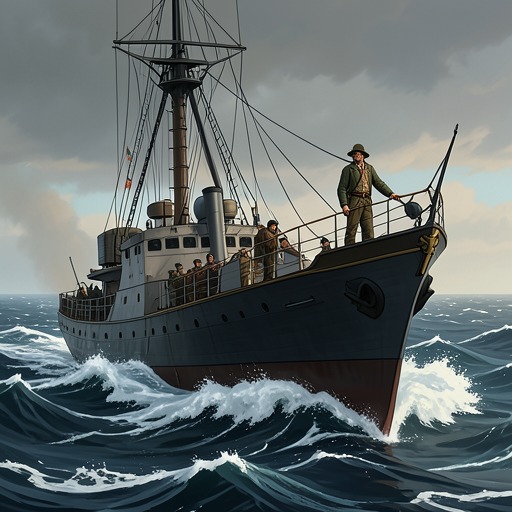
Cancellation of Caine's Pago Pago orders and reassignment to target towing
The Caine Mutiny Court-MartialThe cancellation of the Caine’s Pago Pago orders redirects the ship from a planned departure to target-towing duty at Pearl Harbor, while the Moulton takes over convoy duty. The change matters not only because it alters the ship’s assignment, but because Captain Queeg first presents it as welcome and then treats its unexplained cause as a possible judgment on the Caine’s competence. The episode moves from routine decoding to an officers’ address in which uncertainty about orders becomes pressure to prove the ship worthy of them.
The Changed Orders
At dawn, Rabbitt wakes Willie Keith with news that an action dispatch has arrived from ComServPac. Keith goes to the wardroom and decodes it at the coding machine while Gorton watches. Its instructions are direct: the Caine’s departure for Pago Pago is canceled; the Moulton is to replace it on convoy duty; the Caine is to remain at Pearl Harbor and tow targets; and towing gear is to be obtained from the target repair base. The message thus changes both the ship’s destination and the kind of work expected of it, without giving a reason.
Gorton immediately wonders why the orders have changed. He raises the possibility that the change may be connected to the Caine’s earlier grounding, but does not claim to know that it is. Keith asks whether he should wake the captain before reveille; Gorton tells him to do so. The dispatch therefore arrives not as an explanation but as a problem that the officers must interpret, with the possibility of blame already present in their first reactions.
Queeg’s First Response and Reversal
Keith reports that the new orders do not seem to faze Captain Queeg. When Gorton asks what the captain said, Keith relays that Queeg welcomed being switched to Pearl Harbor duty and said that nobody could make him angry by keeping him there. Gorton accepts this apparent unconcern, reasoning that there is no reason for him to worry if the captain is not worried. The immediate mood is therefore one of relief: the assignment is less demanding than the departure the ship had expected, and Queeg appears content with the change.
That impression does not hold. About an hour later, Queeg summons Gorton and asks him to look at the dispatch. Gorton says he saw it while Keith was decoding it, prompting Queeg to impose a restriction: no one except the coding officer and the captain is to have access to action dispatches unless the captain releases them. He then asks what Gorton thinks the new orders mean. When Gorton answers that they mean the Caine will tow targets instead of going to Pago Pago, Queeg rejects this as a reading of the words rather than an explanation of their significance. His concern has shifted from what the dispatch says to why ComServPac issued it.
Queeg tells Gorton that he would rather remain at Pearl Harbor than go west if the change has no hidden implication, but he is beginning to suspect that there may be more to it. He directs Gorton to go to ComServPac, obtain an explanation from whoever can provide it, and not return without one. The episode does not establish that Gorton obtains an answer. Instead, Queeg’s demand makes the unanswered motive behind the reassignment central to the ship’s response.
The Officers’ Address
Queeg later addresses the officers about the new assignment. He links the change to the standard he expects aboard the Caine, saying that excellent performance should be standard and implying that some departments have not met it. He does not identify particular department heads or specify deficiencies in this address. That omission makes the criticism collective: the officers are told that they know what he means, while the particulars remain unstated.
He describes the new duty as pleasant compared with the expected Pago Pago assignment, then asks why ComServPac has favored the ship with it. Queeg insists that naval officers should execute orders rather than speculate about them, and says that he intends to do exactly that. Yet the speech itself dwells on possible explanations. He gives the officers two: ComServPac may consider the Caine so outstanding that it deserves easier duty, or may consider it so poor that it cannot handle an assignment in the forward area. He declines to say which explanation he believes.
Queeg then supplies a possible basis for the less favorable interpretation: he recently reported that the Caine’s engineering performance was below par, and suggests that this report may have contributed to the reassignment. He still presents that connection as possible, not confirmed. His speech thus turns an unexplained operational change into a challenge to the crew: if the ship is not outstanding, it must become so quickly. The assignment remains target towing at Pearl Harbor, but its meaning within the wardroom is no longer settled.
Significance of the Reassignment
The episode’s tension comes from the contrast between the dispatch’s plain instructions and the uncertainty surrounding the decision behind them. The Caine is not told that it has been punished, nor that it has been specially rewarded. Queeg nevertheless frames the change through both possibilities and makes performance the measure by which the crew may be judged. His insistence against speculation sits uneasily beside his own search for an explanation and his public presentation of competing theories.
For Willie Keith, the reassignment also unsettles an initially hopeful view of the captain. After a convivial officers’ party the previous night, Queeg’s first reported response seems to confirm Keith’s favorable impression. The later restriction on access to the dispatch, interrogation of Gorton, and address to the officers replace that ease with a more demanding atmosphere. The episode does not resolve why ComServPac changed the orders; it establishes that the Caine must carry out the new assignment while its captain and officers confront what the change might imply.