Captain Blakely
The Caine Mutiny Court-MartialCaptain Blakely is the president of the court-martial that tries Steve Maryk for relieving Captain Queeg during the typhoon. A severe, experienced naval disciplinarian, he presides over a case in which the court must weigh a subordinate officer’s emergency decision against the Navy’s rules and the testimony about Captain Queeg’s command. His rulings and questions give him an active role in testing both the defense’s argument and the accused captain’s account.
Identity and First Impression
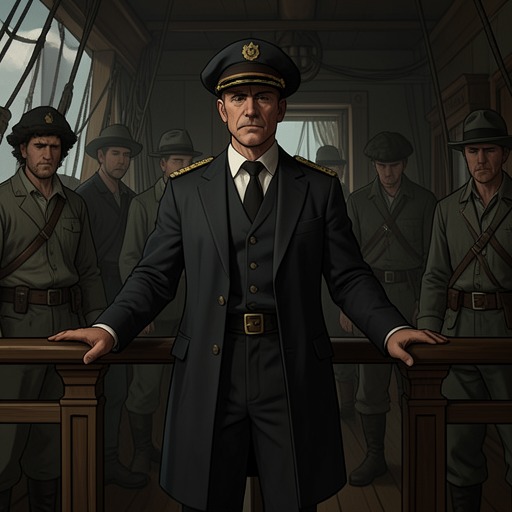
The trial takes place in the court-martial room of Com Twelve on Yerba Buena Island. Its formal arrangement sets the tone: seven officers sit behind a polished bench, with a large American flag on the wall behind them. Captain Blakely occupies the center of the bench as president. For Steve Maryk, the setting and ceremony are already intimidating, but it is chiefly Blakely’s appearance and reputation that unsettle him. Maryk knows him as a submariner who rose from the ranks, was removed from sea duty because of a heart condition, and became Com Twelve’s strictest disciplinarian. Maryk is shaking by the time he sits down after the court members swear their oath.
Blakely’s authority is presented through both the ceremony and Maryk’s apprehension. The other six officers on the board include a regular lieutenant commander and five lieutenants; among those lieutenants are reserve doctors, regular line officers, and a reserve line officer. Against this mixed panel, Blakely’s central position and reputation make him the figure whose decisions Maryk watches most closely. His stern bearing does not itself determine the case, but it establishes the pressure under which the testimony will be heard.
Managing the Evidence and the Defense
From the opening stages, Blakely polices the boundaries of the defense’s questioning. When Greenwald explains that Maryk’s authority rests on Navy Regulations Articles 184–186, and that Captain Queeg’s conduct aboard the Caine is relevant to justifiable cause, Blakely clears the courtroom. On the parties’ return, he cautions Greenwald that the case is unusually delicate because it involves an officer with fourteen years of service and combat duty. He insists that legal ethics and military respect still apply and holds defense counsel responsible for the conduct of the case, including abuses of cross-examination. Even so, he overrules the objection before him and allows the questioning to continue.
That combination of warning and permission defines much of Blakely’s conduct: he makes the risks of the proceedings explicit, but does not simply close off lines of inquiry that may bear on the charge. When Greenwald questions Urban about what happened during the typhoon, Blakely reminds the signalman that he is under oath and warns that evasive answers can constitute contempt of court. Urban then gives a more definite, though uncertain, account: he thinks Captain Queeg wanted to turn left while Maryk wanted to turn right. Blakely’s intervention makes the witness’s obligation to answer part of the courtroom’s scrutiny, rather than leaving the exchange solely to the lawyers.
Blakely also enforces limits on the defense. After Greenwald uses leading questions to elicit testimony about the Caine cutting a towline, Jack Challee objects that the point was not raised in direct examination. Greenwald answers that leading questions are permitted on cross-examination under Courts and Boards. Blakely clears the room, then sustains the objection and strikes the cross-examination so far from the record. He leaves open the possibility that the defense can introduce evidence later and recall the witness. The ruling therefore curtails Greenwald’s method without permanently excluding the subject from the case.
The Case Against Captain Queeg
The legal stakes become especially stark when the defense approaches conduct that could suggest Maryk deserted his duty or induced others to do so. Blakely reads Article 4, Sections 13 and 14 of the Articles for the Government of the Navy, which authorize severe punishment, including death, for specified forms of cowardice, negligence, disaffection, or desertion in battle. He warns Greenwald and the witness that accusing a United States Navy officer of such an offense carries grave consequences, then asks whether the defense wishes to withdraw its questions. His intervention frames the dispute not as a routine challenge to a captain’s judgment, but as an accusation that could place the defense itself under serious scrutiny.
When testimony turns to Captain Queeg’s mental condition, Blakely again weighs relevance against procedural restraint. Jack Challee objects that Greenwald is probing medical confidences and that Captain Queeg is not the one on trial. Greenwald argues that disturbing features of the captain’s mental makeup matter to the issue before the court. Blakely clears the room, then rules the question material while allowing Dr. Forrest Lundeen discretion in how to answer. Lundeen describes a broad problem of inferiority feelings, and the examination proceeds. Later, after Greenwald withdraws a question seeking the doctor’s personal emotional reaction, Blakely asks whether extreme stress might temporarily impair a person with a mild condition, making him confused or prone to erroneous judgments. Lundeen says that extreme stress can do this to almost anyone. Blakely responds that it is not supposed to happen to commanding officers. The exchange shows him testing a narrower issue: whether a condition that does not ordinarily disable an officer might nevertheless affect command in an extreme emergency.
Questioning and Outcome
Blakely’s scrutiny turns directly to Captain Queeg when testimony raises questions about earlier operations. He urges the captain to search his memory and says the court can recess for several days, if necessary, to obtain depositions from members of the attack group. The request for definite answers about the past is especially pointed because Captain Queeg has been describing matters as small or difficult to recall. Blakely’s intervention places the burden of precision on a witness whose account bears on Maryk’s judgment of his command.
When the testimony concerns whether the Stanfield moved out of Captain Queeg’s line of fire, Blakely again announces that the court wishes to question the witness. Captain Queeg denies being agitated and insists that he made no mistakes during fifteen months aboard the Caine. Blakely’s attention to the testimony does not produce a verdict on its own; the panel must assess the accumulated evidence, including the psychiatrists’ accounts and the captain’s evasions, incoherence, changing explanations, and insistence on his spotless record.
After one hour and ten minutes of deliberation, the court acquits Steve Maryk. The outcome belongs to the court as a whole, not to Blakely alone. His narrative importance lies in the way he makes the trial’s competing demands visible: military discipline and deference to command on one side, careful examination of the captain’s conduct and Maryk’s justification on the other. By warning the defense, limiting some questioning, permitting other inquiries, and asking his own questions of Captain Queeg and the psychiatrist, he helps turn the proceeding into a test of both the evidence and the standards by which command is judged.