Chain of command
The Caine Mutiny Court-MartialChain of command is the organizing principle that makes naval authority legible: a captain gives orders, subordinates execute them, and disagreement does not by itself confer the right to take command. In the novel, however, this structure is more than a rule of obedience. Captain Queeg’s command aboard the USS Caine tests the difference between carrying out orders and endorsing their justice, while Steve Maryk’s court-martial asks whether protecting command authority can become a threat to the ship and its crew.
Authority and Everyday Discipline
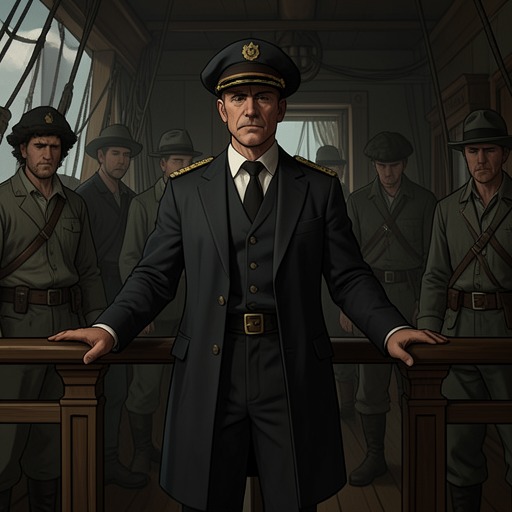
Aboard the USS Caine, command is enacted through orders that reach into routine shipboard life. After the ship crashes into a wharf while docking, Captain Queeg attributes the accident to the after line-handling party and orders that the entire crew lose two days’ leave. Maryk objects that the punishment is severe given what the crew could have done, but Queeg insists that he is the ship’s captain, threatens to triple the penalty and extend it to the officers, and directs Maryk to transmit the order. Maryk complies, then faces Queeg’s accusation that his objection was insubordinate and would affect his fitness report. The exchange makes the chain visible as both a practical channel for transmitting orders and a means by which a superior can discipline a subordinate who questions them.
Queeg’s wider system of discipline reveals a gap between formal authority and its actual reach. Following a posted order and a cigarette butt found in a forecastle scupper, he cancels the crew’s liberty. The deck force briefly keeps the main deck clean, but the effort lapses once the ship sails for Kwajalein; cleaning persists chiefly in the small area near the captain’s cabin, the bridge ladder, and the wardroom hatch. The crew has learned Queeg’s routines and generally obeys within the range of his sight and hearing, while shipboard life beyond that range remains substantially unchanged. This informal boundary is not described as a coordinated conspiracy. It is a pattern of individual accommodation, sometimes enforced through sailors’ own rough community rules, in a ship where attitudes toward Queeg range from mild dislike to intense hostility.
The same separation between official command and lived practice appears during Queeg’s search of the ship. Although he orders the search to continue, the crew perceives a change in the situation, and the search loses energy as officers and sailors go through its motions. By midday it has become an embarrassing farce to the officers and a source of amusement to the crew; Maryk eventually ends it after accepting perfunctory reports. Queeg treats the result as confirmation that he correctly judged his subordinates’ loyalty. The episode shows how an order can remain formally in force after the shared confidence that might make it effective has drained away.
Compliance, Necessity, and Subordinate Judgment
Aboard the ship, Queeg’s control also encounters material conditions that his orders do not resolve. In oppressive heat and air fouled by stack gas, the black gang begins secretly drawing water in the after engine room, where the evaporators are located. Sailors crowd the ladders to reach it. When Paynter reports what is happening to Maryk, the executive officer declines to intervene openly, answering that he cannot hear over the effects of the stack gas. Officers as a group do not join the sailors, partly because of the symbolic weight of an officer’s cap. The scene complicates a simple account of obedience: an informal response to the crew’s hardship emerges outside the captain’s orders, while the officers’ rank restrains them from taking part.
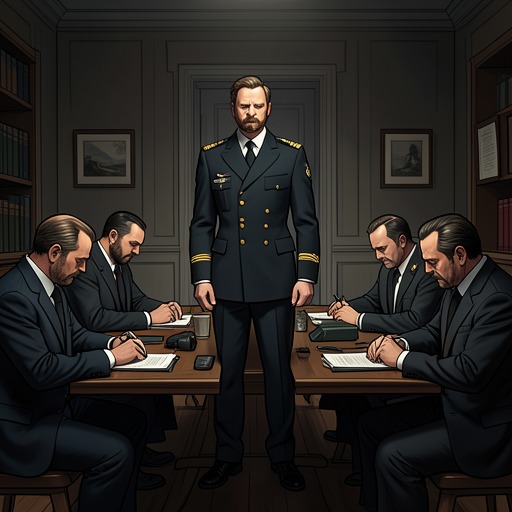
At Maryk’s trial, questions to Willie Keith bring this tension into explicit terms. Keith acknowledges that all orders should be obeyed, while allowing an exception for irrational persecution. Asked whether the Navy offers recourse besides disobedience, he identifies the possibility of forwarding a letter to higher authority through the captain. That route matters precisely because it preserves the formal chain while seeking review above the officer whose conduct is contested. Yet the incidents recalled in court include Keith’s admission that he, Maryk, and Stilwell had circumvented an express order well before the typhoon. Keith says he would do so again under the same circumstances. Obedience, in this account, is the default obligation, but the trial probes whether procedure can answer a situation in which subordinates believe that ordinary channels fail to protect those under command.
The wardroom’s conduct further unsettles the equation of executed orders with loyalty. Asked whether Queeg had a loyal group of officers, Keith points out that all of Queeg’s orders were carried out, while also acknowledging derogatory remarks by every officer except Maryk and admitting that he disliked the captain. The distinction prevents outward compliance from serving as conclusive evidence of trust or allegiance. It also sharpens the trial’s question about Keith’s own judgment on December 18: whether his decision to follow Maryk arose from a belief that Queeg had lost his sanity or from personal dislike of Queeg.
Who Can Judge a Captain?
The trial shifts the chain-of-command dispute into a conflict among professional forms of judgment. Greenwald questions the Navy psychiatrists about Queeg’s behavior and the limits of their conclusions. Dr. Lundeen’s testimony, as Greenwald summarizes it, includes rigidity, feelings of persecution, unreasonable suspicion, withdrawal from reality, perfectionist anxiety, an unreal basic premise, and obsessive self-righteousness; Lundeen characterizes the symptoms as mild and compensated. Greenwald presses the difference between recognizing troubling traits and deciding whether they disable a man for command. Dr. Bird, in turn, resists the lawyer’s use of sick as a loose substitute for more precise clinical language. The exchange does not make medical diagnosis identical to command judgment: it exposes the difficulty of translating observations about personality into a decision about authority and capacity.
Greenwald’s questioning also challenges the assumption that a medical assessment alone settles the matter. He argues that the doctors may not know enough about the requirements of command to judge Queeg’s fitness, while Dr. Bird rejects that implication. At issue is not merely whether Queeg can be described as disturbed or sick, but who has the relevant expertise to determine what those descriptions mean aboard a naval vessel. The testimony places clinical assessment alongside the practical judgment of officers who served with Queeg and the legal standards the court must apply. None of these forms of assessment automatically substitutes for the others.
The Legal Stakes of Command
When Greenwald asks Queeg whether he considered the USS Caine to be in the last extremity at the moment Maryk relieved him, Queeg says that it was not. The question focuses the dispute on the circumstances of the transfer of authority, rather than only on the history of Queeg’s administration. In court, the boundary between an unpopular or mistaken captain and a captain whose command can lawfully be taken away becomes decisive.
The prosecution’s closing argument frames that boundary as a safeguard against mutiny. It maintains that evidence of bad judgment, poor administration, or personal eccentricity cannot by itself justify summary relief of a captain. If subordinates could remove a commander for apparent mistakes and then force him to answer every grievance at a general court-martial, the prosecution argues, the chain of command would be destroyed. It further insists that the governing articles require unmistakable insanity, not merely proof of errors or misconduct, and invokes the rarity of a case brought against a Navy captain under those articles. The argument places the presumption of command authority within a system that selects officers for combat duty and expects them to bear the strain of command despite human weaknesses.
The novel thus presents the chain of command as both operational necessity and moral pressure. Orders must pass through recognized authority if a ship is to act as a unit; yet obedience, the execution of orders, professional diagnosis, and lawful authority to relieve a captain are not interchangeable tests. The shipboard incidents show how discipline can be obeyed in public and evaded in practice, while the trial demands a sharper legal distinction between flawed command and incapacitated command. The concept’s central tension remains unresolved by simple loyalty: preserving the hierarchy matters, but so does deciding when its authority can no longer safely be trusted.