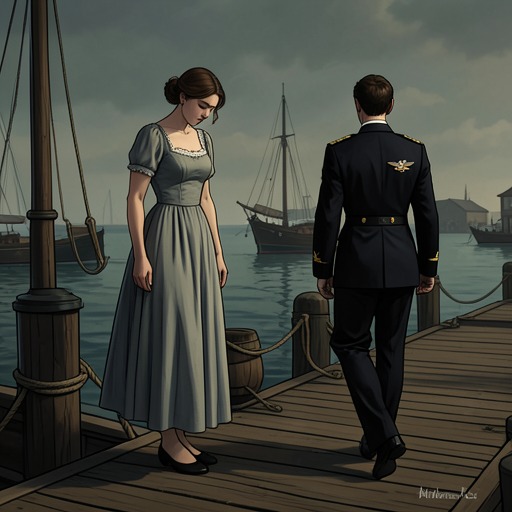
Cherubino's love aria from The Marriage of Figaro
The Caine Mutiny Court-MartialCherubino's love aria from The Marriage of Figaro becomes a recurring musical expression of Willie Keith’s attachment to May Wynn. Its appearances move from a playful first encounter to private musical absorption, a public performance charged with parting, and a record carried by Willie after he has resolved to end their relationship. The aria’s shifting arrangements and settings trace a romance that Willie repeatedly tries to control, even as the music preserves what he cannot simply put away.
The First Performance
At their first musical encounter, the aria appears in an ambitious arrangement that begins with Italian words, breaks into a syncopated parody in clumsy English, and then returns to Mozart’s music and Da Ponte’s words. Willie reacts to the piece as a performer as well as a listener: he recognizes its high-class musical character and jokes that the audience will not like it. May invites him to try it anyway, and he begins playing an aria he knows by heart. The moment draws him into her company through the music before he can fully make sense of his interest in her.
The scene attends closely to the contrast between the arrangement’s transformations and May’s manner of singing. Her voice is not presented as a professional instrument; it has the appeal of a bright amateur singing for the pleasure of friends. She sings the Italian text with a correct accent and apparently understands it. While the aria is in its Mozartian mode, she leans casually against the piano, gestures with humorous grace, and shares a smile with Willie. When the arrangement turns to its jazz parody, she performs a deliberately exaggerated nightclub persona, moving her hips, adopting a Southern accent, and twisting her wrists. As the music returns to Mozart, she returns to her natural ease. The contrast makes the aria a small performance within the performance: the comic imitation briefly conceals May’s charm, and the return to the original music restores it.
Music Taken Home
The aria continues beyond the encounter as something Willie carries into his private life. At three in the morning, his mother wakes to the sound of the song coming from his room and initially thinks he is playing records. Willie is at his portable phonograph with a pad and pencil, explaining that he is borrowing a stretch of Mozart for a new number. He has been moved to work on music after returning home, and the aria supplies material for his own creative effort. His mother reads his unusual, exalted appearance as creative excitement; Willie, tired, puts the work aside until morning.
This late-night episode gives the aria a different function from its first performance. In the cellar, Willie plays for May and follows a composition whose changes are already written into the arrangement. At home, he listens closely enough to take part of Mozart’s music for a new number. The song thus connects his encounter with May to his own musical imagination, while also making that encounter audible in the household. His mother hears the same music without knowing what has drawn him to it; Willie’s brief explanation is all that passes between them before he stops the phonograph.
A Public Farewell
Later, at Club Tahiti, May Wynn and Willie are introduced to the audience as entertainers who have appeared there before, and as a couple now facing Willie’s military service. They resist the invitation to perform, but the audience takes up a call for Mozart, leaving them little room to refuse. The aria that first brought them together in an intimate musical exchange is now performed before a room full of customers, many of them servicemen soon to leave home and fight.
May sings with a sweet sadness that quiets the crowd. The performance gathers a sense of farewell and regret for passing love; its effect reaches even those who have arranged to remain behind. May stumbles in the final strains, then hurries back to her seat without bowing as the room breaks into applause and the dance orchestra begins again. Afterward, she tells Willie that she has never lost her composure like that before. The aria’s public setting makes the emotion more than a private exchange between the two singers: their performance gives the audience’s approaching separations a shared musical form, while May’s stumble makes the moment’s feeling visible in her own delivery.
The Record and the Parting
In San Francisco, Willie finds a record among the few belongings he has brought in his valise. May had recorded the aria for him in a Broadway shop on an evening when they were both giddy with champagne. At the hotel, with the sunset over the city around him, Willie turns the record in his fingers and wishes he had brought his portable phonograph. He imagines May’s voice and Mozart’s aria in the setting, then reaches for the telephone before remembering that it is nearly midnight in the Bronx.
The record preserves the song in a form that belongs specifically to their relationship: not an arranged performance in a cellar, a piece Willie is studying, or a duet before an audience, but May’s recorded voice made for him. Yet Willie has decided that he cannot marry her and intends to end their relationship by leaving and not answering her letters. He has already shared an ecstatic farewell with her, but May has not been told of his plan. The aria therefore accompanies both his memory of their closeness and his attempt to withdraw from it. Its recurrence does not settle their relationship; instead, each return gives the music a new circumstance, until the record makes the distance between remembered intimacy and Willie’s chosen silence tangible.