Courage and cowardice
The Caine Mutiny Court-MartialCourage and cowardice are contested measures of character in the novel, tested not only under enemy fire but also in moments when fear, authority, and responsibility collide. The story first presents battle as an almost exhilarating spectacle, then forces Willie Keith to reconsider what he sees: Captain Queeg is accused of fleeing danger, Tom Keefer jumps from a stricken ship, and Willie himself discovers that terror and courage can coexist. The contrast between public reputation and consequential action prevents either label from settling easily.
An initiation into battle
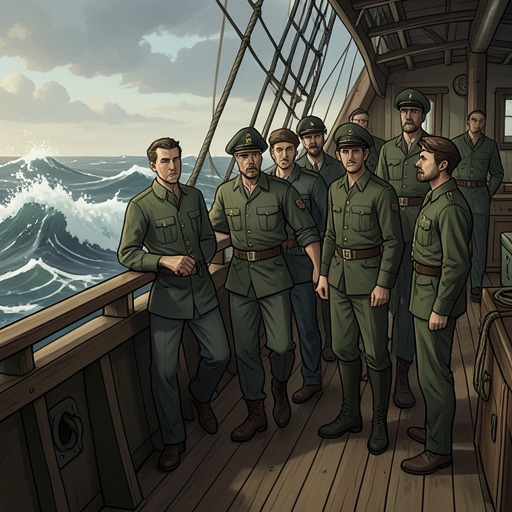
At the Battle of Kwajalein, Willie watches the bombardment from the flying bridge of the USS Caine. Under a pink-and-blue sunset, tracer fire crosses the water and the islands burn; Willie smokes, whistles Cole Porter tunes, and watches with the detachment of an entertained spectator. The scene makes his first taste of combat less an encounter with personal danger than an overwhelming display of naval force. Its theatrical beauty is set against the deaths it produces, a distance that allows Willie to applaud the spectacle without attending to its human cost.
That distance matters because the novel does not treat the appearance of fearlessness as proof of moral courage. At Kwajalein, Willie’s ease reflects how remote and one-sided the battle seems from his position, not a demonstrated willingness to face danger at close quarters. The contrast foreshadows the more intimate tests ahead, in which he must act without the protection of spectacle or certainty.
A different kind of test comes during the typhoon, when Steve Maryk maneuvers the USS Caine toward the wind and sea. Willie cannot understand what the executive officer is doing. Sitting on the deck with water around him, clutching a telephone jackbox, he has lost faith in the ship and can think only of being saved. His fear reduces the crisis to his own immediate vulnerability; the duties, hierarchy, and ambitions that ordinarily organize his world momentarily fall away. The episode does not make him a coward. Instead, it shows how thoroughly mortal fear can overwhelm judgment, and how little an observer in crisis may understand of another person’s decisive action.
Queeg under accusation
At the court-martial of Steve Maryk, Willie’s testimony turns courage from a private impression into a public accusation. Asked to give the chief reason for disliking Captain Queeg, Willie says that he regarded Queeg as a coward in battle. He describes Captain Queeg running from a shore battery that had fired on the Stanfield, and recounts an episode at Kwajalein associated with the nickname Old Yellowstain. The name, Willie explains, combined an implication of cowardice with the yellow marker involved in the incident; it caught on without anyone clearly establishing who coined it.
Willie’s account extends beyond those particular incidents. He says that in combat Captain Queeg would be found on the side of the bridge away from the firing, and that whenever the ship reversed course while patrolling near a beach, Queeg changed bridge wings. The behavior had become a common joke among the bridge personnel. Willie offers their potential corroboration, while also acknowledging the possibility that they might be afraid to speak. His testimony thus exposes both the force of shipboard rumor and the risk of challenging a commanding officer: conduct noticed by many may still be difficult to establish in court.
The prosecution and defense give the charge sharply different meanings. The judge advocate, Jack Challee, argues that the case concerns an unauthorized relief of command and that the Navy’s medical findings support Captain Queeg’s fitness; he presents the cowardice allegation as a smear against a battle-tested officer. Greenwald, defending Steve Maryk, insists that the accusation is central because it helps explain Willie’s dislike, but he rejects cowardice as the defense’s claim about Captain Queeg. His argument instead asks the court to interpret questionable conduct under fire as evidence of illness. In Greenwald’s framing, the relevant distinction is between bad judgment and cowardice, not between a flawless commander and a disloyal crew.
Fear, action, and responsibility
The kamikaze attack on the USS Caine gives the novel a more immediate comparison. As the plane descends toward the ship, Willie drops his navigation tools and runs to the bridge wing. He sees the pilot and believes the aircraft is about to hit. In that instant, terror is inseparable from a sudden recognition: he regrets not having married May Wynn, and understands that the loss he once tried to dismiss matters deeply to him. Fear does not simply paralyze him; it strips away his evasions about what he values.
After the impact and explosions, Tom Keefer declares that the ship will not survive and urges everyone to abandon it. Willie tries to correct Keefer’s belief that the men in the water are jumping from the main deck, then seizes him as he prepares to go overboard. Willie requests permission to stay aboard with volunteers to fight the fire. Keefer dismisses the choice as suicidal and jumps. Willie’s action is not presented as the product of perfect knowledge: the ship is burning, smoke and explosions obscure the damage, and the bridge crew is frightened. Its significance lies in his willingness to accept responsibility for an uncertain attempt to save the ship, rather than treating panic as an order to flee.
The contrast becomes more painful because Keefer later recognizes what his choice means to him. He says that he would still have jumped, and that he cannot escape the fact: it has given him an identity. His intelligence, he reflects, makes it impossible to hide from the judgment he passes on himself, unlike Captain Queeg’s capacity for self-protective explanations. Keefer also compares his own choice with Roland Keefer’s death while saving his ship during the same attack. The comparison is Keefer’s interpretation of events, not proof that courage can be measured by a single outcome; it nevertheless shows how the act of leaving the USS Caine becomes a lasting source of shame for him.
Manhood and the novel’s measure
The novel connects courage to manhood without reducing the connection to combat performance. In his final letter, Willie’s father urges him to remember his father’s wrong turns at the crossroads of his own life, to choose rightly, and to carry his blessing. The letter ends with the injunction, “Be a man.” Placed alongside Willie’s changing conduct, that counsel gives courage a broader moral dimension: what matters is not simply appearing unafraid, but accepting responsibility for choices and their consequences.
The episodes do not produce a single, uncomplicated ranking of the men. Willie’s detached enjoyment at Kwajalein gives way to fear in the typhoon and then to a choice to remain aboard during the kamikaze crisis. Captain Queeg’s alleged movements away from enemy fire become evidence in a dispute where illness, judgment, and cowardice are difficult to separate. Tom Keefer’s jump, followed by his persistent self-reproach, shows how an act can become an identity in the eyes of the person who performed it. Across these reversals, courage is neither a fixed reputation nor an absence of fear: it is revealed, imperfectly and under pressure, in what a person does when danger makes responsibility unavoidable.