Court-martial of Steve Maryk
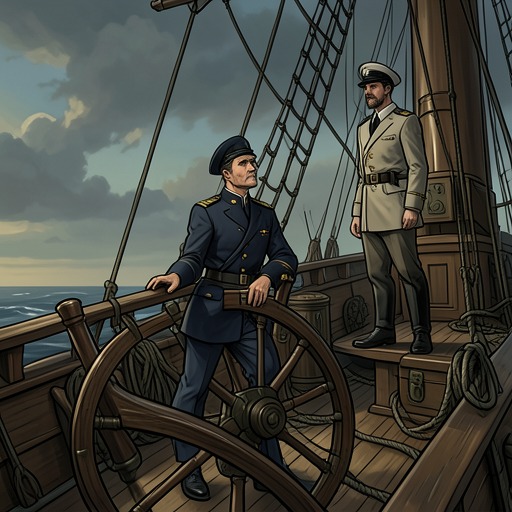
The Caine Mutiny Court-MartialThe court-martial of Steve Maryk tested the boundary between a second-in-command’s responsibility to act in a crisis and the Navy’s insistence that a ship have only one properly appointed commander. Maryk was acquitted after relieving Captain Queeg, but the Navy’s later review disapproved the acquittal and formally reprimanded Willie Keith for his part in the affair. The result was therefore divided: Maryk could not be tried again, yet official criticism left his naval career effectively over, and Keith’s service record acquired a lasting mark against him.
Background: Command and Compliance
Before the court-martial, Captain Queeg had made his command philosophy explicit to the officers of the USS Caine. He insisted that shipboard work be done his way, invoked the rule book, and declared that excellent performance was the required standard. In a separate dispute over the ship’s radio watch, he rejected assumptions about ordinary conditions and ordered the USS Caine to maintain its own round-the-clock guard. These rules presented discipline as both a practical safeguard and a test of obedience to the captain.
The distinction between written rules and their lived application became increasingly visible. After a failed docking, Queeg attributed the accident to the after line-handling party and ordered two days’ leave withheld from the entire crew. When Steve Maryk objected that the collective punishment was severe, Queeg threatened to extend it to the officers and warned that Maryk’s fitness report would reflect what he treated as insubordination. Maryk nevertheless passed the order to the crew. The episode established a conflict that mattered to the later case: Maryk could carry out a command while also judging it to be unjust.
Queeg’s regulations did not produce uniform obedience throughout the ship. The crew learned where he was likely to look and observe, maintaining the appearance of compliance within that range while the rest of the USS Caine continued under looser, informal customs. During a water shortage, sailors secretly drew water from the engine room’s evaporators; officers learned what was happening but did not go down to join them. During the search for the missing keys, the crew’s effort slackened as Queeg withdrew from the search, and Maryk eventually stopped it after it had become largely perfunctory. These incidents supplied a picture of a command whose formal authority remained intact while practical cooperation eroded.
The Case and Its Ruling
The court-martial concerned Maryk’s irregular relief of Captain Queeg from command on December 18, 1944. The available account of the proceeding establishes its outcome and the subsequent administrative review, rather than providing a full record of courtroom testimony. The Navy’s order identified the relief as improper performance of duty. It also reported that the medical board had recommended restoring Queeg to duty and had found no evidence of mental illness. The review therefore rejected a medical justification based on an alleged mental ailment, and treated Maryk’s action as an unauthorized displacement of the officer appointed to command.
The authorities’ reasoning emphasized the chain of command even in danger. The convening authority argued that a ship could have only one commanding officer appointed by the government, and that a second-in-command could not remove him irregularly without referring the matter to the highest available authority. Regulations allowing an exception were characterized as applying only in exceedingly rare circumstances. The official position held that hazard intensified, rather than relaxed, a senior officer’s responsibility to preserve naval discipline. The case thus turned not simply on whether the USS Caine had been in danger, but on who was entitled to judge that danger and what procedure permitted a change of command.
Review and Consequences
The initial result did not survive institutional review. The Bureau disapproved the acquittal, while the endorsements of the higher authorities concurred emphatically with the convening authority’s criticism. The order stated that the finding concerning Queeg showed gross ignorance of medical facts and poor judgment in relying on uninformed opinions in a matter with serious consequences. The same official comments reached Keith, whose testimony was taken to show that he had sided wholeheartedly with Queeg’s actions rather than complying reluctantly. Keith received a formal reprimand for improper performance of duty, and a copy was placed in his promotion jacket.
The review also distinguished Maryk’s legal exposure from his professional future. Keith understood that Maryk could not be tried again after the acquittal, so the disapproval did not create a new trial. But the higher authorities’ assessment made the end of Maryk’s naval career seem certain. Keith’s response joined that institutional outcome to his own: he regarded the result as a medal and a reprimand arriving together, and felt pity for Maryk. He filed the reprimand beside the citation for his career, preserving the record’s opposed judgments in the same folder.
Significance
The case’s aftermath makes the verdict only one part of its meaning. The court acquitted Maryk, but the later review insisted that the Navy’s command structure could not be set aside through an irregular relief, even in a hazardous situation. Its formal language converted the dispute into questions of procedure, medical judgment, and responsibility; the resulting reprimand made those questions consequential for Keith’s record as well as Maryk’s prospects.
That outcome also throws the earlier life aboard the USS Caine into sharper relief. Queeg’s insistence on personal authority and strict standards had coexisted with collective penalties, selective compliance, and a crew that often observed rules only within the captain’s immediate reach. The court-martial did not erase those circumstances, but the Navy’s review placed the greatest weight on the formal chain of command. Its divided aftermath—acquittal, disapproval, and reprimand—captures the tension between a decision made under pressure and an institution’s later effort to define who may act when command itself is in dispute.