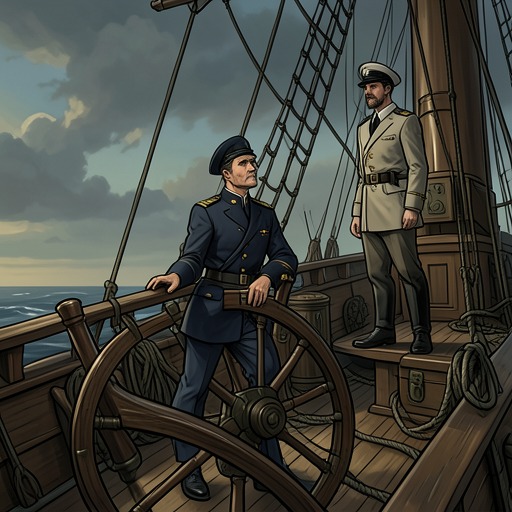
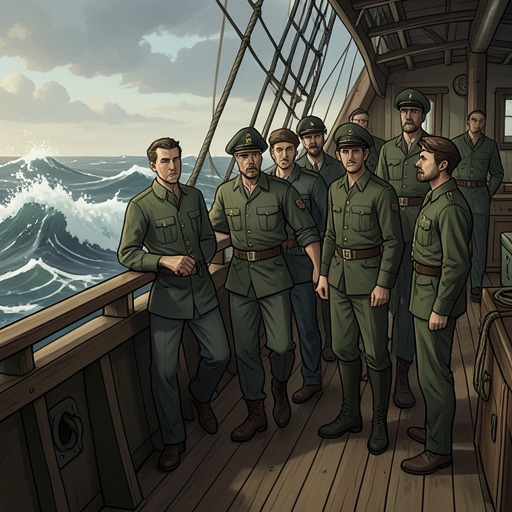
December 1944 typhoon encounter
The Caine Mutiny Court-MartialThe December 1944 typhoon encounter transforms a dull screening voyage into a test of seamanship and command. A calm departure and an empty weather chart offer Willie Keith false reassurance; as the storm builds, the Caine’s machinery and crew are subjected to forces that make ordinary procedures uncertain. The encounter also sharpens the conflict between Captain Queeg’s authority and the judgment required to keep a ship alive in conditions no rulebook can fully master.
Routine Voyage and False Reassurance
The tanker group stood out from Mugai Channel under a clear sky and bright sun. The Caine took the extreme right-hand station in the screen, five thousand yards from the guide. The tankers advanced in their familiar zigzag pattern while destroyers moved ahead, using sound to probe beneath the sea. To the sailors, these wartime formations and precautions had become as habitual as domestic routines; the passage seemed marked by sleepy monotony rather than imminent danger.
Willie’s typhoon chart appeared to confirm that sense of security. Its blue expanse between Ulithi Atoll and the Philippines contained no red squares, and he concluded that there were no typhoons in the area. He went about his duties quietly, treating an absence of plotted storms as evidence of safety. That assumption gives the encounter one of its governing ironies: the chart’s blankness does not mean the sea is harmless, and a familiar caution associated with Captain Queeg proves especially apt when the weather turns.
The first worsening did not immediately announce a crisis. On the night of December 16, the Caine began rolling hard, but Willie had experienced steep rolls before, with the inclinometer reaching forty-five degrees and green, white-capped seas filling the bridge windows. Reading Charles Dickens in his room, he felt the headache that preceded seasickness, put his book away, and braced himself in bed against the ship’s motion. The ordinary remedies of a rough night still seemed adequate. A boatswain’s mate later woke him, and Willie’s first instinct was to check his watch and protest that it was only half past two.
The Fleet Presses On
By ten in the morning, the sea had become a landscape of heaving ridges and deep troughs. From the careening port wing, Willie and Steve Maryk saw battleships, carriers, tankers, and destroyers repeatedly disappear behind swells and reappear as they climbed them. Waves broke over the ships’ forecastles; the Caine’s own forecastle remained inches deep in water. Black seas engulfed the anchors, while foam streamed over the deck, piled against the bridgehouse, and spilled over the sides. Although it was not raining, the air felt bathhouse-warm, beneath masses of tumbling dark-gray cloud. The ship rolled less than it had during the night but pitched far more sharply, its deck rising and dropping like an elevator floor.
The fleet nevertheless attempted to fuel. The operation continued until early afternoon, consuming hoses and steadying lines and spilling oil as the ships struggled in the sea. Junior officers joked about the fleet commander’s judgment, unaware that the task force had to fuel in support of an air strike connected to a landing on Mindoro: without fuel, the Army would lose its air cover. The order to persist thus had stakes beyond the ships themselves, even as the conditions made the work increasingly hazardous. At half past one, the task force abandoned fueling and turned southwest to escape the storm.
The change of course did not immediately restore control or visibility. During his watch from eight until midnight, Willie gradually recognized that the weather was not merely rough but seriously dangerous. Steep rolls brought brief flashes of panic. He steadied himself by watching the helmsman and quartermasters cling to the wheel and engine-room telegraph, exchanging obscene insults in exhausted but level voices. Rain rattled against the wheelhouse windows and trickled across its deck; the other ships had vanished from sight. Willie maintained the Caine’s station by radar ranges and bearings on the nearest tanker.
Ship, Storm, and Command
The storm’s severity becomes clearer against the Caine’s physical capabilities. A warship was built for power rather than capacity or economy, and even the old minesweeper could bring roughly thirty thousand horsepower to bear. At a little over a thousand tons, it was small beside that power, a compact vessel with substantial strength for emergencies. Yet machinery could not guarantee mastery over the sea. In a typhoon, winds reaching a hundred and fifty miles per hour or more could make the rudder ineffective by driving water along as fast as the rudder moved through it. Wind, waves, hull, and helm might exert competing forces, leaving a ship’s response erratic from one moment to the next.
The danger was not simply that the Caine might be thrown off course. A ship could yaw or broach; in extreme conditions, wind might prevent even full engine power from turning its bow. The central practical requirement was to keep the vessel steaming under control. If a destroyer lost its engines and became a drifting hulk, it could capsize or fill and sink. Even the accepted advice to point a ship into the wind and sea was not a certainty: authorities disagreed, and none could claim enough experience in the worst typhoons to make universal rules. The exposition makes the storm an adversary that exposes the limits of expertise as well as the limits of steel and horsepower.
At half past eleven, a drenched radioman brought Willie a storm warning. Willie woke Maryk, who had been dozing in the captain’s chair with a grip on its arms, and the two went to the chartroom. Captain Queeg was asleep in the bunk above the desk and did not stir. Maryk plotted the storm’s position, nearly a hundred and fifty miles away and almost due east. Willie judged that the Caine was in the navigable semicircle and expected to be clear by morning. The episode places practical interpretation of the warning in the hands of the executive officer and a junior officer while the captain remains asleep, a contrast that will gain weight as the crisis deepens.
The Crisis Breaks Open
The worsening weather eventually makes the ship’s danger unmistakable. Willie struck his head against a closed hatch and, disoriented, mistook its darkness for open night. After realizing it was seven in the morning, he forced open the small scuttle, pushed his shoes and shirt through, and wriggled onto the main deck. Sailors packed the passageways, watching with wide, pale eyes. Willie rushed toward the bridge barefoot, but a severe starboard roll nearly sent him down into the sea; he survived by clinging to the handrail with arms and legs.
From the loudspeaker came Queeg’s shrill demand that the forward engine room produce emergency flank power on the starboard engine. On the bridge, officers and sailors clung to rails and cleats while the Caine rose and fell on immense swells. Willie grabbed Tom Keefer’s arm; Keefer’s face was gray. The scene reverses the earlier quietness of the voyage: the chartroom’s measured plotting and the routine watch have given way to bodily peril, shouted orders, and a ship that must be held together by immediate action.
The fleet’s radio orders then bring the command problem into focus. Through static and the roar of wind and waves, Willie made out instructions to discontinue fueling, take a new southerly course, and reorient the smaller ships in the screen. Queeg asked him to repeat the message, then accepted the turn south as an effort to get out of the storm. Maryk warned that the Caine might ride badly with its stern to the wind, since quartering seas were especially dangerous to it. Queeg rejected that concern in favor of any course that would take the ship out of the storm, ordered Willie to have Paynter stand by the engines for rapid action, and told Maryk to remain on the bridge while he went to conn from the radar shack.
Queeg then ordered all engines ahead full and the rudder right standard, setting the ship on a heading of 180 degrees. As the Caine plunged down into a foaming trough, Stilwell reported that the helm felt loose. That detail condenses the encounter’s central pressure: an order can be given in precise naval language, but the ship’s response depends on machinery and water behaving unpredictably. The typhoon turns routine command into a contest between authority, technical uncertainty, and the continuing need to keep the Caine under power.