Dr. Bird
The Caine Mutiny Court-MartialDr. Bird is the second psychiatrist called by Jack Challee at Steve Maryk’s court-martial and the witness whose testimony makes the difference between psychological disturbance and incapacity for command explicit. He supports the prosecution’s case that Commander Queeg was never unfit to lead, yet concedes that Queeg is disturbed. Under Barney Greenwald’s cross-examination, that concession becomes a dispute not only about Queeg’s condition but about how far psychiatric expertise can reach into the practical judgment of command.
Identity and Appearance
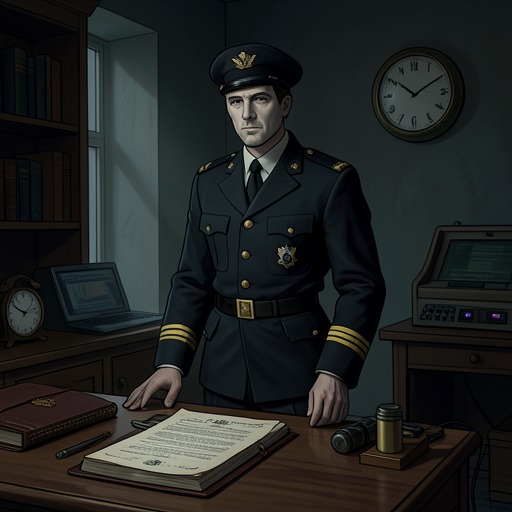
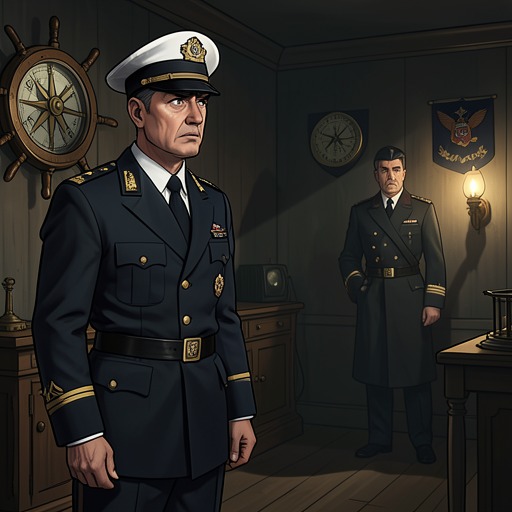
Dr. Bird enters as the prosecution’s last witness, summoned after Dr. Forrest Lundeen has testified. He is a lieutenant, strikingly slender and youthful-looking, with dark hair, sallow skin, and sharp, sensitive features. His brown eyes are described as deep-set, large, and penetrating; his handsome appearance is accompanied by something the narration calls fanatic in his look. The physical portrait gives him an intensity that contrasts with the measured, technical distinctions he tries to maintain on the stand.
Testimony on Queeg
Under Challee’s direct examination, Bird confirms what Lundeen has said: Queeg is fit for command now and has never been unfit. He also confirms that Dr. Manella shared that opinion. Asked whether Queeg showed signs of a paranoid personality, Bird refines the label, preferring “an obsessive personality with paranoid features.” The qualification matters: he acknowledges paranoid features without treating them as evidence that Queeg could not command.
Greenwald’s questions draw out the limits and implications of that assessment. Bird describes a person with an unconscious psychological disturbance as someone driven to strange behavior and sustained tension without knowing its cause. Such a person may compensate through willpower, daydreams, or other conscious devices, but Bird says adjustment requires psychoanalysis that brings the disturbance into awareness. Queeg, Bird confirms, has never undergone psychoanalysis. From this account Greenwald asks whether Queeg is disturbed; Bird answers yes, while insisting that the disturbance has not disabled him. His evidence thus holds together two claims that might otherwise seem contradictory: Queeg can be sick in a broad psychological sense and still, in Bird’s professional judgment, remain capable of command.
Cross-Examination and Professional Authority
Greenwald makes the distinction itself the pressure point. He asks Bird to connect the technical categories of disturbed and adjusted with the ordinary terms sick and well. Bird accepts that connection in broad terms, but resists the flattening of his terminology. When Greenwald frames Queeg as sick and suggests that Bird may be wrong because he does not understand the requirements of command, Bird repudiates the suggestion. He objects that Greenwald has substituted a loose, polarized word for the more precise clinical description.
The exchange exposes a boundary neither witness can simply erase. Bird’s training allows him to describe unconscious disturbance and compensatory behavior; Greenwald’s challenge is that the question before the court concerns a naval commander’s fitness under the requirements of command. Bird insists that command and psychiatry require different abilities, rather than accepting Greenwald’s implied ranking of one profession over the other. His rebuttal is not a retreat from his conclusion about Queeg, but a defense of the limits and proper language of his expertise.
Narrative Role
Bird’s testimony complicates the prosecution’s cleanest possible defense of Queeg. He does not repeat an uncomplicated claim that the commander is wholly well: he calls him disturbed, confirms that he has not been psychoanalyzed, and explains how serious inner tension may coexist with outward compensation. At the same time, he does not convert those observations into a finding of incapacity. The court is left to consider the gap between a diagnosis and the practical judgment that a commander can perform his duties.
That gap also shapes Bird’s presentation as a witness. His analytical distinctions initially give the testimony a clinical precision, but Greenwald’s blunt questioning makes precision itself contested: can a carefully bounded psychiatric opinion answer a question about command, and can a lawyer’s ordinary word for illness capture what the specialist means? Bird’s voice quivers when he feels his terminology has been deliberately distorted, and the narrative likens his offended expression to that of an insulted boy. The moment does not settle Queeg’s fitness; it reveals how readily professional authority becomes vulnerable when its specialized language is translated into the courtroom’s more polarized terms.