Greenwald’s cross-examination of Queeg
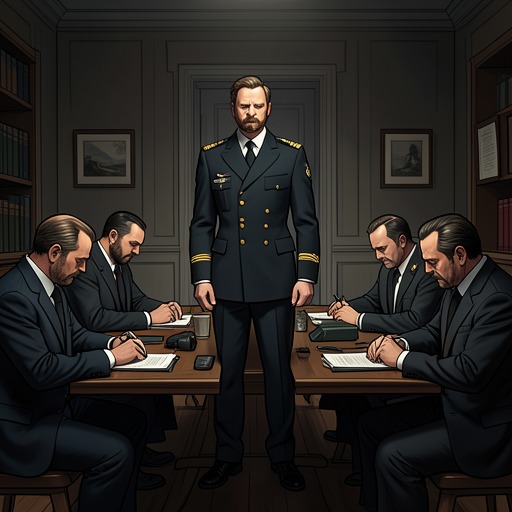
The Caine Mutiny Court-MartialGreenwald’s cross-examination of Captain Queeg makes the ex-captain’s testimony, rather than Maryk’s conduct alone, the trial’s central object of scrutiny. Queeg appears composed and commanding, but questions about money, lost property, shipboard mishaps, and his own written assessments repeatedly unsettle the authority of his account. The decisive reversal comes when Greenwald has him read a fitness report praising Maryk as an outstanding officer fully qualified for command.
The witness and the strategy
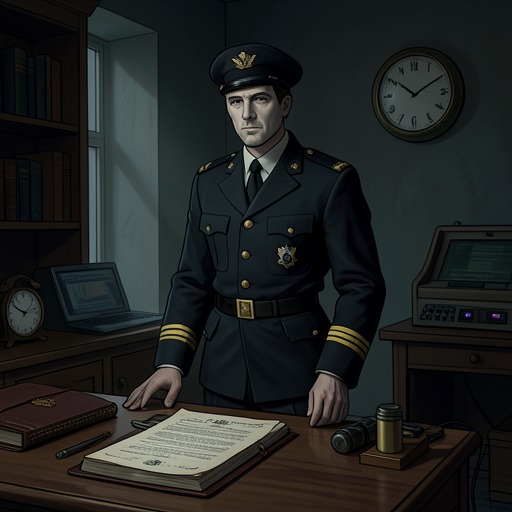
The defense introduces photostatic copies of Maryk’s fitness reports and calls Queeg to the stand. Rested, in a new blue uniform, and looking like a poster image of a Navy commander, Queeg seems at first to have recovered the assurance with which he took command of the Caine. The contrast matters: his outward bearing presents authority as a stable appearance, while Greenwald’s questioning tests whether the facts underneath it will hold together.
Greenwald begins with the interview Queeg had with Maryk on the morning after the typhoon. He then asks whether Queeg received $110 from Willie Keith. Queeg says that he may have, but cannot recall; Greenwald points out that Keith testified that he did. The exchange does not establish Queeg’s answer as false, but it places his uncertainty before the court and signals the method of the examination: rather than let Queeg’s confident manner settle questions of credibility, Greenwald makes specific recollections and records answerable to comparison.
The crate and the towline
The lost liquor crate produces a clearer correction. At first Queeg says he is not clear and cannot recall. When Greenwald offers a recess so he can think, Queeg asks for a moment, then admits, “I made a misstatement.” He explains that he had confused Keith’s lost crate with another crate, containing clothes, that he lost in San Diego Harbor in 1938 or 1939. Keith’s crate, Queeg now says, contained liquor; when asked whether it held thirty-one bottles, he answers that it was something like that. The pause and correction give the court a visible instance of Queeg revising his account under examination, though the precise number remains uncertain.
Greenwald next asks whether Queeg ever steamed over the Caine’s towline while it was towing targets at Pearl Harbor. Jack Challee objects that the question turns the proceedings into a smear campaign against Queeg, and the judge advocate warns that allowing it could invalidate the trial. The court clears the room to consider the objection. After a fifteen-minute wait, the members return and overrule it; Queeg must answer. This procedural pause raises the stakes of the testimony: the dispute is not merely whether an old mishap reflects on Queeg, but whether the defense may use it to test his credibility.
Queeg says he saw antiaircraft bursts to starboard, worried that the Caine might be in range, and was watching the firing area while John Stilwell had the helm. He accuses Stilwell of failing to warn him that the ship was turning through a full circle. Queeg says he noticed the turn, reversed course, and, to the best of his knowledge, avoided running over the line, although the line parted during the maneuver. He acknowledges that gossip said he had cut it, but says he attributed the break to a defective line in his report to ComServPac, which accepted that report despite knowing of the gossip and circumstances. Asked whether officers could confirm the antiaircraft bursts, Queeg cannot say whether they all saw them or none did, citing the passage of fifteen months and the demands of war. His detailed defense thus ends with uncertainty about a central supporting fact.
Accusation, evasion, and self-defense
Greenwald asks whether Queeg dropped a yellow dye marker off Enneubing on the first morning of the Kwajalein invasion. Queeg again answers that he may have but does not recall. The question follows a pattern established by the money and towline exchanges: Queeg is asked about a concrete action, but his response retreats to uncertain memory rather than supplying a definite account.
Asked whether, during invasions, he stationed himself on the bridge’s side sheltered from the beach, Queeg angrily rejects the premise. He says that he had to be on every side at once because Maryk was navigator and Willie Keith was the officer of the deck at general quarters, and both, he alleges, scurried to safety. Queeg presents his own movement around the bridge as the consequence of having to perform all three roles. Greenwald then asks about the U.S.S. Stanfield being fired on by a shore battery during the Saipan invasion, but the supplied exchange gives no answer to that question; the cross-examination’s next developed episode comes when Greenwald turns to Maryk’s log.
Queeg calls the log a conglomeration of lies, distortions, and half-truths and launches into an extended account of being betrayed by Maryk and Keith. His recollection repeatedly gathers separate disputes under one accusation: the strawberry investigation, water conservation, coffee, government-owned Silexes, and John Stilwell’s court-martial become evidence, in Queeg’s telling, of officers undermining his authority and the crew’s lack of responsibility. He insists that the strawberry inquiry had proved someone possessed a key to the icebox, faults Maryk for allegedly making a sham search, and claims the steward’s mates could not have eaten the fruit. He also returns to the water dispute, arguing that the crew bathed excessively while the evaporators were often out of order. The speech runs for eight or nine minutes. Its accumulation shows how Queeg organizes grievances into a single case against the officers, even as his movement from one episode to another makes the defense’s question about his reliability newly pointed.
The written record and the reversal
After thanking Queeg for his thorough answer, Greenwald presents two authenticated copies of fitness reports Queeg wrote on Maryk. Queeg recognizes them. Greenwald asks him to read the January comment, then the comment dated July 1. Queeg hesitates over whether Maryk had by then improved, before reading the later assessment aloud: “This officer has if anything improved in his performance of duty since the last fitness report. He is consistently loyal, unflagging, thorough, courageous, and efficient. He is considered at present fully qualified for command of a 1200-ton DMS. His professional zeal and integrity set him apart as an outstanding example for other officers, reserve and regular alike. He cannot be too highly commended. He is recommended for transfer to the regular Navy.”
The report does more than provide praise from a former superior. It places Queeg’s own formal judgment beside his present effort to portray Maryk as disloyal and responsible for undermining command. Greenwald asks no further questions. Queeg looks toward the judge advocate, but Challee declines to cross-examine him. The examination therefore ends not with a competing account that repairs Queeg’s standing, but with his written endorsement of the officer whose actions the trial is judging. The contrast leaves the court with two records from the same commander: an expansive courtroom denunciation and a professional evaluation commending Maryk’s loyalty, courage, competence, and command fitness.