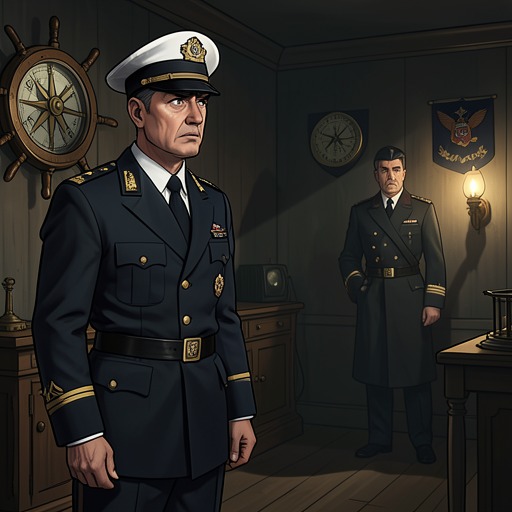
Greenwald’s cross-examination of the Navy psychiatrists
The Caine Mutiny Court-MartialGreenwald’s cross-examination of the Navy psychiatrists reframes the case against Steve Maryk as a question not merely of whether Captain Queeg showed psychological disturbance, but of whether a condition that might leave a man functional in subordinate duties could compromise him in command. Greenwald begins with deliberate deference to the doctors’ expertise, then turns their cautious distinctions into a sustained test of what their evaluations can—and cannot—establish about Queeg’s capacity to lead.
Setting and Method
At Maryk’s trial, Greenwald approaches Dr. Forrest Lundeen with an appearance of uncertainty, explaining that his own background is legal rather than medical and that he will ask elementary questions. The manner is strategically mild: he invites the psychiatrist to clarify technical language rather than immediately challenge his authority. As the exchange proceeds, Greenwald gathers Lundeen’s descriptions of Queeg’s behavior and arranges them into a pattern, shifting from a scattered list of traits to the question of whether they belong to a recognizable psychiatric category.
The change in Greenwald’s manner is part of the examination’s force. Once the relevant symptoms have been established, his questions become precise and sequential. He tests the boundary between personality and illness, and then between illness and incapacity. The cross-examination does not depend on one dramatic disclosure so much as on making the doctors account for the practical implications of distinctions they might otherwise leave abstract.
Lundeen and the Question of Command
Lundeen’s testimony identifies rigidity, feelings of persecution, unreasonable suspicion, withdrawal from reality, perfectionist anxiety, an unreal basic premise, and an obsessive sense of self-righteousness as features of Queeg’s behavior. He qualifies these symptoms as mild and compensated. Pressed to say whether they form a single psychiatric pattern, he resists Greenwald’s initial framing, objecting to the implication that there is a syndrome or disease. He nevertheless identifies the pattern as a paranoid personality and characterizes it as non-disabling.
Greenwald then moves from classification to function. He asks whether a person could be capable of subordinate duties yet disabled for command. Lundeen concedes that this is conceivable. That distinction matters to the trial: a clean bill of health for service in general would not necessarily settle whether Queeg could exercise independent authority over a ship and crew. Greenwald’s line of questioning makes the demands of a captaincy, rather than a broad label of mental health, the relevant measure.
The examination also tests how such a personality might be recognized. Lundeen explains that the pattern can be difficult to detect because a person may appear plausible and convincingly normal, particularly when justifying himself. The testimony thus complicates the apparent contrast between outward composure and inward disturbance. It also gives the court a reason to consider behavior over time rather than treating a convincing manner as conclusive evidence of sound judgment.
Conduct Put to the Witnesses
Greenwald next poses a hypothetical about a commanding officer who becomes bewildered or frightened under fire and runs away, damages government property and denies it, falsifies official records, extorts money from subordinates, and imposes excessive punishments for minor offenses. He asks whether such a man would be disabled for command. Lundeen replies that the question is incomplete without knowing whether the officer performs his duties satisfactorily in other respects. Greenwald stipulates that, hypothetically, he does.
The hypothetical gathers conduct that resonates with the broader record of Queeg’s command without allowing each incident to stand as an isolated accusation. The Caine had struck a pier while docking, after which Queeg attributed the mishap to the current. He ordered the entire crew deprived of two days’ leave for the after line-handling party’s performance, and threatened to extend the punishment to the officers when Maryk objected. In other episodes, orders were enforced most consistently within the captain’s immediate sight and hearing, while a search for stolen keys dwindled into a farce before Queeg ended it without finding them. The trial question is whether such actions indicate incapacity, excessive but still functional authority, or conduct whose significance depends on circumstances and performance as a whole.
Greenwald also asks whether a psychiatrist is needed to recognize paranoia. Lundeen answers that its surface plausibility, especially in self-justification, makes the pattern hard to identify by ordinary observation alone. When Greenwald asks whether he would want his own son serving under Queeg in battle, the judge advocate objects that the question seeks an emotional response rather than expert opinion. Greenwald withdraws it. The exchange shows the limit he encounters: he can press the clinical testimony toward a practical judgment, but the court still distinguishes professional evidence from a witness’s personal reaction.
Bird, Unconscious Disturbance, and Stress
Dr. Bird offers a different account of psychological disturbance. He describes a deep-seated problem outside conscious awareness that can keep a person tense and drive unusual behavior without the person understanding its source. He says a person may compensate through willpower, daydreams, or other conscious devices, but that adjustment would require psychoanalysis to bring the disturbance into awareness. Bird confirms that Queeg has never undergone psychoanalysis.
Greenwald presses the consequences of Bird’s account as well. When he asks whether an intensified sickness could disable Queeg, Bird agrees that it could if greatly intensified. Greenwald then challenges Bird’s confidence in his conclusion, suggesting that an evaluator unfamiliar with the demands of command might misjudge how serious a condition is for a captain. Bird resists the wording and insists on a distinction between calling Queeg sick and using a more precise clinical term. Their disagreement reveals how much rests on the boundary between diagnosis and functional judgment: acknowledging a disturbance does not, by itself, determine whether command is impaired.
The court also asks whether a mild condition might cause a temporary loss of efficiency under an exceptionally severe emergency, without producing a complete collapse. The response allows that extreme stress can confuse judgment and reduce efficiency, as it can for almost anyone. The testimony therefore leaves room for a stress-related failure of performance without establishing that Queeg was continuously or categorically incapable of command.
Significance and Limits
The cross-examination sharpens the central uncertainty of Maryk’s defense. Lundeen recognizes a paranoid personality but does not treat it as disabling; Bird describes an underlying disturbance and allows that severe intensification could disable; both lines of testimony stop short of a straightforward finding that Queeg was unfit. Greenwald’s achievement is to expose the gap between a general medical assessment and the specific responsibilities of command, while forcing the psychiatrists to address how stress and context might alter that assessment.
That gap keeps the trial’s conflict from being reduced to a simple choice between a healthy captain and a mentally ill one. The evidence places the court between Queeg’s outward plausibility, the troubling pattern of his conduct, and the extraordinary demands imposed by command under pressure. The witnesses supply distinctions and possibilities, not a final verdict on the case. Greenwald’s examination makes those limits visible and leaves the practical question—what Queeg’s condition meant for command, especially in an emergency—at the center of the courtroom dispute.