Gunner Stilwell
The Caine Mutiny Court-MartialGunner Stilwell is a gunner’s mate second class and helmsman aboard the USS Caine. His most consequential scenes place him at the wheel under Captain Queeg’s command: first in a foggy passage, where Queeg treats an apparent attempt to steady the ship as an unacceptable exercise of independent judgment, and later on a routine watch, when Stilwell is permitted to return to his post. The contrast makes Stilwell more than a sailor caught in a disciplinary dispute. His experience shows how Queeg’s authority reaches into ordinary shipboard work, and how a crew member singled out by that authority can become a focus for the reactions of others.
Identity and Duties
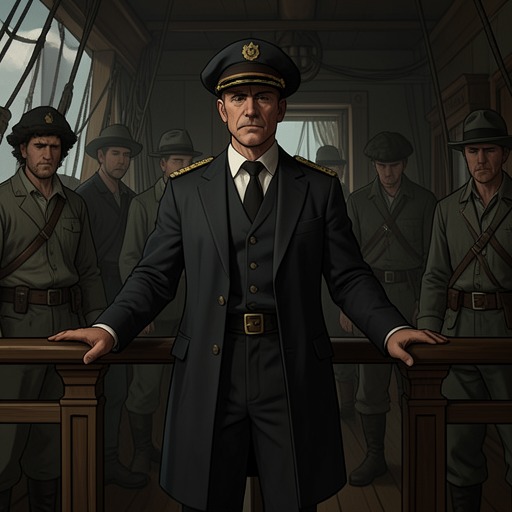
Stilwell is introduced on the wheel during a difficult passage through fog. He is tall, with thick, straight black hair and sensitive, boyish features; his attention is fixed on the gyrocompass as he grips the helm. The description emphasizes his concentration at a practical task rather than any ambition to command. He calls the ship’s heading as required, and the bridge’s attention remains on the changing visibility, the course, and the channel.
His position gives his actions immediate significance. The helmsman handles the wheel, but does so within orders issued by the officers on the bridge. In the fog scene, that division of responsibility becomes unstable: Stilwell’s attempt to steady the ship is treated by Queeg not as a response to the situation but as unauthorized thought. The episode therefore introduces him through his work while exposing the narrow limits Queeg places on judgment within that work.
The Fog Passage and Queeg’s Rebuke
As the fog begins to clear, the bridge receives successive calls of the ship’s heading and discusses the course toward the channel gate. When Stilwell calls that he is steadying on the ordered course, Queeg rushes into the pilothouse and demands to know who authorized the maneuver. Stilwell starts to explain that he thought it was what he should do, but Queeg cuts him off and insists that he must follow instructions rather than think for himself.
The exchange changes the atmosphere at the wheel. Stilwell’s legs tremble, his face turns white, and his eyes appear wide with fear. He answers the captain and asks whether he should come left again, but Queeg tells him not to do anything and demands to know the course. The scene places the sailor in a bind: after being sharply rebuked for acting, he is left to respond to the captain’s further questions without a clear, calm exchange of instructions. The narrative presents the moment from close to Stilwell’s exposed position, making the captain’s anger a direct pressure on the person responsible for the helm.
Queeg then calls Steve Maryk to the wheelhouse and asks for Stilwell’s name and rating. He threatens to reduce him to seaman second and demands that he be relieved, adding that an experienced sailor should take the wheel in the channel. Maryk counters that Stilwell is their best helmsman. That defense establishes a pointed contrast between the captain’s public judgment and the first lieutenant’s assessment of Stilwell’s ability. The episode does not show Stilwell being dismissed from the ship or losing his rating; it shows Queeg demanding his removal and using the possibility of demotion as a threat.
Return to the Wheel
The question of whether Stilwell has been barred from the bridge for good or dismissed only from that particular watch passes through the ship’s chain of command. When his next turn at the wheel comes, sailors and officers seek clarification through their superiors until Burt Gorton decides to ask Queeg directly. The uncertainty itself records how a sharp order can leave a practical matter unresolved for the crew.
By then, the USS Caine is proceeding steadily, with a target trailing behind and destroyers preparing for the final firing run of the afternoon. Queeg tells Gorton that Stilwell may stand his watch, characterizing the earlier incident as a mistake and saying that Stilwell should not change the helm without orders. His pleasant manner is a marked contrast with the outburst in the fog. Stilwell comes to the bridge in new dungarees, a freshly bleached white hat, and polished shoes, salutes smartly, and takes the wheel. He studies the compass with painful concentration, trying to keep the ship from drifting even half a degree off course. The return is thus a restoration of his duty, but not a resolution of the earlier conflict: the captain’s permission is accompanied by a warning that defines how narrowly Stilwell is expected to exercise his role.
A Target of Dislike
Stilwell’s difficulty with Queeg persists beyond the fog passage. The ship’s crew knows that he is the particular object of the captain’s dislike. While the USS Caine is under Queeg’s strict order, Stilwell also waits anxiously for a response from the Red Cross concerning his mother’s illness; Steve Maryk has sent the letter on her behalf. Weeks pass without an answer, and Stilwell grows gaunt as he worries that punishment may follow. At the helm within Queeg’s range, each watch becomes a source of strain.
The crew does not respond to his position uniformly. Sailors opposed to Queeg make a point of befriending Stilwell and trying to cheer him, so that opposition to the captain gathers around him. Other sailors avoid him, fearing that Queeg’s hostility might extend to those associated with him. Stilwell is therefore isolated in two different ways: exposed to the captain’s scrutiny while working, and treated cautiously by shipmates who see closeness to him as a possible liability. The account gives no final answer about his mother’s illness or the consequences of the Red Cross inquiry, leaving that personal worry unresolved.
Narrative Role
Stilwell’s arc is limited in scope, but its repeated details clarify the lived meaning of command aboard the USS Caine. His careful watchkeeping, the contrast between Maryk’s praise and Queeg’s denunciation, and the conspicuous care with which he returns to the wheel all keep attention on a capable sailor trying to perform a defined duty under unpredictable scrutiny. The ship’s larger conflicts are not his to direct; instead, his experiences show how command disputes reach down to routine work and shape relations among the crew.
His story also resists a simple account of either defiance or incompetence. Stilwell does appear to act without waiting for an explicit order, but the narrative does not portray him as generally careless: Maryk calls him the ship’s best helmsman, and his later watch is marked by painstaking attention to the compass. What remains unresolved is the tension between initiative and obedience in the captain’s system. Stilwell’s place at the wheel makes that tension concrete: his task requires attention to the ship’s course, while Queeg’s rebuke insists that authority, not the helmsman’s judgment, determines when he may act.