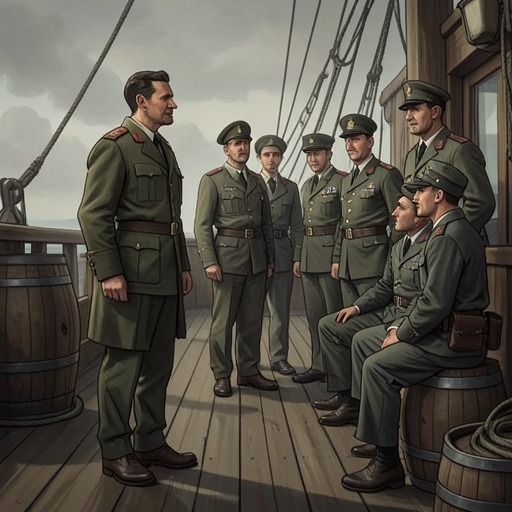
Harding
The Caine Mutiny Court-MartialHarding is an officer aboard the USS Caine whose professional background as a certified public accountant gives him a sharply practical view of naval service. He accepts the small, unglamorous work the ship requires, but expects the Navy in return to provide a vessel and a commanding officer capable of meeting danger. His family responsibilities make that expectation more than an abstract standard: he is afraid not only for himself but for his wife and three children.
Professional Standards and Command
Harding’s frustration emerges in a conversation with Willie Keith about the ship’s service audit. He explains that he had audited businesses such as Onondaga Carbide and now finds himself counting candy bars and toothpaste in the ship’s canteen. The contrast is comic in scale but serious in meaning: his expertise is being applied to petty inventory while he doubts whether the USS Caine can perform its larger purpose. He nevertheless volunteers to do the audit if it helps the ship. His complaint is not that the work is beneath him, but that administrative exactitude cannot substitute for a seaworthy ship and effective leadership.
That distinction shapes his criticism of Captain Queeg. Harding asks what will happen if the ship gets into trouble, arguing that a captain’s purpose is to get the crew out of danger rather than merely keep reports and assignments current. His accounting credentials lend weight to the contrast: he understands audits and accepts them as necessary, but sees them as instruments serving the ship, not as the measure of its success. He recognizes the USS Caine as a wartime misfortune the crew must endure, yet his willingness to endure it does not erase his fear that the Navy has failed to provide what the crew needs.
Family and Personal Stakes
Harding makes his anxiety concrete by telling Willie that their circumstances differ because Harding is married. He is responsible for five people: himself, his wife, and their three children. He singles out one child, a six-year-old boy whose smile he wants to show Willie sometime. The detail makes his concern for the ship’s condition inseparable from the lives waiting beyond it. His fear is not presented as lack of commitment; he has volunteered for the Navy and remains willing to perform work he considers trivial. Rather, his family obligations give his demand for competent command a personal urgency that Willie, at that point, does not share.
After making this point, Harding hurries away to his stateroom. The exchange ends without resolving his fears. His brief appearance nevertheless provides a counterweight to the shipboard language of duty: service is not merely a test of professional pride, because its risks fall on families as well as on the men at sea.
Shipboard Duties and the Stilwell Case
Harding is among the officers who serve as officers of the deck, alongside Tom Keefer and Willie. At the same time, testimony later identifies him as often absent from the watch bill because of engine breakdowns. The combination places him within the ship’s operational responsibilities while also reflecting how mechanical troubles constrain its routine. His role is not confined to argument about Queeg; he participates in the working structure through which the USS Caine is watched and run.
Harding also serves with Keefer and Paynter on the summary court that hears Stilwell’s case. The court finds the specification proved by Stilwell’s plea and sentences him to the loss of six liberties. Harding tries to look solemn, but a grin is nearly breaking through. Willie is appalled, regarding the light sentence as a direct insult to Queeg and, in effect, an acquittal after Stilwell had already spent months confined. Harding’s expression marks the verdict as an outcome the court’s members do not treat with the gravity Queeg expects. The episode places Harding within the informal resistance that grows around the captain’s disciplinary authority, though the evidence does not make him the court’s spokesman or identify him as the source of its decision.
The Typhoon and the Limits of Reassurance
During the typhoon, Harding speaks with Willie as the ship’s rolling worsens. When Willie says the motion is not as bad as conditions outside San Francisco the previous year, Harding asks whether any typhoons are nearby. The exchange is restrained, but his question registers the uncertainty surrounding the weather and the vessel’s safety. He is present among the officers and sailors gathered against the bridgehouse as the storm intensifies, and asks Willie whether they are going to be all right. Willie nods, offering reassurance without certainty; the question remains a measure of how little anyone aboard can control the conditions.
Earlier, Harding tells Willie that he has heard Willie will relieve him rather than Paynter. When Willie offers to take over immediately, Harding’s brief response conveys surprise at the prospect of an immediate handover. The watch change places the two officers within the same chain of responsibility as the storm develops, while their exchange keeps the focus on the practical burden of remaining at one’s post rather than on abstract debate about command.
Trial Testimony and Later Absence
At the court-martial of Steve Maryk, Harding and Paynter testify as sullen witnesses. Their evidence supports Tom Keefer’s account that Queeg did not appear crazy after Maryk relieved him, and that they did not know what had prompted Maryk’s decision. Under questioning, both acknowledge their dislike of Queeg, yet neither can report having seen him commit an act of madness throughout his command. Harding’s testimony therefore separates personal antipathy from the more consequential claim of incapacity: disliking a captain does not by itself establish that he was insane or that relieving him was necessary.
The testimony also recalls the disciplinary atmosphere aboard the ship. Harding confirms that Stilwell had been confined to the USS Caine for half a year after reading on watch and that the crew had lost five days’ leave in the United States after sailors appeared at general quarters without life jackets. These examples show the scale of collective punishment and the sort of strict enforcement that the officers had lived under. Harding’s evidence helps establish Queeg’s severity, even as it stops short of proving madness.
When Willie later takes part in the USS Caine’s decommissioning, Harding is one of the absent officers Willie searches for among the unfamiliar faces assembled on the forecastle. The moment does not explain where Harding has gone or what became of him. It does, however, measure the distance between the ship’s wartime company and its final, diminished crew: Harding belongs to the remembered circle of officers whose shared watches, disputes, and testimony shaped Willie’s experience, but he is no longer there to hear the decommissioning order.