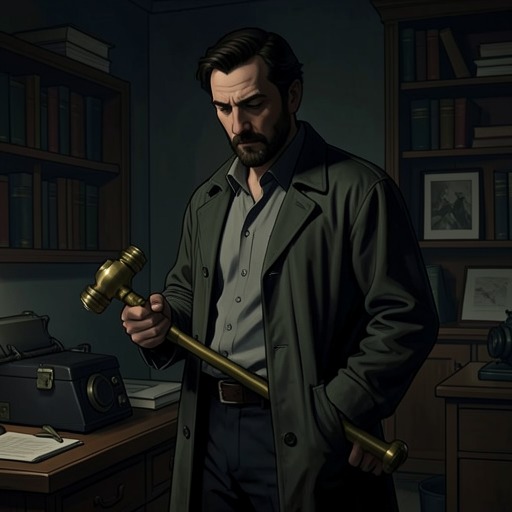
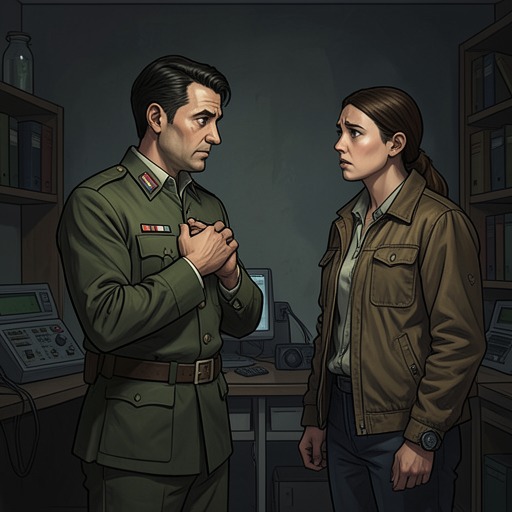
Keefer's guilt over abandoning ship
The Caine Mutiny Court-MartialTom Keefer’s guilt over abandoning the USS Caine is a burden he cannot turn into a reassuring story about himself. During the kamikaze attack, he urged the crew to abandon ship and jumped into the water; later, he told Willie Keith that he would still have made the same choice. What haunts him is not simply that he left the ship, but that he knows what the decision means to him and cannot reason it away.
The Abandonment
As the ship came under attack, Keefer sat up and proposed passing the word to abandon ship. He then entered the wheelhouse, used the public-address system in the captain’s voice, and ordered all hands to leave. The command gave his fear immediate force: this was no longer only a suggestion among officers, but an announcement addressed to the crew as an order.
Keefer soon returned from the wheelhouse, convinced the ship would not survive much longer. Seeing sailors jumping from the main deck, he hurried to the rail and seized a canvas sack before calling for everyone to go over the side. His actions followed his reading of the explosions and the crew’s movement, but the certainty of his warning exceeded what the scene established: he believed the USS Caine had only minutes left, rather than knowing that it would sink.
Willie Keith did not follow him. When Keefer urged him to leave, Willie challenged what was holding him back. Keefer answered by treating Willie’s decision as a choice to risk death, then jumped himself. The contrast fixes the act in both men’s memories: Keefer abandons the ship, while Willie remains aboard. The scene gives the later guilt a concrete origin in a decision made under immediate threat, not merely in Keefer’s subsequent judgment of his own character.
The Memory Becomes an Identity
Years later, Keefer describes a story idea about a man who jumps overboard when he should not and is haunted for the rest of his life by that one impulsive act. He presents the idea to Willie as something he has just perceived and asks him to read it. The imagined figure’s predicament closely echoes Keefer’s own experience, making the act of writing another return to the memory rather than evidence that he has escaped it.
In speaking directly about the incident, Keefer does not claim that he would have acted differently with the benefit of experience. He says he would still have jumped. That admission sharpens the source of his guilt: it does not depend on a belief that a better choice was available to him at the time. Instead, he is burdened by knowing that he made the choice and by the enduring meaning he assigns to it.
Keefer contrasts his condition with Captain Queeg’s. In his view, Queeg could accept his own protective falsehoods because he lacked the intelligence to analyze them, whereas Keefer’s ability to think leaves him unable to forget what he did. He describes the jump as having given him an identity, one he cannot put aside without losing his clear grasp of himself. The contrast is Keefer’s own interpretation, not proof that Queeg is free of guilt; its significance is that Keefer regards self-awareness as a trap rather than a source of absolution.
Roland Keefer as a Counterexample
Keefer’s recollection becomes more painful when he compares himself with Roland Keefer. He recalls that Roland served on carriers while he was assigned to the USS Caine, and sees both men as having faced a test during a kamikaze attack. Roland died saving his ship; Tom jumped. The juxtaposition turns his private memory into a comparison with a specific act of sacrifice by his brother.
Keefer presents the parallel as a cruel chance of naval assignment and circumstance, not as a test he knowingly accepted. Yet he cannot keep the two outcomes separate: Roland’s death is inseparable from the fact that he stayed to save his ship, while Tom’s survival is inseparable from his own departure. His humiliation comes not only from having jumped, but from measuring that choice against Roland’s opposite one.
The Burden’s Lasting Meaning
Keefer’s guilt persists because neither explanation nor intelligence changes the fact at its center. He can analyze the event, recognize the gap between his conduct and Roland’s, and imagine a character condemned to remember one impulsive act; none of those activities reverses his decision. Even his admission that he would jump again leaves the moral wound intact rather than resolving it.
The episode therefore complicates Keefer’s earlier self-presentation as a sharp observer of the Navy and its ways. At this later moment, his analytical ability does not put him above judgment: it makes him the most relentless judge of his own conduct. The memory has become an identity he recognizes as humiliating, and his comparison with Roland supplies the standard against which he continues to condemn himself.